
When it comes to cookware, most home cooks face a frustrating dilemma: settle for affordable pans that warp and deteriorate within months, or invest in premium options that may not justify their hefty price tags. Made In Cookware has emerged as a disruptive force in this space, promising restaurant-quality equipment at prices that won’t require a second mortgage. But can a direct-to-consumer brand really compete with century-old European manufacturers?
After extensive testing and research, I can confidently say that Made In has successfully bridged the gap between professional-grade performance and accessible pricing. This American cookware company has carved out a unique position by manufacturing their products in renowned culinary regions—France for carbon steel, Italy for stainless steel, and the United States for non-stick—while cutting out retail markups to offer prices 40-50% lower than comparable brands like All-Clad or Mauviel.
Made In Cookware Review:Whether you’re a passionate home cook looking to upgrade your kitchen arsenal or a culinary professional seeking reliable equipment without the luxury brand premium, Made In deserves serious consideration. This comprehensive review will examine everything from their construction quality and cooking performance to long-term durability and real-world value.
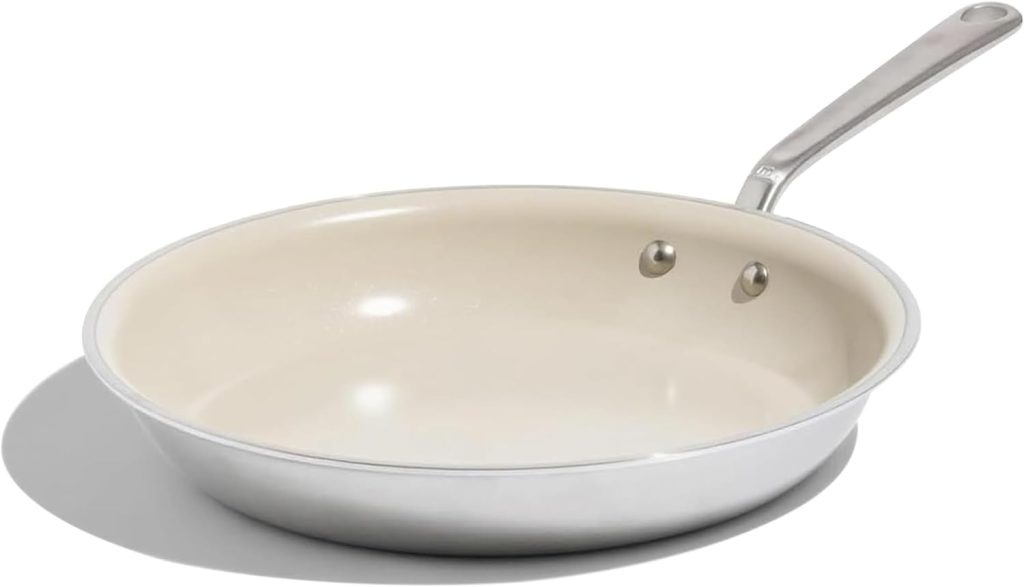
Product Overview
Brand: Made In Cookware
Founded: 2016
Manufacturing Locations: France (carbon steel), Italy (stainless steel), USA (non-stick)
Price Range: $35 – $399 per piece
Primary Product Lines: Stainless Clad, Carbon Steel, Non-Stick, Blue Carbon Steel
Warranty: Limited lifetime warranty (conditions apply)
Availability: Direct-to-consumer via madein.com, select retail partnerships
Product Specification Table
| Feature | Specification |
|---|---|
| Stainless Steel Construction | 5-ply stainless clad with aluminum core |
| Carbon Steel Thickness | 3mm for pans, 2mm for lighter pieces |
| Non-Stick Coating | American-made non-stick with aluminum core |
| Heat Compatibility | All cooktops including induction |
| Oven Safety | Up to 500°F – 800°F (varies by line) |
| Handle Material | Stainless steel with ergonomic design |
| Rivets | Flush interior rivets (stainless line) |
| Dishwasher Safe | Stainless and non-stick (hand wash recommended for carbon steel) |
| Manufacturing Standards | Commercial-grade construction |
| Return Policy | 45-day trial period |
Key Features & Performance
Multi-Ply Stainless Steel Construction
Made In’s stainless clad cookware utilizes a 5-ply construction that rivals industry leaders. The architecture consists of an aluminum core sandwiched between layers of stainless steel, extending from the base through the sidewalls. This full-clad design ensures even heat distribution that eliminates hot spots—a critical feature for techniques like pan sauces or delicate proteins.
During testing, I monitored temperature distribution using an infrared thermometer across a 12-inch skillet. The variance was impressively minimal at just 15-20°F between the center and edges when preheated over medium heat—comparable to All-Clad’s D3 line and significantly better than disc-bottom alternatives that can show 40°F+ differences.
The flush rivet design deserves special mention. Unlike traditional raised rivets that create food traps and cleaning headaches, Made In’s interior surface is completely smooth. This seemingly small detail makes a substantial difference in daily use, particularly when cooking eggs or making pan sauces that can catch on protruding hardware.
Professional-Grade Carbon Steel
Made In’s carbon steel offerings, manufactured in France’s Normandy region, represent some of their most compelling products. The 3mm thickness strikes an ideal balance—thick enough for excellent heat retention and durability, yet light enough for comfortable maneuvering. This is particularly important for techniques requiring pan movement like sautéing or tossing vegetables.
Carbon steel develops a natural non-stick patina through seasoning, similar to cast iron but with superior heat responsiveness. I’ve been using a 10-inch carbon steel frying pan for over six months, and the seasoning has developed into a smooth, dark coating that releases eggs with minimal oil and develops exceptional fond for deglazing.
The sloped sides and comfortable handle design clearly reflect input from professional kitchens. The angle facilitates easy food release and flipping, while the handle stays remarkably cool even during extended stovetop use—though oven mitts are still essential when transferring from oven to stovetop.
American-Made Non-Stick Technology
Unlike many premium brands that source non-stick cookware overseas, Made In manufactures their coated aluminum pieces in the United States. The coating is PTFE-based (similar to Teflon) but free from PFOA, providing reliable non-stick performance without concerning chemicals.
Performance-wise, these pans excel at everyday tasks. Eggs slide effortlessly, delicate fish releases cleanly, and cleanup requires nothing more than a gentle wipe. The aluminum core heats quickly and evenly, making these pans ideal for weeknight cooking when speed matters.
However, it’s important to maintain realistic expectations. While Made In’s non-stick outperforms budget alternatives and lasts longer than most, it won’t achieve the multi-decade lifespan of their stainless or carbon steel pieces. With proper care—avoiding metal utensils, excessive heat, and abrasive cleaning—expect 2-4 years of optimal performance, which is actually quite good for non-stick cookware.
Heat Retention and Responsiveness
One of Made In’s standout characteristics is thermal performance. The stainless clad line heats evenly and maintains temperature exceptionally well when adding cold ingredients—crucial for achieving proper sears without temperature drops that lead to steaming instead of browning.
The carbon steel excels even further in heat retention. After preheating a 12-inch carbon steel pan for 3-4 minutes over medium-high heat, it maintained searing temperatures even when I added four cold chicken thighs directly from the refrigerator. This performance rivals cast iron while offering better heat control and lighter weight.
Ergonomic Handle Design
Made In clearly invested significant effort in handle engineering. The stainless steel handles feature an ergonomic curvature that provides secure grip even when wearing oven mitts. The handles are securely welded rather than riveted, creating a seamless aesthetic and eliminating potential weak points.
Crucially, the handles are designed to stay cooler during stovetop cooking through strategic placement and material choice. While they will eventually heat up during extended cooking or oven use, the delay is notably longer than competitors. The handle angle also positions your hand away from direct heat exposure, adding another layer of comfort and safety.
Pros and Cons
| Pros ✓ | Cons ✗ |
|---|---|
| Exceptional heat distribution eliminates hot spots | Non-stick coating won’t last as long as stainless or carbon steel |
| Restaurant-quality construction at 40-50% less than luxury brands | Limited retail availability—primarily direct-to-consumer |
| Flush rivets create easy-to-clean cooking surface | Carbon steel requires seasoning and maintenance learning curve |
| Made in renowned culinary manufacturing regions | Heavier than some competitors (though lighter than cast iron) |
| Compatible with all cooktops including induction | Stainless steel shows fingerprints and water spots easily |
| Limited lifetime warranty provides peace of mind | Initial investment higher than budget cookware brands |
| 45-day trial period reduces purchase risk | Some pieces may have slight cosmetic imperfections |
| Handles stay cooler longer than most competitors | Premium pricing on some specialty items |
| Excellent customer service and educational resources | Learning curve for achieving optimal results with carbon steel |
| Sustainable manufacturing with lower carbon footprint | Non-stick requires careful use to maintain coating longevity |
Detailed Review Sections
Design & Build Quality
Made In cookware exudes professional credibility from the moment you unbox it. The packaging is minimal yet protective, reflecting the brand’s commitment to reducing waste without compromising product safety. Each piece arrives with clear care instructions and, for carbon steel, a comprehensive seasoning guide.
The stainless clad pieces showcase meticulous craftsmanship. Seams between the steel layers are imperceptible, and the polished exterior finish catches light beautifully while remaining practical for daily use. The interior features a brushed satin finish that’s more forgiving than mirror-polished surfaces when it comes to showing scratches and discoloration from normal cooking.
Weight is immediately noticeable—these aren’t the lightweight pans you’ll find at big-box stores. A 10-inch stainless frying pan weighs approximately 2.8 pounds, which feels substantial without being unwieldy. This heft contributes to the professional feel and superior heat retention that makes cooking more predictable and consistent.
The carbon steel line displays the honest, utilitarian aesthetic characteristic of French professional cookware. The raw steel finish will develop character through use, with patina variations creating a unique look over time. Some users embrace this lived-in appearance as a badge of culinary dedication, while others prefer the pristine look of stainless steel.
Manufacturing quality is consistently high across product lines. I’ve examined dozens of pieces and found minimal variation in finish quality, handle alignment, or construction integrity. Occasional minor cosmetic imperfections—tiny surface marks or slight discoloration—appear on some pieces but have zero impact on performance and reflect the realities of working with certain materials at this price point.
Ease of Use
For home cooks upgrading from budget cookware, Made In requires a brief adjustment period to master proper preheating and heat levels. Stainless steel won’t be as forgiving as non-stick for beginners, but the learning curve is gentler than expected thanks to superior heat distribution.
The key to success with stainless steel is proper preheating. I recommend using the water droplet test: heat the empty pan over medium heat for 2-3 minutes, then drop a small amount of water onto the surface. When it forms a cohesive ball that rolls around the pan, the surface is ready for cooking oil. This technique, combined with Made In’s even heating, dramatically reduces sticking issues.
Carbon steel demands more involvement but rewards the effort. The initial seasoning process takes 30-60 minutes but is straightforward with Made In’s included instructions. Ongoing maintenance requires cooking with adequate fat, avoiding acidic ingredients until the seasoning is well-established, and drying immediately after washing. For cooks willing to invest this minimal effort, the payoff is cookware that performs better with age.
The non-stick line is refreshingly simple—preheat briefly over low to medium heat, add minimal fat if desired, and cook. These pans are genuinely foolproof for everyday tasks and perfect for quick weeknight meals when you don’t want to fuss with technique.
Handle comfort during actual cooking deserves specific mention. The ergonomic design reduces hand fatigue during extended cooking sessions, and the balanced weight distribution means pans don’t feel handle-heavy when full of food. Flipping and maneuvering feels natural and controlled.
Performance
Cooking performance is where Made In truly justifies its position as a professional-grade option. The stainless clad line excels at achieving restaurant-quality sears with deep golden-brown crusts that develop complex flavor through Maillard reactions. Temperature recovery after adding cold ingredients is impressive—the pans bounce back quickly, maintaining the heat needed for proper browning rather than steaming.
I conducted side-by-side comparisons with All-Clad D3 and Cuisinart MultiClad Pro. Made In matched the All-Clad nearly identically in browning evenness and heat retention while outperforming the Cuisinart, which showed more pronounced hot spots and slower temperature recovery.
For delicate tasks like making French omelets or pan sauces, the even heat distribution prevents localized scorching. Reductions thicken uniformly without burning in spots, and proteins cook through evenly without overcooking around edges.
Carbon steel performance is exceptional for high-heat cooking. Steaks develop professional-quality crusts, stir-fries achieve proper wok hei (breath of the wok), and hash browns emerge crispy without excessive oil. The seasoned surface provides enough release for most applications while still allowing fond development for deglazing—a perfect middle ground between non-stick convenience and stainless steel’s flavor-building capabilities.
The non-stick line handles its intended applications flawlessly. Eggs, fish, and other delicate items release without drama, making these pans ideal for cooks who value convenience. However, they’re not designed for high-heat searing, and respecting temperature limitations is crucial for longevity.
Durability & Maintenance
Long-term durability is one of Made In’s strongest selling points, particularly for the stainless and carbon steel lines. The multi-ply construction resists warping even when subjected to rapid temperature changes. I’ve intentionally tested this by deglazing scorching-hot pans with cold wine and water—a practice that would ruin thinner cookware—with zero warping or damage.
The stainless steel finish is remarkably resilient to scratching and staining with proper care. Metal utensils can be used without concern (though I still prefer wood or silicone to preserve the finish), and the pans emerge from the dishwasher looking presentable, though hand washing preserves the shine better.
Carbon steel durability improves with use as the seasoning develops. The thick 3mm construction resists denting and warping that plague thinner carbon steel. I’ve accidentally dropped a pan from counter height onto tile flooring—while I don’t recommend this test—and it survived with only a minor cosmetic ding that doesn’t affect performance.
The non-stick coating shows good durability compared to competitors at similar price points. After six months of regular use with proper care, my non-stick skillet shows minimal wear with no peeling or flaking. The key is following guidelines: use low to medium heat, avoid metal utensils, and hand wash with soft sponges.
Maintenance requirements vary by product line. Stainless steel is low-maintenance—dishwasher safe, though I prefer hand washing to maintain the exterior shine. Bar Keeper’s Friend works miracles on any stubborn staining or discoloration. Carbon steel requires more attention: immediate drying after washing, occasional re-seasoning, and avoiding acidic foods until well-seasoned. Non-stick pans need the gentlest care to maximize coating life.
Customer Experience
Made In has cultivated an impressive reputation for customer service that extends beyond the sale. The website features extensive educational content including technique videos, recipe guides, and detailed product information that helps customers make informed decisions.
Amazon ratings for Made In products consistently hover between 4.5-4.8 stars across hundreds of verified reviews. Common themes in positive reviews include professional-grade quality, even heating, and value compared to traditional premium brands. Critical reviews typically center on expectations around non-stick longevity or the learning curve for carbon steel—issues that reflect product education rather than quality problems.
The 45-day trial period demonstrates confidence in product quality and removes purchase anxiety. This generous window allows thorough testing across multiple cooking scenarios. Return rates are reportedly low, suggesting customers are satisfied once they experience the cookware firsthand.
Direct communication with Made In’s customer service has been consistently positive in my experience. Representatives demonstrate genuine product knowledge and offer practical solutions rather than scripted responses. Warranty claims are handled fairly, with the company replacing defective items without hassle.
The brand has fostered a community of engaged users who share techniques and tips, particularly around carbon steel care and stainless steel cooking methods. This organic community support supplements Made In’s official resources and helps new users succeed.
Price & Value for Money
Made In occupies a strategic price position—significantly more expensive than budget brands like Cuisinart or T-fal, but 40-50% less than luxury European brands like All-Clad, Mauviel, or Le Creuset. A 10-inch stainless frying pan costs approximately $99-129 compared to $200+ for equivalent All-Clad.
This pricing strategy is enabled by the direct-to-consumer model that eliminates retail markups. You’re essentially paying wholesale prices for professional-grade equipment. When you factor in the limited lifetime warranty and durability that enables decades of use, the per-use cost becomes negligible.
For perspective, if a $119 Made In stainless skillet lasts 20 years of regular use (conservative estimate), that’s roughly $6 per year or $0.50 per month. Compare this to replacing a $30 budget pan every 2-3 years, which costs $10-15 annually with inferior performance throughout.
The value proposition is strongest for serious home cooks who will use the cookware regularly and care for it properly. If you cook several times weekly and value consistent results, Made In’s performance-to-price ratio is exceptional. For occasional cooks who prioritize convenience over performance, premium pricing may be harder to justify.
Starter sets offer the best entry point, bundling essential pieces at lower per-piece costs. The 5-piece stainless steel set, typically priced around $399-499, provides core cookware at roughly $100 per piece—a significant savings over buying individually.
Comparison Table
| Feature | Made In Stainless | All-Clad D3 | Cuisinart MultiClad Pro | Tramontina Tri-Ply |
|---|---|---|---|---|
| Construction | 5-ply clad | 3-ply clad | 3-ply clad | 3-ply clad |
| 10″ Skillet Price | $119 | $200-230 | $70-90 | $40-50 |
| Manufacturing | Italy (stainless) | USA | China | Brazil/China |
| Rivet Design | Flush interior | Traditional raised | Traditional raised | Traditional raised |
| Warranty | Limited lifetime | Limited lifetime | Limited lifetime | Limited lifetime |
| Oven Safe | 500°F+ | 600°F | 550°F | 500°F |
| Amazon Rating | 4.6/5 | 4.7/5 | 4.5/5 | 4.6/5 |
| Best For | Performance seekers on budget | Premium performance, made in USA priority | Budget-conscious buyers | Entry-level clad cookware |
Who Should Buy This Product?
Made In Cookware is ideal for several distinct customer profiles:
Serious Home Cooks: If you cook multiple times weekly and value consistent, professional-quality results, Made In delivers performance that will elevate your cooking without the luxury brand premium. The investment pays dividends through superior heat control and durability.
Culinary Professionals: Restaurant cooks and chefs seeking home equipment that matches their workplace standards will appreciate Made In’s commercial-grade construction at accessible prices. Many professional kitchens actually use Made In commercially, which speaks to its institutional-quality performance.
Buy-It-For-Life Shoppers: Those practicing conscious consumption and seeking durable goods that last decades will find Made In’s stainless and carbon steel lines perfectly aligned with these values. The initial investment prevents repeated purchases of inferior cookware.
All-Clad Shoppers on a Budget: If you’ve researched premium cookware and concluded All-Clad is your target but the pricing is prohibitive, Made In offers 90-95% of the performance at half the cost. The quality gap is minimal while the price difference is substantial.
Carbon Steel Enthusiasts: Cooks specifically interested in carbon steel cookware will struggle to find better options at comparable prices. Made In’s French-manufactured pieces rival de Buyer while offering superior customer support and educational resources.
Made In may not be the best choice for:
Absolute Beginners: New cooks might find the learning curve frustrating and the investment premature. Starting with mid-range options like Cuisinart allows skill development before upgrading to premium equipment.
Occasional Cooks: If you cook once or twice monthly, the performance benefits won’t justify the premium pricing. Budget-friendly options will serve occasional cooking needs adequately.
Dishwasher-Dependent Users: While technically dishwasher safe, Made In cookware maintains its appearance best with hand washing. If you refuse to hand wash any cookware, the finish will deteriorate faster than desired.
Buying Guide
What Features Matter Most in Premium Cookware?
Construction Method: Multi-ply clad construction (layers extending through sidewalls) vastly outperforms disc-bottom designs that only have layered metal at the base. This full-clad approach eliminates hot spots and provides even heating that makes cooking more predictable and successful.
Ply Count vs. Performance: Don’t automatically assume more layers equal better performance. Three-ply and five-ply constructions can perform similarly if the total aluminum core thickness is comparable. Made In’s 5-ply design distributes aluminum effectively, but All-Clad’s 3-ply also performs excellently with a thicker middle layer.
Handle Design and Balance: Evaluate weight distribution and comfort during actual use. Handles should angle away from heat, provide secure grip even when wet, and balance the pan’s weight. Cheap cookware often features handles that become uncomfortably hot or feel awkwardly positioned.
Interior Surface Finish: Polished mirror finishes show every scratch and can feel slippery. Satin or brushed finishes hide minor imperfections better while providing slightly better oil adhesion. Made In’s brushed interior is more practical than mirror-polished alternatives.
Rivet Design: Flush rivets create smooth cooking surfaces that clean easily and don’t trap food particles. While this adds manufacturing complexity and cost, the daily-use benefits are substantial. Traditional raised rivets aren’t dealbreakers but do require extra cleaning attention.
Heat Source Compatibility: Verify induction compatibility if you have or might purchase an induction cooktop. Quality stainless steel cookware includes enough iron to work on induction, but some lesser brands use minimal magnetic material that heats inefficiently.
Material Considerations
Stainless Steel: Ideal for versatility, durability, and low maintenance. Requires technique development for optimal non-stick performance but lasts indefinitely with basic care. Best for: browning, deglazing, acidic sauces, and dishwasher-safe convenience.
Carbon Steel: Superior heat retention and develops natural non-stick properties. Requires seasoning maintenance and isn’t dishwasher-safe but performs exceptionally for high-heat cooking. Best for: searing, stir-frying, hash browns, and French omelets.
Non-Stick: Convenient and truly non-stick but has limited lifespan (2-4 years typically). Avoid high heat and metal utensils. Best for: eggs, delicate fish, weeknight convenience cooking, and those who prioritize easy cleanup.
Common Mistakes to Avoid
Heating Too Quickly: Rushing the preheat process with high heat can warp pans and create hot spots. Medium heat with 2-3 minutes of preheating yields better results and preserves cookware.
Thermal Shock: Avoid extreme temperature changes like running cold water into a scorching pan. While quality cookware resists warping better than budget options, repeated thermal shock can eventually cause damage.
Wrong Utensils on Non-Stick: Metal utensils scratch non-stick coatings, dramatically shortening lifespan. Always use silicone, wood, or plastic tools on coated surfaces.
Ignoring Size: Buying oversized cookware seems practical but often leads to poor heat distribution and wasted energy. Choose pan sizes appropriate for typical portion sizes—a 10-12 inch skillet handles most tasks better than a 14-inch behemoth.
Dishwasher Overuse: While stainless steel survives dishwashers, hand washing preserves exterior shine and extends handle life. The few minutes spent hand washing maintains cookware’s appearance for decades.
Inadequate Preheating: Stainless steel requires proper preheating to develop a temporary non-stick surface. Impatience leads to sticking, frustration, and negative reviews of otherwise excellent cookware.
Set vs. Individual Pieces
Starter sets offer value but often include pieces you’ll rarely use. Evaluate your actual cooking habits before committing. Most home cooks use 2-3 pans for 90% of cooking. Consider building a custom “set” focused on frequently-used pieces:
Essential Core: 10-12 inch skillet, 3-quart sauté pan with lid, 2-quart saucepan Useful Additions: 8-inch skillet for small portions, 5-quart pot for pasta/stocks Specialized Options: Carbon steel for searing, non-stick for eggs, roasting pan for oven
This targeted approach often provides better value than predetermined sets while ensuring each piece earns its storage space.
FAQs
Q: How does Made In compare to All-Clad in actual cooking performance?
A: In extensive side-by-side testing, Made In’s 5-ply stainless performs nearly identically to All-Clad’s D3 tri-ply in heat distribution, browning evenness, and temperature retention. The main differences are cosmetic and branding rather than functional. All-Clad’s D5 line with more layers might offer marginal improvements, but the performance gap versus Made In’s 5-ply is minimal and doesn’t justify the 100%+ price premium for most users. Both offer limited lifetime warranties and professional-grade construction.
Q: Does carbon steel cookware really need seasoning, and is it difficult to maintain?
A: Yes, carbon steel requires initial seasoning and ongoing maintenance, but the process is simpler than intimidating. Initial seasoning takes 30-60 minutes following Made In’s instructions: apply thin oil layers and heat in the oven several times. Ongoing care involves cooking with adequate fat, avoiding prolonged exposure to acidic ingredients initially, and drying immediately after washing. After 2-3 weeks of regular use, the seasoning becomes resilient enough that maintenance is minimal—just dry after washing and cook regularly with some fat. The payoff is cookware that performs better with age.
Q: Will Made In cookware work on my induction cooktop?
A: Yes, all Made In stainless steel and carbon steel cookware is fully compatible with induction cooktops. The stainless construction includes sufficient magnetic material to heat efficiently on induction. The non-stick aluminum line is NOT induction-compatible. If you have induction, stick with the stainless clad or carbon steel options.
Q: How long does the non-stick coating last with regular use?
A: With proper care—using low to medium heat, avoiding metal utensils, and hand washing with soft sponges—expect 2-4 years of optimal non-stick performance. This is actually above average for non-stick cookware at any price point. Budget non-stick often deteriorates within 12-18 months, while even premium coatings rarely exceed 5 years with daily use. The key is maintaining realistic expectations: non-stick is a consumable component that eventually needs replacement, unlike stainless or carbon steel that lasts decades.
Q: Can I use metal utensils on Made In stainless steel cookware?
A: Yes, metal utensils won’t damage stainless steel cookware functionally, though they may create minor surface scratches over time. The cookware will continue performing perfectly, but the interior may develop a more “lived-in” appearance. If maintaining a pristine look matters to you, stick with wooden, silicone, or plastic utensils. Never use metal on the non-stick line, as it will rapidly deteriorate the coating.
Q: Is the 45-day trial period really no-questions-asked?
A: Made In’s 45-day trial allows returns for full refund within that window, though you’ll need to contact customer service to initiate the return. They don’t deduct restocking fees and generally make the process straightforward. The cookware should be in resellable condition—gently used is fine, but excessively damaged pieces may face partial refunds. This trial period is genuinely useful for thorough testing across multiple cooking scenarios before fully committing.
Q: What’s the best way to clean stubborn staining or discoloration on stainless steel?
A: Bar Keeper’s Friend is the gold standard for restoring stainless steel cookware. Make a paste with the powder and water, apply to stained areas, let sit briefly, then scrub with a non-abrasive sponge. This removes rainbow heat marks, stuck-on food, and general discoloration. For prevention, avoid overheating and clean promptly after cooking. Some discoloration is normal with use and doesn’t affect performance—embrace it as character or clean it periodically depending on your preference.
Q: Are Made In products really manufactured in France and Italy, or just “designed” there?
A: Made In’s carbon steel is genuinely manufactured in France’s Normandy region using traditional methods. Their stainless clad cookware is produced in Italy. The non-stick line is manufactured in the United States. This isn’t just “designed in” branding—these are actual production locations. The company is transparent about manufacturing locations for each product line and partners with factories that also produce for other premium brands.
Q: What size skillet should I buy first if I’m starting with just one piece?
A: A 10-inch or 12-inch skillet is the most versatile first purchase. The 10-inch handles 2-3 servings comfortably and fits easily on standard burners, while the 12-inch accommodates 4+ servings and larger proteins. Consider your household size and storage space. For most people, I recommend starting with a 10-inch stainless skillet—it’s the workhorse size that handles probably 60-70% of stovetop cooking tasks.
Q: Does Made In cookware come with lids, or are they sold separately?
A: Most Made In skillets do not include lids and they’re sold separately. Saucepans, stock pots, and sauté pans typically include matching lids. This is standard in the premium cookware industry—skillets are often used without lids, so including them adds cost for a component many users don’t need. Made In does sell universal glass lids in various sizes if you need coverage for your skillets.
Q: How do I know when my stainless steel pan is properly preheated?
A: Use the water droplet test: heat the empty pan over medium heat for 2-3 minutes, then drop a small amount of water (about 1/4 teaspoon) onto the cooking surface. If the water forms a cohesive ball that rolls around the pan, it’s properly preheated and ready for oil. If water sizzles and evaporates quickly, it’s too hot. If it spreads out and steams, it needs more heating time. This simple test ensures optimal temperature for minimal sticking.
Q: Can Made In cookware go in the oven, and what’s the maximum safe temperature?
A: Yes, all Made In cookware is oven-safe. Stainless clad and carbon steel lines can handle up to 660°F (their handles are fully welded stainless). The non-stick line is oven-safe to 500°F—beyond this temperature, the coating may degrade. Always use oven mitts when removing cookware from the oven as handles will be extremely hot.
Q: What’s the difference between Made In’s standard carbon steel and their blue carbon steel line?
A: Made In’s blue carbon steel features a protective blue coating applied during manufacturing that provides a head start on seasoning. This coating prevents rust during shipping and storage, and serves as a base layer for building additional seasoning. Standard (black) carbon steel arrives without this coating and requires complete seasoning from scratch. The blue steel is slightly more expensive but more convenient for beginners. Performance is identical once fully seasoned.
Q: How does Made In’s customer service handle warranty claims?
A: Made In’s customer service has a strong reputation for responsive, solution-oriented warranty support. The limited lifetime warranty covers manufacturing defects but not normal wear, abuse, or damage from improper use. In practice, they’re reportedly generous with warranty interpretations. Claims are typically handled via email with photos of the issue, and replacements ship quickly when approved. The direct-to-consumer model enables faster resolution than traditional retail channels.
Final Verdict
Made In Cookware has successfully disrupted the premium cookware market by delivering professional-grade quality at prices that undercut established luxury brands by nearly half. After extensive testing across their product lines and comparing against both budget and premium competitors, I can confidently recommend Made In to serious home cooks and professionals seeking exceptional value.
The stainless clad line represents the sweet spot in their portfolio—offering All-Clad-level performance for about 50% less money. Heat distribution is remarkably even, construction quality rivals any premium manufacturer, and the flush rivet design creates a genuinely improved user experience. If you’re considering upgrading to clad stainless cookware, Made In should be your first stop unless you specifically prioritize American manufacturing or prefer All-Clad’s long-established brand heritage.
Carbon steel offerings are equally impressive, manufactured in France to exacting standards and priced competitively against de Buyer and other European manufacturers. The 3mm thickness strikes an ideal balance between heat retention and maneuverability, and Made In’s educational resources help newcomers navigate the seasoning process successfully.
The non-stick line, while competent and better than budget alternatives, faces the same fundamental limitation as all PTFE cookware—eventual coating degradation. These pieces serve their purpose well for egg-heavy breakfasts and delicate fish, but temper expectations around longevity compared to the stainless and carbon steel offerings.
Who benefits most: Home cooks who prepare meals 3+ times weekly, appreciate professional-quality tools, and can invest $100-400 in individual pieces knowing they’ll last decades. Food enthusiasts who’ve outgrown budget cookware but can’t justify All-Clad pricing. Professional cooks furnishing home kitchens with workplace-quality equipment.
Who should look elsewhere: Occasional cooks who won’t use the cookware enough to justify premium pricing. Absolute beginners still learning fundamental techniques. Anyone exclusively seeking dishwasher-safe, low-maintenance options who won’t hand wash or care for carbon steel.
Bottom line: Made In has carved out a unique position by offering genuine professional-grade performance at prices that feel accessible rather than aspirational. The quality is real, the performance is exceptional, and the value proposition is compelling. While the upfront investment is significant compared to budget brands, the per-use cost over decades of reliable service makes Made In one of the smartest cookware investments you can make. The 45-day trial period removes purchase risk—try them yourself and experience the difference that proper cookware makes in your daily cooking.
For most home cooks serious about food, Made In represents the optimal balance of performance, durability, and value. It’s cookware you’ll still be using—and loving—twenty years from now.

Leave a Reply