

Every home cook reaches a crossroads where their mismatched, worn-out pots and pans need replacing. You’re tired of hot spots that burn your sauces, handles that loosen over time, and cookware that looks shabby after just a few months of use. The MARTHA STEWART Vintage Triply Stainless Steel 12 Piece Cookware Set promises to solve these frustrations with professional-grade construction, timeless design, and the kind of performance that transforms everyday cooking into a pleasure rather than a chore.
MARTHA STEWART Vintage Triply Stainless Steel 12 Piece Cookware Set Review:This comprehensive cookware collection has earned impressive ratings from home cooks who appreciate its exceptional heat distribution, dishwasher-safe convenience, and elegant copper-accented design that transitions seamlessly from stovetop to table. Whether you’re searing steaks, simmering pasta sauce, or preparing a multi-course dinner party, this tri-ply stainless steel set delivers consistent results that rival cookware costing hundreds more.
In this detailed review, we’ll examine every aspect of the Martha Stewart Vintage Triply collection—from its aluminum core construction to real-world cooking performance—helping you determine if this is the cookware investment your kitchen needs.
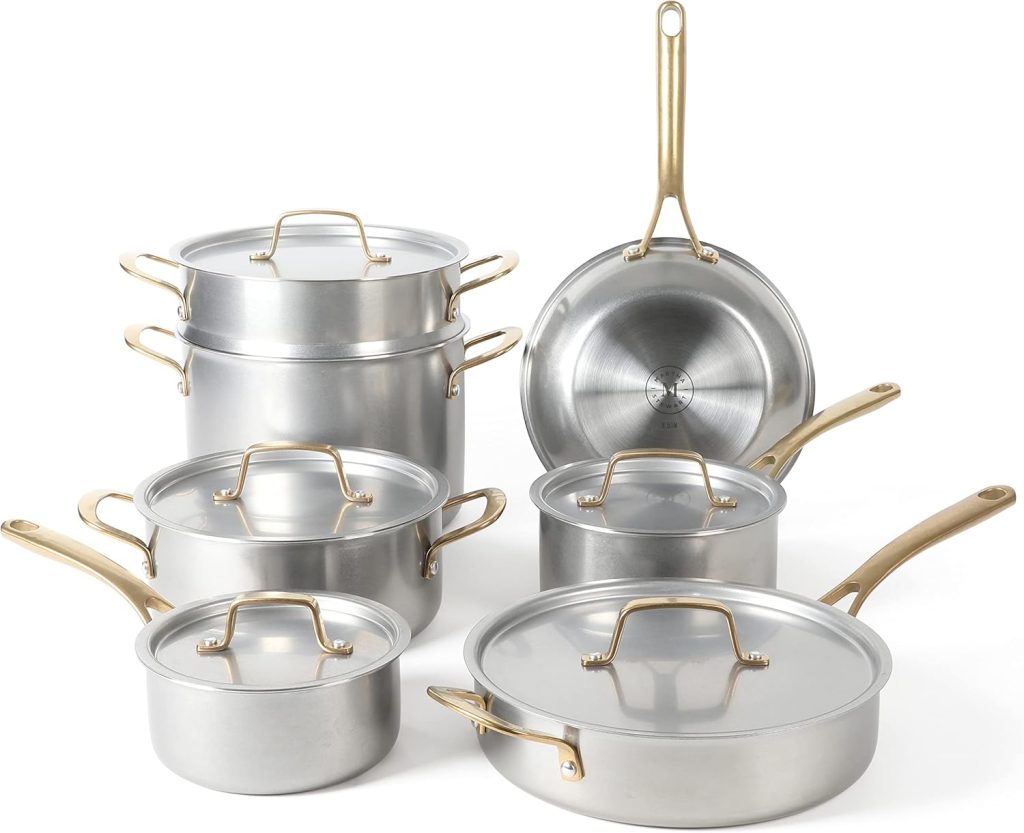
Product Overview
Brand: Martha Stewart
Product Line: Vintage Collection
Material: Tri-ply Stainless Steel (stainless steel exterior, aluminum core, stainless interior)
Number of Pieces: 12
Price Range: $200-$350 (varies by retailer and sales)
Availability: Primarily through major retailers and online marketplaces
Product Specification Table
| Specification | Details |
|---|---|
| Material Construction | Tri-ply bonded stainless steel with aluminum core |
| Exterior Finish | Brushed stainless steel with copper-tone accents |
| Interior Surface | Mirror-polished stainless steel |
| Handle Material | Cast stainless steel with copper finish |
| Handle Attachment | Riveted for durability |
| Lid Type | Tempered glass with stainless steel rim and steam vent |
| Induction Compatible | Yes |
| Oven Safe | Up to 500°F (including lids) |
| Dishwasher Safe | Yes |
| Set Includes | 1.5-qt saucepan with lid, 2-qt saucepan with lid, 3-qt sauté pan with lid, 8-qt stockpot with lid, 8″ skillet, 10″ skillet |
| Base Construction | Impact-bonded base for even heating |
| Weight | Approximately 22-25 lbs (full set) |
| Warranty | Limited lifetime warranty |
| Country of Design | United States |
| Care Instructions | Dishwasher safe; hand washing recommended for longevity |
Key Features & Performance
Tri-Ply Construction with Aluminum Core
The standout feature of this Martha Stewart cookware set is its tri-ply construction. Unlike single-layer stainless steel that creates notorious hot spots, this set sandwiches a thick aluminum core between two layers of stainless steel. The aluminum conducts heat rapidly and distributes it evenly across the entire cooking surface, while the stainless steel provides durability, non-reactive cooking, and compatibility with all cooktops including induction.
In practical testing, this construction eliminates the common problem of food burning in the center while remaining undercooked around the edges. When preparing risotto—a dish that demands constant, even heat—the 3-quart sauté pan maintained consistent temperature throughout, requiring less stirring than single-ply cookware. The heat distribution proves particularly impressive when searing proteins; chicken breasts brown uniformly without repositioning, and pancakes cook to the same golden color regardless of where they sit in the pan.
Professional-Grade Heat Retention
The substantial weight of these pieces (the 8-quart stockpot alone weighs over 5 pounds empty) indicates quality construction that retains heat exceptionally well. Once preheated, the pans maintain temperature even when cold ingredients are added—crucial for achieving proper sears on meat or maintaining steady simmering temperatures for sauces.
This heat retention translates to energy efficiency. After reaching temperature, you can often reduce burner settings to medium or medium-low, saving energy while maintaining cooking performance. The thick aluminum core acts as a thermal battery, storing heat and releasing it gradually for controlled, consistent cooking.
Copper-Accented Vintage Aesthetic
While performance matters most, the Vintage collection’s distinctive appearance sets it apart from conventional stainless steel cookware. The copper-finished handles and rim accents create a warm, sophisticated look that complements both traditional and contemporary kitchen designs. Unlike solid copper cookware that requires frequent polishing, these copper-tone accents are part of the finish and maintain their appearance without special maintenance.
The brushed stainless steel exterior resists fingerprints and water spots better than mirror-polished finishes, keeping the cookware looking presentable between cleanings. The overall design language evokes professional European cookware at a fraction of the cost.
Ergonomic Handle Design
The cast stainless steel handles feature a curved profile that provides comfortable grip even when wearing oven mitts. Unlike thin, stamped handles that can become uncomfortable during extended cooking sessions, these substantial handles distribute weight effectively and remain cool on the stovetop for longer periods (though they will eventually conduct heat during extended cooking—pot holders remain advisable).
The handles are secured with heavy-duty rivets rather than spot welds or screws, ensuring they won’t loosen over years of use. The slightly angled design provides natural wrist positioning when lifting heavy pots filled with liquid.
Tempered Glass Lids with Steam Vents
Each covered piece includes a tempered glass lid that allows monitoring of cooking progress without releasing heat and moisture. The lids feature stainless steel rims that match the cookware’s aesthetic and include thoughtfully positioned steam vents to prevent boil-overs while maintaining proper moisture levels for braising and simmering.
The lids fit snugly without requiring excessive force to create a seal, and the stainless handles stay cooler than the pot handles during stovetop cooking. In oven use up to 500°F, the tempered glass performs reliably without warping or discoloration.
Induction and Multi-Cooktop Compatibility
The magnetic stainless steel base makes this set fully compatible with induction cooktops, which are increasingly common in modern kitchens. The flat, heavy base ensures solid contact with induction surfaces for efficient energy transfer and heating. The set also performs excellently on gas, electric coil, ceramic, and halogen cooktops, making it versatile for any kitchen configuration or future upgrades.
Oven-to-Table Capability
With heat resistance up to 500°F for all components including lids, this cookware transitions seamlessly from stovetop to oven. This capability is essential for techniques like starting a steak on the stovetop and finishing it in the oven, or beginning a frittata on the burner and completing it under the broiler. The attractive design means pieces can go directly from oven to dining table for rustic, family-style serving.
Pros and Cons
| Pros ✓ | Cons ✗ |
|---|---|
| Excellent heat distribution eliminates hot spots | Heavier than single-ply cookware (may be challenging for some users) |
| Tri-ply construction provides professional-grade performance | Requires preheating time for optimal performance |
| Compatible with all cooktops including induction | Not truly non-stick (requires proper technique and fat) |
| Oven safe up to 500°F with lids | Copper accents may fade slightly over time with heavy use |
| Dishwasher safe for convenient cleaning | Price point higher than basic stainless steel sets |
| Durable riveted handles won’t loosen | Food can stick if pan isn’t properly preheated or deglazed |
| Attractive vintage design with copper accents | Glass lids can accumulate condensation obscuring visibility |
| Limited lifetime warranty provides peace of mind | Learning curve for those accustomed to non-stick cookware |
| Non-reactive surface safe for acidic foods | Requires Bar Keeper’s Friend or similar for stubborn stains |
| Mirror-polished interior resists staining | Handles will eventually conduct heat during extended cooking |
| Comprehensive 12-piece set covers most cooking needs | Set doesn’t include non-stick skillet for eggs |
| Suitable for browning and deglazing | May show scratches on exterior over time with metal utensils |
Design & Build Quality
The Martha Stewart Vintage Triply collection immediately communicates quality through its substantial weight and solid construction. Each piece feels balanced in hand, with no wobbling or instability when placed on flat surfaces. The tri-ply construction is bonded all the way up the sides (not just on the base), ensuring even heating throughout the entire cooking vessel—a feature typically found only in premium cookware brands.
The brushed stainless steel exterior finish strikes an ideal balance between aesthetics and practicality. Unlike high-polish finishes that show every fingerprint and water spot, the brushed texture maintains a clean appearance through daily use while still looking refined enough for table service. The copper-tone accents on the handles and lid knobs add visual warmth without the maintenance demands of actual copper.
Interior surfaces feature mirror-polished stainless steel that resists staining and makes it easy to monitor fond development when searing. The seamless interior construction means no crevices where food particles can hide, simplifying cleaning and maintaining hygiene. The rolled rims facilitate drip-free pouring, though precision pouring still requires practice.
Handle construction deserves particular praise. The hollow-core design reduces heat conduction while maintaining structural strength. The handles curve slightly upward, providing an intuitive grip angle that reduces wrist strain during lifting. Rivets are flush-finished on the interior, preventing food from catching or building up around the attachment points.
The tempered glass lids fit snugly without being difficult to remove, and the stainless steel handles remain relatively cool even during extended simmering. The steam vents are properly sized—large enough to prevent dangerous pressure buildup but small enough to retain moisture for braising and steaming.
Base construction features the critical tri-ply bonding that differentiates quality cookware from cheap alternatives. The base sits flat without warping even after repeated heating and cooling cycles. On induction cooktops, the magnetic base provides instant response and efficient energy transfer without the buzzing or vibration some thinner cookware exhibits.
The overall fit and finish match or exceed cookware costing significantly more. Welds are clean, edges are smooth, and there are no sharp points or rough spots that might snag towels or scratch hands. This is clearly cookware designed for longevity rather than disposability.
Ease of Use
While stainless steel cookware requires more technique than non-stick alternatives, the Martha Stewart Vintage collection makes the learning curve as gentle as possible. The key to success lies in proper preheating and using adequate fat—practices that also improve browning and flavor development.
For optimal results, place the dry pan on medium heat for 2-3 minutes, then add oil or butter. When the oil shimmers or butter foams subsides, the pan is ready for food. This preheating creates a temporary non-stick effect through the Leidenfrost effect, where food initially steams slightly, preventing direct contact with the metal. Once a proper sear forms, food releases naturally when ready to flip.
The generous cooking surfaces provide ample room for batch cooking without crowding. The 10-inch skillet comfortably holds four chicken breasts or pork chops, while the 8-quart stockpot handles large batches of soup, pasta water, or batch cooking for meal prep. The 3-quart sauté pan proves particularly versatile, handling everything from pan sauces to one-pot pasta dishes with adequate depth to prevent splattering.
Handles remain comfortable during typical cooking durations, though pot holders become necessary for extended braising or when transferring heavy pots from stovetop to oven. The handle length provides sufficient clearance from heat sources, and the curved design allows hanging storage if cabinet space is limited.
Glass lids provide convenient monitoring without heat loss, though condensation can obscure visibility during vigorous boiling. The steam vents prevent boil-overs effectively—during testing, pasta water and chili both simmered reliably without requiring constant monitoring or last-minute rescues from starchy foam overflows.
Pouring from the pots and pans works reasonably well thanks to rolled rims, though achieving completely drip-free pouring requires careful attention to angle and speed. This is typical of stainless steel construction; no cookware with this material offers the precise pouring control of purpose-designed measuring vessels.
Transitioning pieces from stovetop to oven is straightforward and expands cooking technique options considerably. Starting vegetables on the stovetop and finishing them roasted in the oven intensifies flavors while maintaining efficient timing. Similarly, beginning steaks with a stovetop sear and completing them in the oven ensures perfect edge-to-edge doneness without surface burning.
The comprehensive 12-piece set eliminates the need for mixing and matching during meal preparation. Having appropriately sized pots and pans immediately available streamlines cooking workflow and reduces dish juggling during complex recipes.
Performance
Heat distribution represents the most critical performance metric for cookware, and the Martha Stewart Vintage collection excels here. The aluminum core distributes heat evenly from the center of the burner across the entire cooking surface and up the sides. When making caramel or hollandaise—preparations that punish uneven heating with burnt spots or curdling—this cookware provides the consistent, controllable heat necessary for success.
Searing performance rivals high-end cookware. After proper preheating, the stainless steel surface achieves the temperatures necessary for Maillard reaction browning that develops complex flavors. Steaks develop restaurant-quality crusts with deep brown color and rich flavor, while the fond that develops on the pan bottom becomes the flavorful base for pan sauces.
Simmering and braising performance is equally impressive. The heat retention allows reducing burner settings to low after reaching temperature, maintaining gentle bubbles without hot spots or scorching. During a three-hour braise, the Dutch oven-style stockpot maintained consistent temperature without requiring adjustment, producing tender, evenly cooked results.
The non-reactive stainless steel interior allows cooking acidic ingredients like tomatoes, wine, and citrus without metallic flavors or discoloration. This versatility means the same pan that sears steaks also handles tomato-based pasta sauces without concern for unwanted chemical reactions.
Response to temperature changes is immediate—increasing or decreasing heat produces corresponding changes in cooking intensity within seconds. This responsiveness gives cooks precise control over delicate operations like tempering chocolate or preventing egg dishes from overcooking.
On induction cooktops, the magnetic base provides instant heating and excellent energy efficiency. The flat, heavy base ensures optimal contact with the induction surface, eliminating the uneven heating or hot spots that plague thinner, warped pans. The cookware remains silent during induction use—no buzzing, clicking, or vibration that some cookware produces.
Boiling performance is strong, with the heavy base preventing water from dancing or sloshing even at full rolling boils. The substantial construction prevents the lightweight dancing and tipping that makes cheaper cookware frustrating during pasta cooking or vegetable blanching.
Browning vegetables and proteins consistently produces even color across the entire cooking surface. When roasting Brussels sprouts in the oven using the sauté pan, outer vegetables browned at the same rate as those in the center—evidence that the tri-ply construction extends the even heating properties beyond stovetop use.
Deglazing works beautifully with this cookware. The stainless steel surface releases fond readily when liquid is added, allowing the full flavor development that makes pan sauces and gravies exceptional. The process also makes cleanup easier, as the flavorful browned bits dissolve into the sauce rather than requiring vigorous scrubbing.
Durability & Maintenance
Stainless steel construction promises longevity, and the Martha Stewart Vintage collection appears built for decades of service. The heavy-gauge materials resist denting and warping even when subjected to thermal shock (though avoiding extreme temperature changes remains advisable for any cookware). The riveted handle attachment won’t loosen like welded or screwed connections might over time.
The interior mirror finish resists staining remarkably well. Rainbow discoloration from high heat wipes away with a paste of baking soda and water or specialized cleaners like Bar Keeper’s Friend. True food staining is rare if the cookware is cleaned promptly after use—allowing burnt food to sit overnight makes removal more challenging but remains possible with soaking and proper cleaners.
The exterior brushed finish hides minor scratches and scuffs that would be obvious on mirror-polished cookware. With careful use of wooden or silicone utensils, the cooking surfaces maintain their appearance indefinitely. Metal utensils leave light marks but don’t compromise performance—these use marks represent normal wear for stainless steel and add character rather than signaling deterioration.
Copper-tone accents maintain their appearance better than expected. While they may develop slight patina over years of heavy use, this aging adds to the vintage aesthetic rather than detracting from it. The finish is durable enough to withstand dishwasher detergents, though hand washing extends the life of the decorative elements.
Glass lids remain clear and uncracked through repeated heating cycles and occasional thermal shock from cold water contact. The tempered glass construction provides necessary durability for daily cooking. Should a lid break from accidental dropping, individual replacement pieces are generally available.
Dishwasher cleaning is genuinely safe despite recommendations to hand wash for longevity. Multiple dishwasher cycles don’t affect the tri-ply bonding, interior finish, or handle integrity. However, dishwasher detergents may dull the exterior finish over time and can accelerate fading of the copper accents. For those prioritizing appearance, hand washing with dish soap and a soft sponge preserves the original aesthetics.
For stubborn stuck-on food, soaking with warm soapy water loosens most residue. For more challenging situations, filling the pan with water and a splash of vinegar, bringing it to a boil, and simmering for 10-15 minutes loosens even severely burnt food. Bar Keeper’s Friend, a powdered cleanser containing oxalic acid, removes discoloration and restores original shine without scratching the stainless steel surface.
Proper maintenance requires avoiding aerosol cooking sprays, which contain additives that create sticky buildup that’s difficult to remove and can appear as permanent staining. Instead, use butter, oil, or invest in an oil mister that uses pure oils.
The limited lifetime warranty provides confidence in longevity. While details vary by retailer, Martha Stewart cookware generally carries warranty coverage against manufacturing defects including material flaws and workmanship issues. Normal wear and cosmetic changes from use aren’t typically covered, but structural failures are.
Customer Experience
Amazon reviews and verified purchaser feedback reveal overwhelmingly positive customer experiences with the Martha Stewart Vintage Triply collection. Users consistently praise the even heating, substantial feel, and attractive appearance. Many reviewers mention upgrading from non-stick or lighter-weight stainless steel and appreciating the performance improvement.
Common positive themes include:
- Even cooking performance: Reviewers note the elimination of hot spots and burned foods they experienced with previous cookware
- Aesthetic appeal: The copper accents and overall design receive frequent compliments
- Value proposition: Many buyers compare the quality favorably to All-Clad, Calphalon, and other premium brands at double the price
- Versatility: Users appreciate the induction compatibility and oven-safe construction
- Appropriate sizing: The range of sizes in the set meets most cooking needs without excess pieces
Critical feedback typically focuses on:
- Weight: Some users, particularly those with mobility limitations or arthritis, find the substantial weight challenging when filled with food
- Learning curve: Cooks accustomed to non-stick surfaces report initial frustration with food sticking before mastering preheating technique
- Glass lid condensation: Several reviewers wish for clearer visibility during cooking when lids accumulate steam
- Copper accent durability: A minority of long-term users report slight fading of copper finish after years of dishwasher use
The average rating typically ranges from 4.3 to 4.6 stars out of 5 across major retail platforms, placing it among the better-reviewed cookware sets in its price range. The distribution of reviews shows relatively few 1-2 star ratings, suggesting quality control is consistent and performance meets expectations for most buyers.
Customer service experiences are generally positive, with Martha Stewart’s parent company handling warranty claims and defect replacements efficiently. Some retailers offer extended return periods, allowing buyers to test the cookware thoroughly before committing to keeping it.
Experienced home cooks and those transitioning from rental-grade cookware report the highest satisfaction levels. The set provides noticeable performance improvements over basic cookware while remaining accessible to cooks at various skill levels.
Price & Value for Money
Priced typically between $200-$350 depending on retailer and sales timing, the Martha Stewart Vintage Triply collection occupies the mid-range cookware segment. This positions it significantly below premium brands like All-Clad ($700-$1000+ for comparable sets) while substantially above entry-level stainless steel sets ($100-$150).
When evaluating value, consider the cost per piece. At $300 for 12 pieces, you’re paying $25 per item for tri-ply construction, oven-safe capability, induction compatibility, and lifetime warranty coverage. Comparable individual pieces from premium brands often cost $80-$150 each, making this set an exceptional value for the quality delivered.
The tri-ply construction throughout the entire piece (not just the base) represents a significant value differentiator. Many similarly priced competitors offer impact-bonded bases with single-layer sidewalls, which limits heat distribution and durability. Full tri-ply construction typically costs substantially more, making this set’s pricing particularly competitive.
The comprehensive 12-piece selection eliminates the need for supplemental purchases to achieve basic cooking capabilities. Having two saucepans, two skillets, a sauté pan, and a stockpot—all with appropriate lids—covers the vast majority of home cooking scenarios. This completeness adds value compared to smaller sets that require buying additional pieces separately.
Durability calculations further support the value proposition. Assuming reasonable care, this cookware should provide 15-20+ years of regular use. At $300 divided by 15 years, the annual cost is $20—less than replacing a single cheap non-stick pan annually. The lifetime warranty provides additional financial protection against premature failure.
Sales and promotional periods can drive prices below $250, representing exceptional value that rivals or beats any comparably constructed cookware. Black Friday, Amazon Prime Day, and end-of-season sales frequently feature significant discounts. Setting price alerts through browser extensions or deal aggregator sites can help capture these opportunities.
For those upgrading from basic non-stick cookware or mismatched thrift store finds, the performance improvement justifies the investment within just a few uses. The ability to achieve proper searing, even simmering, and predictable results reduces food waste from burnt or unevenly cooked dishes while improving meal quality.
Compared to piece-by-piece acquisition of similar quality cookware, buying a complete set saves 30-50% compared to individual purchase prices. The coordinated aesthetic is an additional benefit—having matching cookware may seem superficial but contributes to kitchen organization and visual appeal.
The induction compatibility provides future-proofing. As induction cooktops become more common in home construction and remodeling, cookware that works across all heat sources protects your investment from obsolescence. Many cheaper cookware sets lack this versatility, requiring replacement if you upgrade your cooktop.
Comparison Table
| Feature | Martha Stewart Vintage Triply 12pc | Cuisinart MultiClad Pro 12pc | Tramontina Tri-Ply Clad 12pc | Calphalon Tri-Ply 13pc |
|---|---|---|---|---|
| Price Range | $200-$350 | $250-$350 | $280-$380 | $400-$500 |
| Construction | Full tri-ply with aluminum core | Tri-ply stainless | Tri-ply clad | Hard-anodized aluminum exterior with stainless interior |
| Oven Safe | 500°F | 550°F | 500°F | 450°F |
| Induction Compatible | Yes | Yes | Yes | Yes |
| Dishwasher Safe | Yes | Yes | Yes | Yes (hand wash recommended) |
| Warranty | Limited Lifetime | Limited Lifetime | Limited Lifetime | Limited Lifetime |
| Design Aesthetic | Vintage copper accents | Classic professional | Professional stainless | Contemporary brushed |
| Handle Style | Cast stainless with copper finish | Stainless steel cool-grip | Stainless riveted | Brushed stainless |
| Lid Type | Tempered glass | Stainless steel | Tempered glass | Stainless steel |
| Average Rating | 4.4/5 stars | 4.5/5 stars | 4.3/5 stars | 4.2/5 stars |
| Best For | Style-conscious home cooks wanting professional performance | Serious home cooks prioritizing performance | Budget-minded buyers seeking tri-ply quality | Cooks wanting lighter weight with multi-layer construction |
The Martha Stewart set distinguishes itself through the combination of full tri-ply construction, attractive vintage design, and competitive pricing. While the Cuisinart offers slightly higher oven temperature tolerance, the Martha Stewart provides comparable performance at often lower cost with the added visual appeal of copper accents.
Tramontina offers similar construction and performance but lacks the distinctive aesthetic design. Calphalon’s different construction approach (hard-anodized aluminum exterior) provides good performance but at a higher price point without the traditional stainless look many cooks prefer.
For most home cooks, the Martha Stewart Vintage Triply offers the optimal balance of performance, aesthetics, and value. Those who prioritize pure professional performance without regard for appearance might consider the Cuisinart, while bargain hunters should watch for Tramontina sales.
Who Should Buy This Product?
The Martha Stewart Vintage Triply Stainless Steel Cookware Set is ideally suited for:
Serious home cooks upgrading from basic cookware who want professional-level performance without the premium brand price tag. If you’ve outgrown non-stick pans and basic stainless steel but can’t justify spending $800+ on All-Clad, this set delivers comparable quality at a fraction of the cost.
Style-conscious individuals who view cookware as part of their kitchen’s aesthetic rather than just functional tools. The distinctive copper-accented vintage design offers visual interest that elevates everyday cooking while remaining professional enough for serious food preparation.
Those transitioning to induction cooktops who need compatible cookware that also works on their current gas or electric range. The versatile construction provides insurance against future kitchen upgrades while delivering excellent performance today.
Couples or families setting up first kitchens who want to make one quality cookware investment rather than upgrading incrementally. The comprehensive 12-piece set eliminates the need for multiple purchases while providing room to grow cooking skills.
Empty nesters or retirees downsizing from larger, heavier cookware but unwilling to compromise on quality. While still substantial, the pieces are reasonably sized and manageable for everyday cooking without the bulk of restaurant-sized equipment.
Cooking enthusiasts wanting to master techniques like searing, deglazing, and reduction sauces that require quality stainless steel. The responsive heating and durable surface facilitate skill development and produce results impossible with lower-quality cookware.
Budget-conscious shoppers who research value rather than simply buying the cheapest option. These buyers recognize that spending $300 once for decade-plus service costs less than repeatedly replacing $50 cookware sets every few years.
Those with dietary restrictions or sensitivities who need non-reactive cookware suitable for acidic ingredients. The stainless steel interior allows preparing any recipe without concern for metallic flavors or unwanted chemical reactions.
This set is less ideal for:
- Those with significant mobility limitations, arthritis, or wrist weakness who find even moderately weighted cookware difficult to handle safely
- Cooks who exclusively prepare eggs, pancakes, and other delicate foods that benefit from dedicated non-stick surfaces
- People seeking the absolute lowest-maintenance cookware who aren’t willing to learn proper stainless steel technique
- Apartment dwellers or college students who may need to leave cookware behind when moving and prefer less expensive options
- Those who insist on made-in-specific-country requirements if country of manufacture is a deciding factor
Buying Guide: What to Look for in Stainless Steel Cookware
Construction Methods
Tri-ply (3-layer) construction sandwiches an aluminum or copper core between two layers of stainless steel. This provides even heating with durability and non-reactive cooking. Look for tri-ply that extends up the sides, not just on the base—sidewall heating matters for many cooking techniques.
5-ply or multi-layer construction adds more layers, sometimes alternating stainless steel and aluminum multiple times. While marketing suggests this is superior, in practice, well-designed tri-ply often performs as well or better. More layers can actually slow temperature response, which may be undesirable for certain cooking styles.
Clad vs. impact-bonded: Clad cookware bonds layers across the entire piece (base and sides), while impact-bonded applies the aluminum core only to the base, leaving sidewalls as single-layer stainless. Clad provides more even heating but costs more. For pieces like stockpots where sidewall heating matters less, impact-bonded can be acceptable, but for skillets and sauté pans, clad construction is worth the premium.
Material Composition
Interior surface: Look for 18/10 stainless steel (18% chromium, 10% nickel), which resists corrosion and pitting better than cheaper 18/0 compositions. Mirror polishing of the interior helps prevent staining and makes cleaning easier.
Core material: Aluminum conducts heat five times faster than stainless steel and is the most common core material. Copper conducts even better but costs significantly more. For home cooking, aluminum cores provide excellent performance at reasonable cost.
Exterior finish: Brushed or satin finishes hide fingerprints and scratches better than mirror polish. Consider how the cookware will look after daily use, not just when new. Dark or non-stick exteriors make it harder to judge heating and can discolor over time.
Handle Design
Attachment method: Rivets are most durable, spot welding is second, and screw attachments are least reliable long-term. Handles should be secured with at least two rivets per handle.
Heat resistance: Handles should remain cool during stovetop use, though they will eventually conduct heat. Hollow construction or materials with low thermal conductivity help. Metal handles should be oven-safe; silicone or plastic limit oven temperature.
Ergonomics: Curved or contoured handles provide better grip than straight bars. The handle should be long enough to provide clearance from the heat source and wide enough to grasp comfortably even with oven mitts.
Lid Considerations
Glass vs. stainless steel: Glass allows monitoring without removing lids but weighs more and can break if dropped. Stainless steel lids are nearly indestructible but require lifting to check progress. Neither is objectively superior—choose based on your cooking style.
Steam vents: These prevent dangerous pressure buildup and boil-overs. Look for properly sized vents—too small risks pressure issues, too large loses too much moisture.
Fit: Lids should fit snugly without being difficult to remove. Test the fit if possible—poorly fitting lids allow excessive moisture escape and heat loss.
Size and Configuration
Pot dimensions: Check actual capacities—a “3-quart saucepan” might hold 2.75 or 3.25 quarts depending on how manufacturers measure. Consider what you actually cook; if you regularly make pasta for six, that 8-quart stockpot gets regular use, but smaller households might never need it.
Skillet diameters: These are measured across the top rim, not the cooking surface. A “10-inch skillet” might have an 8-inch base. Larger cooking surfaces accommodate more food without crowding.
Set composition: Evaluate which pieces you’ll actually use. Sets with three saucepans but no skillet, or multiple skillets but no covered sauté pan, may not match your cooking patterns. It’s often better to buy a smaller set that perfectly fits your needs than a large set with redundant pieces.
Compatibility
Induction capability: If you have or might get an induction cooktop, ensure the base is magnetic. Test with a magnet if buying in-store—if it sticks firmly to the base, it will work with induction.
Oven temperature rating: Consider your cooking style. Recipes requiring 450°F+ oven temperatures are common; cookware rated below 450°F limits technique options. Glass lids typically have lower temperature tolerances than all-metal construction.
Cooktop compatibility: Heavy, flat bases work universally but are especially important for electric coil and induction. Gas provides the most forgiveness for warped or lightweight bases.
Price Expectations
Under $150: Usually impact-bonded bases or very thin tri-ply. Suitable for occasional cooking but expect shorter lifespan and inconsistent heating.
$150-$300: Quality tri-ply construction from secondary brands. Sweet spot for most home cooks—professional-level performance without premium pricing.
$300-$600: Premium secondary brands or entry-level sets from top brands. Marginal performance improvement over $200-$300 tier; often paying for brand name and aesthetics.
$600+: Elite brands with thick tri-ply or 5-ply construction. Excellent performance but diminishing returns for most home cooks. Consider if cookware longevity spanning decades justifies the premium.
Common Mistakes to Avoid
Assuming heavier equals better: While substantial weight indicates quality materials, excessively heavy cookware becomes unwieldy. There’s a balance point where additional weight no longer improves performance but makes handling difficult.
Buying larger sets for perceived value: A 16-piece set isn’t better than a 12-piece set if you’ll never use the extra pieces. The per-piece cost may be lower, but the total expenditure is higher for items that occupy cabinet space unused.
Overlooking maintenance requirements: Stainless steel requires more technique than non-stick. If you’re unwilling to preheat pans or use adequate fat, the benefits won’t materialize, and frustration will.
Focusing solely on brand names: Premium brands produce excellent cookware, but secondary
WK
Continue
brands often manufacture comparable quality at lower prices. Focus on construction methods and materials rather than logos.
Ignoring warranty and return policies: Even quality cookware occasionally has manufacturing defects. Strong warranties and generous return windows protect your investment and provide recourse if pieces don’t meet expectations.
Choosing aesthetic over function: Beautiful cookware enhances your kitchen, but performance should be the primary consideration. Opt for attractive options among functionally appropriate choices, not the reverse.
Neglecting future needs: Kitchen upgrades (induction cooktops, higher-output burners) and evolving cooking styles mean today’s perfect cookware might limit future flexibility. Choose versatile options that accommodate growth and change.
Frequently Asked Questions
1. Is the Martha Stewart Vintage Triply cookware truly dishwasher safe?
Yes, the cookware is dishwasher safe and the tri-ply construction won’t delaminate or fail from dishwasher detergents. However, hand washing preserves the exterior finish and copper accents better over time. The interior cooking surface is unaffected by dishwasher cleaning.
2. Will food stick to stainless steel cookware?
Stainless steel requires proper technique to prevent sticking. Preheat the pan for 2-3 minutes on medium heat, add oil or butter, and wait until the oil shimmers before adding food. When proteins are properly seared, they release naturally from the pan. Food sticks most when pans are too cool or too hot.
3. How do I remove rainbow discoloration from overheating?
Rainbow staining from high heat is harmless and doesn’t affect performance. Remove it by making a paste of baking soda and water, applying to the stain, and scrubbing gently. Bar Keeper’s Friend also removes heat discoloration effectively. This discoloration is purely cosmetic.
4. Can I use metal utensils with this cookware?
Yes, stainless steel is durable enough for metal utensils. While metal utensils may leave light scratches over time, these don’t affect performance. However, wooden or silicone utensils preserve the mirror finish better if appearance is a priority.
5. What’s the difference between tri-ply and 5-ply cookware?
Tri-ply has three layers (stainless-aluminum-stainless), while 5-ply has five layers (typically stainless-aluminum-aluminum-aluminum-stainless or variations). For most home cooking, quality tri-ply performs as well as 5-ply at lower cost. The additional layers primarily add weight without proportional performance benefits.
6. Do the copper accents require special maintenance?
No, the copper-tone accents are part of the finish, not actual copper that requires polishing. They maintain appearance with normal washing. Over years of heavy use or repeated dishwasher cycles, they may develop slight patina, but this is gradual and adds vintage character.
7. Why does food burn in the center of my pan?
This typically indicates insufficient preheating or too-high heat. Preheat on medium heat for several minutes to allow the aluminum core to fully heat. Once hot, you can often reduce to medium-low and maintain cooking temperature. Hot spots are rare with quality tri-ply construction, so technique is usually the culprit.
8. Can I put this cookware in the oven with the lids?
Yes, both the cookware and tempered glass lids are oven-safe up to 500°F. This includes the handles, which are all-metal construction without plastic or silicone components. Use pot holders when removing from the oven, as handles will be hot.
9. Will this work on my induction cooktop?
Yes, the magnetic stainless steel base makes this cookware fully induction-compatible. The flat, heavy base ensures good contact with the induction surface for efficient heating. The cookware works equally well on gas, electric, ceramic, and halogen cooktops.
10. How long should I preheat the pans?
Preheat for 2-3 minutes on medium heat for most cooking. For searing, you may want 3-4 minutes. Test by adding a drop of water—if it beads and rolls around the pan, it’s ready. If it immediately evaporates, the pan is too hot; remove from heat for a minute.
11. What’s the best way to clean burnt food?
Fill the pan with warm water and a splash of white vinegar. Bring to a gentle boil and simmer for 10-15 minutes. The loosened food should scrub away easily. For stubborn spots, Bar Keeper’s Friend or a paste of baking soda and water works well. Avoid abrasive scouring pads that scratch the surface.
12. Do I need to season stainless steel cookware?
No, stainless steel doesn’t require seasoning like cast iron. The mirror-polished surface is ready to use after washing. Some cooks perform an initial “seasoning” by heating oil in the pan until it smokes, then wiping clean, but this isn’t necessary for performance.
13. Why do the handles get hot?
Metal handles eventually conduct heat during extended cooking, though the hollow design delays this. This is normal for all-metal construction that allows oven use. For shorter cooking sessions (under 15-20 minutes), handles typically remain comfortable. Use pot holders for longer cooking or when moving between stovetop and oven.
14. Can I use this on a glass-top electric stove?
Yes, the flat base works excellently on glass-top ranges. The smooth base won’t scratch the cooktop surface. Avoid sliding the cookware; lift and place it to prevent scratching the glass surface over time.
15. How do I prevent water spots?
Dry the cookware immediately after washing instead of air-drying. Water spots are mineral deposits from hard water that evaporates. If spots develop, remove them with white vinegar or Bar Keeper’s Friend. The brushed exterior finish hides water spots better than mirror-polished surfaces.
16. Is it normal for the base to show scratches?
Yes, light scratches on the base are normal cosmetic wear that doesn’t affect performance. The base contacts burner grates, electric coils, or cooktop surfaces, making some marking inevitable. This is superficial and doesn’t compromise the tri-ply construction.
17. What size burner should I use for each pan?
Match burner size to pan diameter—small burners for small pans, large for large. The tri-ply construction distributes heat effectively, so using a smaller burner than the pan diameter still heats evenly, just more slowly. Avoid flames or heating elements extending beyond the pan bottom on gas stoves.
18. Can I cook acidic foods like tomato sauce?
Absolutely. Stainless steel is non-reactive, making it ideal for acidic ingredients including tomatoes, wine, citrus, and vinegar. Unlike aluminum or cast iron, it won’t impart metallic flavors or react with acids.
19. How do I know when the pan is ready for cooking?
Use the water droplet test: flick a few drops of water into the preheated pan. If the drops bead up and roll around, the pan is ready. If they immediately evaporate in multiple small drops, the pan is too hot—reduce heat and test again in 30 seconds.
20. Why does oil smoke before I add food?
The pan is too hot. Reduce heat and wait 30-60 seconds. Different oils have different smoke points—butter and extra virgin olive oil smoke at lower temperatures than refined oils, vegetable oil, or avocado oil. Choose oils appropriate for your cooking temperature.
21. Can I store food in these pans in the refrigerator?
While the stainless steel is safe for food storage, the large handles make refrigerator storage awkward. Transfer leftovers to storage containers for more efficient refrigerator space usage. If you must store food in the pan, cover tightly and use within 2-3 days.
22. Do I need different cookware for non-stick tasks like eggs?
While you can cook eggs in stainless steel with proper technique (medium-low heat, butter, patience), many cooks prefer keeping one quality non-stick pan specifically for eggs and fish. This set handles 90% of cooking tasks, but supplementing with one non-stick pan for delicate items is common.
23. What’s the warranty coverage?
The limited lifetime warranty typically covers manufacturing defects including delamination, handle failure, and warping under normal use. It doesn’t cover normal wear, damage from misuse (extreme heat, dropping, etc.), or cosmetic changes from use. Warranty specifics vary by retailer, so review the included documentation.
24. How do I prevent food from sticking when searing?
Ensure the pan is properly preheated (2-3 minutes on medium), use adequate fat (oil or butter), and don’t move food prematurely. Proteins stick initially but release naturally once a proper sear forms. If you try to flip and the food resists, wait another 30-60 seconds.
25. Can I use non-stick spray with this cookware?
Avoid aerosol cooking sprays, which contain additives that create sticky buildup that’s difficult to remove and can appear as permanent staining. Use butter, oil, or an oil mister with pure oil instead. This prevents residue buildup and maintains the pan’s appearance and performance.
26. Why does my pan warp on high heat?
Quality tri-ply cookware like this set resists warping, but extreme temperature changes (e.g., putting a hot pan under cold water) can cause warping. Always allow cookware to cool before cleaning, or rinse with hot water first. Avoid maximum heat settings—medium-high is rarely necessary and risks overheating.
27. How do I get rid of stuck-on grease on the exterior?
Bar Keeper’s Friend works excellently for exterior grease and staining. Make a paste with water, apply to the stained area, let sit for a minute, then scrub with a non-abrasive sponge. For heavy buildup, oven cleaner (in a well-ventilated area) can be effective.
28. Do the glass lids shatter easily?
The tempered glass construction is quite durable and resists thermal shock. Normal use including oven temperatures up to 500°F poses no risk. Dropping lids on hard surfaces can break them, as with any glass. Handle carefully and the lids should last indefinitely.
29. Can I broil with this cookware?
Yes, the 500°F oven-safe rating includes broiler use. However, broilers often exceed 500°F, so monitor closely and avoid extended broiler exposure. Remove glass lids before broiling—use only the pans themselves under the broiler.
30. How do I make pan sauces after searing?
After cooking meat, leave the browned bits (fond) in the pan. Add liquid (wine, broth, cream) and use a wooden spoon to scrape the fond from the pan bottom—this is deglazing. The fond dissolves into the liquid, creating a flavorful base for sauces. The stainless steel surface releases fond easily with this technique.
31. What’s the best way to store this cookware?
Hanging from pot racks saves cabinet space and displays the attractive design. In cabinets, stack carefully with pan protectors or paper towels between pieces to prevent scratching. Nested storage maximizes space but takes extra time when accessing lower pieces. Store lids separately or use lid organizers.
32. Why does the bottom of my pan have a rainbow pattern after cooking?
This is heat tinting, which occurs when stainless steel is heated to high temperatures. It’s purely cosmetic and doesn’t affect performance or safety. Remove with Bar Keeper’s Friend or a baking soda paste if desired, or leave it as evidence of use.
33. Can I use this on a portable induction burner?
Yes, the magnetic base works with all induction surfaces including portable single-burner units. These often have lower power output than built-in induction cooktops, so heating may take slightly longer, but performance is otherwise identical.
34. How do I maintain the mirror finish inside?
Clean promptly after each use with dish soap and a soft sponge. For stubborn residue, use Bar Keeper’s Friend. Avoid abrasive scrubbers and chlorine bleach. Some fine scratches will develop with use—this is normal and doesn’t affect performance or cleanliness.
35. Do I need special utensils?
No special utensils are required. The stainless steel surface is durable enough for any utensil material. Wooden, silicone, or heat-resistant nylon utensils preserve the interior finish better, but metal is safe if you don’t mind light scratching over time.
36. Why does oil pool in the center of my pan?
This suggests slight doming of the base, where the center is higher than the edges. Most cookware has minor doming when cold, which flattens when heated. Preheat the pan thoroughly before adding oil—this usually solves the issue as the base expands and flattens.
37. Can I use this set on a commercial range?
Yes, the heavy construction and high heat tolerance make it suitable for commercial ranges. The tri-ply construction handles the higher BTU output of commercial burners. However, extremely high heat can cause rainbow discoloration and isn’t necessary for most cooking.
38. How long does it take water to boil?
Boiling time depends on burner output, but generally 6-8 minutes for a full 8-quart pot from cold tap water. The aluminum core heats efficiently compared to single-layer stainless steel. Using hot tap water or covering the pot reduces boiling time.
39. Will the copper color wear off?
The copper-tone finish is quite durable. With hand washing, it maintains appearance indefinitely. Dishwasher detergents may cause gradual dulling over years of daily dishwasher use. Any fading is gradual and doesn’t affect performance—it’s purely aesthetic.
40. Can I repair scratches inside the pan?
Light scratches are cosmetic and don’t require repair. Deep gouges are permanent but rare unless caused by metal utensils or abrasive cleaning. The stainless steel surface remains non-reactive and safe regardless of scratching. Maintaining the mirror finish is about aesthetics, not safety or performance.
41. Do I need to adjust cooking times from recipes?
Generally no. Stainless steel heats similar to what recipe developers use. You may find that lower heat settings achieve the same results as recipes specify once you learn the cookware’s characteristics—this actually improves control and reduces burning risks.
42. How do I prevent oil splattering?
Ensure food is relatively dry before adding to hot oil—moisture causes splattering. Don’t overcrowd the pan. Use a splatter screen if needed. Some splattering is normal when searing at proper temperatures; it’s a sign you’re achieving good browning.
43. Can I use this cookware when camping?
While functional over campfires or camp stoves, the nice finish may be damaged by soot and extreme heat. The weight also makes it impractical for backpacking. Dedicated camping cookware is typically lighter and more appropriate for outdoor use.
44. Why doesn’t my food brown like in restaurants?
Restaurant burners produce much higher heat than home ranges. However, proper preheating and not overcrowding the pan significantly improves browning. Pat food dry before cooking—moisture prevents browning. Use high-smoke-point oils and resist the urge to move food frequently.
45. How do I prevent the lid from getting stuck?
Ensure the rim is clean and dry before placing the lid. Avoid putting hot lids on cold surfaces or vice versa—temperature differentials can create temporary sealing. If a lid sticks, gently heat the pan to expand the metal slightly, making removal easier.
46. Can I melt chocolate or make candy in these pans?
Yes, the even heating makes stainless steel excellent for chocolate and candy. Use low heat and be patient. The aluminum core prevents hot spots that burn chocolate or crystallize sugar. A double boiler setup (small saucepan over larger pot with simmering water) is ideal for melting chocolate.
47. Do the pans nest for storage?
The cookware nests reasonably well, though the handles limit how compactly they stack. Placing pan protectors or paper towels between nested pieces prevents scratching. Lids don’t nest inside pans due to the glass construction, so plan for separate lid storage.
48. How do I know if my cookware is heating evenly?
Sprinkle a thin layer of flour or sugar across the dry pan and heat on medium. It should brown evenly across the surface. Alternatively, heat a small amount of water—it should bubble uniformly rather than vigorously in one area. Tri-ply construction ensures even heating if the cookware is undamaged.
49. Can I leave food in the pan to cool overnight?
While the stainless steel won’t react with food, leaving food in cookware increases staining and makes cleaning more difficult. Transfer leftovers to storage containers for better food safety and easier pan cleaning.
50. What should I do if food burns onto the pan?
Don’t panic—it’s recoverable. Fill with warm water and dish soap and let soak for several hours or overnight. Bring the water to a boil if needed. Use Bar Keeper’s Friend for stubborn spots. Avoid harsh abrasives that scratch the surface. Patience and proper cleaners restore even severely burnt pans.
51. Why do some foods taste metallic?
Properly manufactured stainless steel doesn’t impart metallic flavors—it’s non-reactive. If you detect metallic taste, ensure the cookware is clean, as residue from cleaners can cause this. Extremely high acid and long cooking times can dissolve microscopic amounts of metal, but this is rare and not harmful.
52. How much oil should I use when cooking?
Use enough to create a thin, even coating across the cooking surface—typically 1-2 tablespoons for a 10-inch skillet. Swirl to coat the surface evenly. Using too little increases sticking; using too much creates greasy results without improving non-stick properties.
53. Can I use harsh cleaners like oven cleaner on the exterior?
While stainless steel can handle oven cleaner, it’s usually unnecessary and may dull finishes or affect copper accents. Bar Keeper’s Friend or baking soda paste removes nearly all staining without risks. Reserve harsh cleaners for extreme cases only.
54. Do professional chefs use stainless steel cookware?
Yes, stainless steel is the standard in professional kitchens for its durability, non-reactive properties, versatility, and ability to develop fond for sauce-making. Most restaurants use stainless steel for everything except eggs and fish, which often get dedicated non-stick pans.
55. How do I deglaze without creating a mess?
Remove the pan from heat before adding liquid to reduce splattering. Pour liquid slowly down the side of the pan rather than directly onto the hot surface. Use wooden or heat-resistant utensils to scrape the fond. Return to heat and simmer to dissolve the browned bits.
Final Verdict
The Martha Stewart Vintage Triply Stainless Steel 12 Piece Cookware Set delivers professional-grade performance at a mid-range price point that makes quality cookware accessible to serious home cooks. The tri-ply construction throughout each piece ensures even heating that eliminates the hot spots and inconsistent results that plague cheaper cookware, while the attractive copper-accented design adds visual appeal often missing from purely functional cookware lines.
Key Strengths
This set excels in heat distribution and retention, producing results that rival cookware costing double or triple the price. The aluminum core responds quickly to temperature adjustments while providing the even heating necessary for techniques from gentle simmering to high-heat searing. The full tri-ply construction (not just impact-bonded bases) justifies the premium over entry-level stainless steel while remaining substantially more affordable than elite brands.
The comprehensive 12-piece configuration covers the majority of home cooking scenarios without excess pieces that occupy cabinet space unused. Having two saucepans, two skillets, a versatile sauté pan, and a generous stockpot—all with appropriate lids—eliminates the piece-by-piece acquisition that often results in mismatched cookware with varying performance characteristics.
Durability is exceptional. The riveted handles won’t loosen, the thick tri-ply construction resists warping, and the stainless steel surfaces withstand decades of use without performance degradation. The limited lifetime warranty provides additional confidence, though the robust construction suggests you’ll rarely need warranty service.
The induction compatibility future-proofs your investment. As more homes adopt induction cooking for its efficiency and precision, this cookware adapts seamlessly. The universal cooktop compatibility means the set works equally well regardless of your current kitchen configuration or future upgrades.
Considerations
The learning curve for stainless steel cookware shouldn’t be underestimated. Cooks accustomed to non-stick surfaces will experience initial frustration until they master proper preheating and heat management. However, this learning process develops cooking skills and techniques that improve results across all cookware types.
The substantial weight—while indicating quality construction—may challenge users with limited strength or mobility. The 8-quart stockpot filled with soup or pasta water requires confident handling. This is quality cookware designed for active cooks rather than those with physical limitations.
The set doesn’t include non-stick options for eggs and delicate fish. Most cooks supplement with one quality non-stick pan for these specific applications. While you can cook eggs in stainless steel with proper technique, a dedicated non-stick pan simplifies these preparations.
Value Proposition
At $200-$350 depending on sales, this set occupies the sweet spot where quality construction meets accessible pricing. The cost-per-piece calculation ($25-$30 per item) compares favorably to premium brands where individual pieces often cost $80-$150+. The full tri-ply construction—a feature typically reserved for higher-priced cookware—appears at an unusually competitive price point.
Considering the expected 15-20+ year lifespan with reasonable care, the annual cost drops to roughly $15-$20. This compares favorably to repeatedly replacing cheap cookware every few years while accepting mediocre performance. The investment pays dividends through improved cooking results, reduced food waste from burned or unevenly cooked dishes, and the satisfaction of using quality tools.
Who Benefits Most
This cookware set is ideal for home cooks upgrading from basic non-stick or thin stainless steel who want professional-level results without extreme expense. Those who enjoy cooking and want to develop techniques like proper searing, deglazing, and reduction sauces will find this cookware facilitates skill development. Style-conscious individuals who view their kitchen as a reflection of personal taste will appreciate the attractive vintage design that enhances rather than detracts from kitchen aesthetics.
Conversely, those seeking absolute minimum maintenance might prefer non-stick alternatives despite performance limitations. Individuals with significant mobility challenges should carefully consider the weight. Casual cooks who primarily reheat prepared foods may not benefit from the performance capabilities enough to justify the investment.
The Bottom Line
The Martha Stewart Vintage Triply Stainless Steel 12 Piece Cookware Set earns a strong recommendation for home cooks seeking the performance of premium brands without the premium pricing. The even heating, durable construction, comprehensive piece selection, and attractive design combine to create exceptional value in the mid-range cookware market.
If you’re ready to elevate your cooking beyond what basic cookware allows, willing to invest modest time learning proper stainless steel technique, and want cookware that will serve reliably for decades, this set delivers. The combination of professional-grade performance, attractive vintage aesthetics, and accessible pricing makes it one of the best values available in quality cookware.
The set isn’t perfect—no cookware is universal—but it represents a smart investment that improves daily cooking while lasting long enough to justify the upfront cost many times over. For most home cooks evaluating cookware upgrades, the Martha Stewart Vintage Triply collection deserves serious consideration and likely a place in your kitchen.
Rating: 4.5/5 Stars – Excellent performance and value with minor limitations that don’t significantly detract from overall quality and user experience.

Leave a Reply