
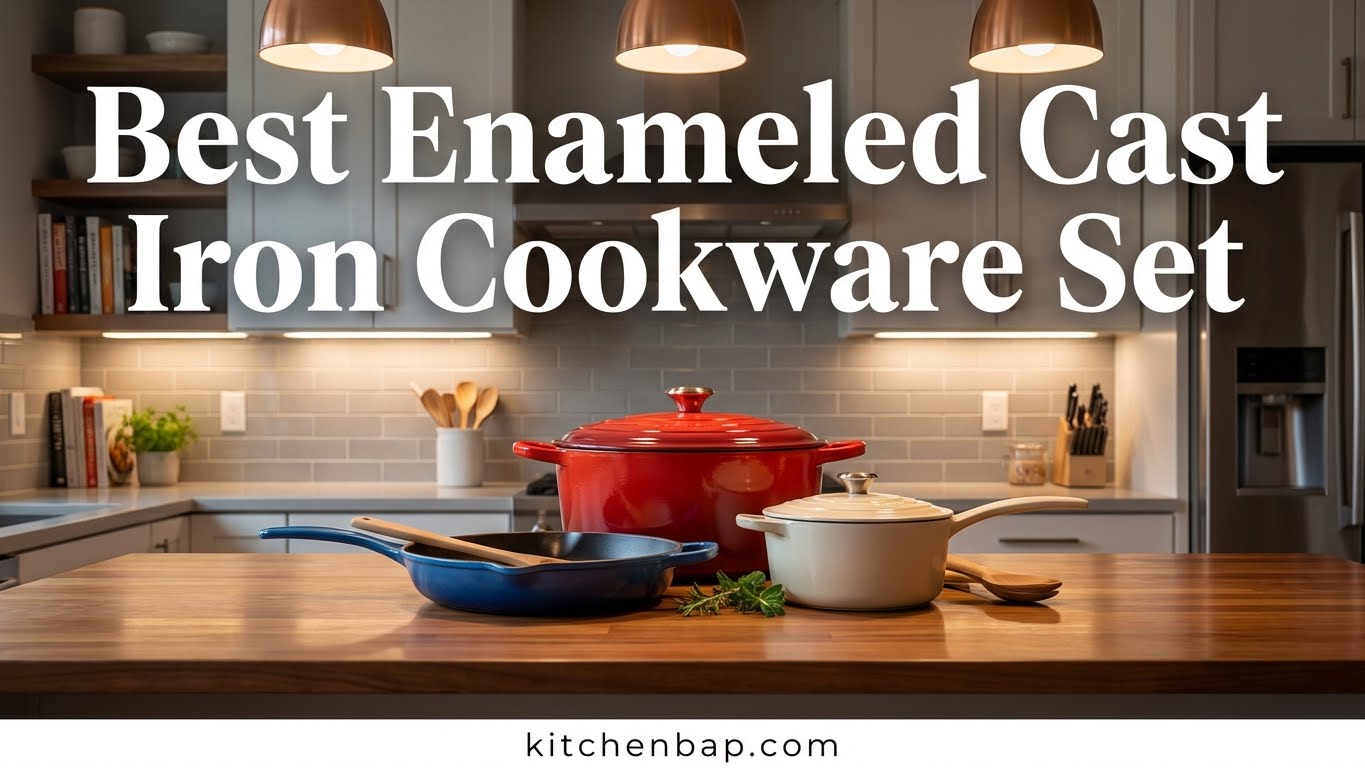
There’s something profoundly satisfying about cooking with enameled cast iron. It’s the kind of cookware that transforms ordinary meals into culinary experiences, the kind your grandmother might have used to create those unforgettable Sunday roasts, and the kind that professional chefs reach for when they want both performance and presentation.
Best Enameled Cast Iron Cookware Set :Enameled cast iron cookware represents the perfect marriage between old-world craftsmanship and modern convenience. Unlike traditional cast iron that requires careful seasoning and maintenance, enameled versions offer the same exceptional heat retention and distribution while adding a protective glass coating that eliminates the need for seasoning, prevents rust, and creates a naturally non-reactive cooking surface that won’t impart metallic flavors to acidic foods like tomatoes or wine-based sauces.

Why Enameled Cast Iron Cookware Deserves a Place in Your Kitchen!
The investment in a quality enameled cast iron cookware set isn’t just about acquiring new pots and pans—it’s about embracing a cooking method that has stood the test of time. These pieces can last generations when properly cared for, making them not just kitchen tools but potential family heirlooms. From slow-braised short ribs to crusty no-knead bread, from vibrant ratatouille to perfectly simmered Sunday gravy, enameled cast iron handles it all with aplomb.
But here’s the challenge: the market is flooded with options ranging from budget-friendly alternatives to premium French imports that cost as much as a mortgage payment. How do you know which set delivers genuine value? Which brands offer the durability to justify their price tags? And which features actually matter when you’re standing in front of your stove?
The popularity of enameled cast iron has exploded in recent years, partly thanks to social media’s obsession with aesthetically pleasing cookware and partly because home cooks have rediscovered the joys of slow cooking and one-pot meals. This surge in demand has brought numerous brands into the market, each promising superior performance, stunning colors, and lifetime durability.
However, not all enameled cast iron is created equal. The quality of the casting process, the thickness and application of the enamel coating, the fit of the lid, and even the choice of knob material can dramatically affect both cooking performance and longevity. A poorly made piece might chip after a few uses, distribute heat unevenly, or develop hot spots that burn your carefully crafted dishes.
This comprehensive guide cuts through the marketing hype to bring you honest, detailed reviews of the eleven best enameled cast iron cookware sets available on Amazon today. We’ve analyzed construction quality, heat distribution, ease of cleaning, design aesthetics, and real-world performance to help you make an informed decision. Whether you’re a culinary enthusiast ready to invest in premium French craftsmanship or a practical home cook seeking reliable performance at a reasonable price, you’ll find options that match your needs and budget.
We’ll explore everything from the iconic Le Creuset sets that have graced kitchens for nearly a century to innovative newcomers offering impressive quality at fraction of the cost. You’ll discover which sets excel at specific cooking techniques, which ones offer the best value for money, and which features you absolutely need versus those that are merely nice to have.
By the end of this guide, you’ll understand exactly what separates a mediocre enameled cast iron set from an exceptional one, and you’ll be equipped to choose cookware that will serve you faithfully for decades to come.
Top 11 Enameled Cast Iron Cookware Sets Reviewed!
1. Le Creuset Signature Cast Iron Cookware Set

Overview:
Le Creuset isn’t just a brand—it’s the gold standard by which all other enameled cast iron cookware is measured. This French company has been perfecting its craft since 1925, and their Signature collection represents nearly a century of refinement. The set typically includes a 5.5-quart round Dutch oven, a 2.75-quart saucepan with lid, and a 10.25-inch skillet, though configurations vary. Each piece is individually sand-cast in France, ensuring no two items are exactly alike, and features the brand’s proprietary enamel that’s applied in multiple layers to create an incredibly durable, chip-resistant surface.
Key Features:
- Sand-Cast Construction: Each piece is individually crafted using traditional sand molds, resulting in superior quality and slight variations that make every item unique
- Multi-Layer Enamel Coating: Exterior enamel is applied in two coats for durability and color vibrancy, while the interior features a smooth, light-colored enamel that makes monitoring cooking easy
- Superior Heat Distribution: The thick cast iron construction (approximately 4-5mm) ensures even heating across the entire cooking surface without hot spots
- Tight-Fitting Lids: Precision engineering creates a seal that continuously bastes food during cooking, enhancing flavors and maintaining moisture
- 45% Larger Handles: Redesigned handles provide better grip even when wearing oven mitts
- Stainless Steel Knob: Heat-safe up to 500°F, allowing for versatile oven use
- Lifetime Warranty: Le Creuset stands behind their products with an exceptional warranty that covers manufacturing defects
Performance and User Experience:
Using Le Creuset is an experience that justifies the premium price for many cooks. The heat retention is exceptional—these pieces take slightly longer to heat up than thinner cookware, but once they reach temperature, they maintain it beautifully. This makes them ideal for slow-cooking techniques like braising, where consistent, gentle heat transforms tough cuts of meat into tender masterpieces.
The cooking surface is remarkably non-stick when properly preheated and used with adequate fat, though it’s not truly non-stick in the modern sense. The light-colored interior enamel (typically in cream or white) is brilliant for monitoring fond development and color changes in your food—essential feedback for skilled cooking. Some users worry about staining on this light surface, and while it does happen, it doesn’t affect performance and can usually be addressed with Bar Keeper’s Friend or baking soda paste.
The weight is substantial, which is both a feature and a consideration. A full 5.5-quart Dutch oven weighs about 12 pounds empty and significantly more when filled with food. This mass contributes to excellent heat retention but may pose challenges for those with limited strength or mobility issues.
Pros:
✅ Unmatched durability – properly cared for Le Creuset can literally last multiple generations
✅ Superior enamel quality – chip-resistant coating that maintains its appearance for decades
✅ Best-in-class heat retention – maintains consistent temperature for perfect slow-cooked dishes
✅ Easy cleaning – smooth enamel surface releases food readily and cleans up without excessive scrubbing
✅ Stunning aesthetics – available in over 15 colors that coordinate beautifully in any kitchen
✅ Lifetime warranty – exceptional customer service and product guarantee
✅ Versatile performance – transitions seamlessly from stovetop to oven
✅ Non-reactive surface – safe for acidic ingredients without metallic taste
Cons:
❌ Premium pricing – significantly more expensive than competitors, sometimes 3-5x the cost of similar sets
❌ Considerable weight – heavier than most alternatives, which can be challenging for some users
❌ Light interior stains – cream-colored interior shows discoloration over time (though this doesn’t affect performance)
❌ Limited set configurations – fewer bundle options compared to some brands
Ideal For:
Le Creuset is perfect for serious home cooks and culinary enthusiasts who view cookware as a long-term investment rather than a disposable kitchen item. It’s ideal for those who appreciate the intersection of function and aesthetics, want cookware that can go from kitchen to table beautifully, and have the budget to invest in premium quality. This is also an excellent choice for gift-givers looking for heirloom-quality items for weddings or special occasions.
Amazon Rating Summary and Unique Value:
With ratings consistently above 4.7 stars from thousands of verified purchasers, Le Creuset maintains its reputation through actual performance. Users repeatedly emphasize that while the initial cost is steep, the per-use cost becomes negligible over decades of daily use. The resale value is also noteworthy—vintage Le Creuset pieces often sell for substantial amounts, sometimes approaching their original retail price.
The unique value proposition is simple: you’re buying cookware that will outlast you. If that matters—if you want to pass down kitchen tools to your children or simply never want to replace your cookware again—Le Creuset delivers on that promise better than virtually any competitor.
2. Lodge Enameled Cast Iron Cookware Set

Overview:
Lodge represents the accessible face of quality enameled cast iron cookware. This American company has been crafting cast iron since 1896, and their enameled line brings over a century of foundry expertise to the table at prices that won’t require a second mortgage. The typical set includes a 6-quart Dutch oven with lid and a 3.6-quart deep skillet, providing excellent versatility for most cooking tasks. While it lacks the cachet of European imports, Lodge delivers surprisingly solid performance that punches well above its price point.
Key Features:
- American-Made Quality: Manufactured in South Pittsburg, Tennessee, supporting domestic production
- Porcelain Enamel Coating: Durable glass coating over cast iron base provides a non-reactive cooking surface
- Dark Enamel Interior: Black interior hides staining better than light-colored alternatives and creates excellent browning conditions
- Generous Capacity: The 6-quart Dutch oven handles large batches and whole chickens with ease
- Stainless Steel Knob: Oven-safe to 500°F for versatile cooking methods
- Wide Loop Handles: Designed for secure grip, even with bulky oven mitts
- Affordable Pricing: Typically 40-60% less expensive than premium European brands
Performance and User Experience:
Lodge enameled cast iron performs admirably for everyday cooking tasks. The heat distribution, while not quite as refined as Le Creuset, is more than adequate for home cooking. You might notice slightly more pronounced hot spots over high heat, but for the braising, roasting, and simmering that enameled cast iron excels at, Lodge handles these tasks with confidence.
The black interior enamel is a practical choice that many experienced cooks actually prefer. It doesn’t show staining, provides excellent contrast for monitoring browning, and seems to develop better non-stick properties over time compared to light-colored interiors. The trade-off is that you can’t as easily monitor color changes in light-colored sauces or see fond development as clearly.
Build quality feels solid, though not quite as refined as premium alternatives. The enamel coating is generally smooth but may have slight imperfections or rougher texture in some areas—these don’t affect performance but do distinguish it from more expensive options. The weight is comparable to other enameled cast iron, so you still get excellent heat retention.
Some users report the enamel being more susceptible to chipping than premium brands, particularly if subjected to thermal shock (like placing a hot pot under cold water) or rough handling. However, minor chips don’t necessarily compromise the cookware’s functionality.
Pros:
✅ Outstanding value – delivers 80-90% of premium performance at 40-60% of the cost
✅ Dark interior advantages – hides staining and provides excellent browning feedback
✅ American-made quality – supports domestic manufacturing with reliable construction
✅ Generous sizing – the 6-quart Dutch oven handles large cooking projects easily
✅ Oven-safe to 500°F – versatile for most cooking techniques
✅ Wide availability – easy to find replacement pieces or expand your collection
✅ Good heat retention – maintains temperature well for slow-cooking methods
✅ Easy maintenance – cleans up well with standard methods
Cons:
❌ Less refined enamel – coating may have slight imperfections and is more chip-prone than premium brands
❌ Slightly uneven heat distribution – may develop minor hot spots under high heat
❌ Limited color options – available in fewer aesthetic choices compared to premium brands
❌ Heavier than some alternatives – substantial weight may challenge some users
❌ Interior doesn’t show fond as clearly – dark color makes monitoring certain dishes more challenging
Ideal For:
Lodge is the smart choice for practical home cooks who want quality enameled cast iron without the premium price tag. It’s perfect for those new to this cookware style who want to explore its capabilities before potentially investing in more expensive pieces. It’s also ideal for families who cook frequently and need durable, reliable equipment that can withstand daily use without anxiety about damaging an expensive investment.
Amazon Rating Summary and Unique Value:
Lodge maintains impressive ratings of 4.5+ stars across thousands of reviews, with users consistently praising the value proposition. The most common theme in positive reviews is surprise—buyers expect compromise at this price point and instead find cookware that performs reliably for years.
The unique value is accessibility. Lodge proves that excellent enameled cast iron cooking doesn’t require luxury pricing. For budget-conscious cooks, those furnishing first kitchens, or anyone who wants to try enameled cast iron without major investment, Lodge removes the financial barrier while maintaining cooking quality.
3. Staub Cast Iron Cookware Set

Overview:
Staub occupies a fascinating position in the enameled cast iron market—revered by professional chefs and culinary purists, yet less recognized by casual home cooks than Le Creuset. This French brand (now owned by Zwilling) has been producing premium cast iron since 1974, and their design philosophy differs notably from competitors. Staub’s signature feature is the black matte enamel interior, which they argue provides superior browning and develops better non-stick properties over time. The typical set includes a 4-quart round cocotte (Dutch oven), a 2.75-quart round cocotte, and sometimes a 10-inch grill pan, all featuring the brand’s distinctive brass knob and self-basting lid design.
Key Features:
- Matte Black Interior Enamel: Unique textured surface that enhances browning and becomes naturally more non-stick with use
- Self-Basting Spikes (Chistera Drops): Interior lid features dozens of precisely placed spikes that continuously baste food as condensation forms and drips back down
- Nickel-Plated Brass Knob: Heat-resistant to 500°F, adds weight to lid for better seal, and provides elegant aesthetic
- Heavy-Duty Construction: Slightly thicker walls than most competitors provide exceptional heat retention
- Sand-Cast in France: Traditional manufacturing ensures quality and makes each piece unique
- Tight-Fitting Flat Lids: Designed to accommodate charcoal on top (traditional French technique) while creating excellent seal
- Commercial-Grade Durability: Built to withstand professional kitchen demands
Performance and User Experience:
Staub delivers cooking performance that many professionals consider superior to any alternative. The matte black interior is genuinely different—it browns proteins more aggressively than smooth light-colored enamel, creating deeper flavors through better Maillard reaction. Over time, this surface develops enhanced non-stick properties as it absorbs oils and fats, though it never becomes truly non-stick like modern coated cookware.
The self-basting lid system is more than marketing gimmick. The spikes do create more consistent, thorough basting than flat lids, resulting in moister meats and more concentrated flavors. When you lift a Staub lid after hours of braising, you’ll notice significantly less liquid accumulation on the lid surface because it’s been continuously dripping back onto the food.
Heat retention is exceptional, even better than most competitors thanks to slightly thicker walls. This makes Staub particularly well-suited for recipes requiring extended gentle heat, like confit, long braises, or slow-roasted dishes. The flip side is that these pieces take longer to heat up initially and are noticeably heavier than alternatives.
The black exterior enamel is more scratch-resistant than lighter colors and doesn’t show wear as obviously, maintaining its appearance better over decades. However, the textured interior can be slightly more challenging to clean than smooth enamel, particularly when dealing with sticky or burnt-on food.
Pros:
✅ Superior browning performance – matte interior creates exceptional searing and Maillard reaction
✅ Self-basting technology – spiked lid design genuinely improves moisture distribution
✅ Develops non-stick properties – interior becomes more non-stick with regular use
✅ Professional-grade construction – built to withstand commercial kitchen demands
✅ Exceptional heat retention – thick walls maintain temperature better than most alternatives
✅ Elegant aesthetics – sophisticated design with brass knob stands out visually
✅ Durable exterior – black enamel resists scratches and maintains appearance over time
✅ Lifetime warranty – backed by manufacturer confidence in durability
Cons:
❌ Higher price point – comparable to Le Creuset, placing it in premium category
❌ Heavier than alternatives – increased weight may challenge some users
❌ Interior shows less fond development – dark surface makes monitoring certain cooking processes harder
❌ More difficult to clean – textured interior can trap food particles requiring more scrubbing
❌ Limited color options – mostly available in dark colors, less variety than competitors
❌ Brass knob can tarnish – requires occasional polishing to maintain appearance
Ideal For:
Staub is the choice for serious cooks who prioritize performance over aesthetics and appreciate cookware designed with culinary functionality as the primary goal. It’s ideal for those who frequently braise meats, make stews, or prepare dishes requiring extended gentle heat. Professional chefs and culinary school graduates often gravitate toward Staub because it’s what they used in professional kitchens.
Amazon Rating Summary and Unique Value:
Staub maintains ratings around 4.6-4.8 stars, with professional cooks and serious home chefs providing particularly enthusiastic reviews. Users consistently mention that the cooking results justify the premium price, with many claiming their food tastes noticeably better prepared in Staub versus other brands.
The unique value lies in the marriage of French engineering heritage with functional design choices that genuinely impact cooking results. If you’re willing to accept slightly more challenging cleaning in exchange for superior browning and moisture retention, Staub delivers meaningful performance advantages.
4. Cuisinart Chef’s Classic Enameled Cast Iron Cookware Set

Overview:
Cuisinart brings their reputation for accessible quality kitchen equipment to the enameled cast iron category with the Chef’s Classic line. This set typically includes a 5-quart round Dutch oven, a 3-quart braiser, and a 2-quart saucepan, providing more pieces than many competitors at a price point that won’t strain most budgets. While it doesn’t carry the prestige of French brands, Cuisinart offers surprisingly competent performance for everyday cooking tasks.
Key Features:
- Porcelain Enamel Over Cast Iron: Non-reactive cooking surface suitable for all ingredients
- Multi-Piece Versatility: More items included than premium sets, providing greater cooking flexibility
- Cream-Colored Interior: Light enamel makes monitoring cooking progress easy
- Wide Loop Handles: Comfortable grip for safe handling of hot cookware
- Oven-Safe to 400°F: Adequate for most cooking tasks, though lower than premium alternatives
- Dishwasher-Safe Construction: Convenient cleaning, though hand washing is still recommended
- Limited Lifetime Warranty: Manufacturer backing provides peace of mind
Performance and User Experience:
Cuisinart’s enameled cast iron performs competently for standard home cooking tasks. The heat distribution is adequate though not exceptional—you may notice slightly more pronounced hot spots compared to premium brands, particularly when cooking over medium-high or high heat. For the slow, gentle cooking that enameled cast iron excels at, these differences are less noticeable.
The cream interior is practical and attractive, making it easy to monitor fond development and color changes in your food. However, it will stain over time, particularly if you cook tomato-based sauces or dark-colored dishes frequently. These stains are cosmetic and don’t affect performance, though they may bother those who prize pristine appearance.
Build quality is decent but reveals the price difference from premium brands. The enamel coating is thinner and more prone to chipping if subjected to rough handling or thermal shock. Several users report chips developing over time, particularly on the rim where lids rest and around handles. While minor chips don’t necessarily compromise cooking ability, they can eventually lead to rust if the raw iron beneath is exposed to moisture.
The 400°F oven limit is lower than most competitors (typically 500°F), which may constrain certain cooking techniques. This is adequate for most braising and roasting but limits your ability to finish dishes under high broiler heat or use certain high-temperature bread baking techniques.
Pros:
✅ Affordable pricing – one of the most budget-friendly multi-piece sets available
✅ Multiple pieces included – provides greater versatility than two-piece premium sets
✅ Light interior enamel – easy to monitor cooking and fond development
✅ Comfortable handles – wide loops accommodate oven mitts easily
✅ Dishwasher-safe – convenient cleaning option for busy households
✅ Decent heat retention – adequate for most home cooking applications
✅ Available through major retailers – easy to find and purchase
✅ Limited warranty included – provides some protection against defects
Cons:
❌ Lower oven temperature limit – 400°F ceiling restricts some cooking techniques
❌ Thinner enamel coating – more susceptible to chipping than premium brands
❌ Less refined heat distribution – may develop hot spots under high heat
❌ Interior stains readily – light enamel shows discoloration quickly
❌ Lighter weight construction – less thermal mass means less consistent heat retention
❌ Shorter lifespan expectation – unlikely to last multiple generations like premium alternatives
Ideal For:
Cuisinart is a sensible choice for budget-conscious cooks who want to explore enameled cast iron without significant investment, occasional users who don’t need commercial-grade durability, or those furnishing a vacation home or rental property where expensive cookware might be impractical. It’s also suitable for college students or young adults establishing their first independent kitchens.
Amazon Rating Summary and Unique Value:
Cuisinart maintains ratings around 4.3-4.5 stars, with users generally satisfied when expectations align with the price point. The most successful buyers are those who understand they’re purchasing functional cookware rather than heirloom pieces, and who appreciate having multiple pieces at a low entry cost.
The unique value proposition is accessibility. Cuisinart removes barriers to entry for enameled cast iron cooking, allowing more people to experience this cooking style. While it won’t last generations like Le Creuset, it provides good value during its serviceable life.
5. AmazonBasics Enameled Cast Iron Covered Dutch Oven

Overview:
Amazon’s house brand entry into enameled cast iron represents the absolute budget end of the spectrum. While technically not a multi-piece set in most configurations, the AmazonBasics Dutch oven is often purchased in multiple sizes to create a custom collection. Available in 2, 3.3, 5, 6, and 7.3-quart capacities, these pieces deliver bare-bones functionality at prices that make enameled cast iron accessible to virtually anyone. Don’t expect refinement or longevity, but do expect serviceable performance for basic cooking tasks.
Key Features:
- Vitreous Enamel Over Cast Iron: Basic non-reactive coating provides adequate protection
- Multiple Size Options: Available in five capacities to suit different cooking needs
- Light-Colored Interior: Cream enamel for monitoring cooking progress
- Loop Handles on Pot and Lid: Utilitarian design provides basic functionality
- Oven-Safe to 400°F: Adequate for most standard cooking applications
- Budget-Friendly Pricing: Typically 60-75% less expensive than premium brands
- Limited One-Year Warranty: Basic coverage for manufacturing defects
Performance and User Experience:
AmazonBasics delivers exactly what you’d expect at this price point—basic functionality with notable compromises. The heat distribution is the most obvious weakness, with more pronounced hot spots than any other option reviewed here. You’ll need to adjust your cooking technique, stirring more frequently and using lower heat settings to compensate.
The enamel quality is noticeably inferior to premium alternatives. It feels thinner, has a rougher texture, and chips more readily. Multiple users report chips developing within the first few months of use, particularly around the rim and handles. Some pieces arrive with minor imperfections already present, suggesting less rigorous quality control.
Heat retention is adequate but not impressive. The lighter construction provides less thermal mass, meaning the pot doesn’t maintain temperature as consistently during cooking. This becomes noticeable when you add cold ingredients to a preheated pot or when cooking over low heat for extended periods.
However, for simple tasks like making soup, boiling pasta, or basic braising, AmazonBasics gets the job done. It’s functional cookware that performs the basic job of containing food and applying heat, even if it doesn’t do so with the elegance or efficiency of premium alternatives.
Pros:
✅ Extremely affordable – lowest price point of any option reviewed, making enameled cast iron accessible to all
✅ Multiple size options – easy to build custom collection matching your specific needs
✅ Adequate for basic tasks – handles simple cooking projects competently
✅ Light interior – easy to monitor cooking progress
✅ No anxiety about damage – low cost means less stress about potential chips or scratches
✅ Widely available – Prime shipping provides quick delivery
✅ Good for experimental cooks – try enameled cast iron with minimal financial risk
Cons:
❌ Poor heat distribution – pronounced hot spots require cooking technique adjustments
❌ Inferior enamel quality – chips easily and has rougher finish than competitors
❌ Shorter lifespan – unlikely to provide years of service like premium brands
❌ Less refined construction – noticeable quality compromises throughout
❌ Lower oven temperature limit – 400°F maximum restricts some techniques
❌ Minimal warranty coverage – only one year versus lifetime for premium brands
❌ Reduced heat retention – lighter construction doesn’t maintain temperature as well
Ideal For:
AmazonBasics is appropriate for extreme budget constraints where any enameled cast iron is better than none, experimental cooks who want to try the format before investing more substantially, college dorm cooking where durability isn’t a primary concern, or as supplementary pieces to handle less demanding tasks while preserving your premium cookware.
Amazon Rating Summary and Unique Value:
Despite limitations, AmazonBasics maintains respectable 4.2-4.4 star ratings from thousands of buyers. The key to satisfaction is appropriate expectations—reviewers who expect premium performance are disappointed, while those who view it as functional budget cookware are generally satisfied.
The unique value is pure accessibility. AmazonBasics proves that you can experience enameled cast iron cooking for under $50, making this cooking style available to demographics who might otherwise never try it. While it won’t last decades or deliver refined results, it successfully removes financial barriers.
6. Crock-Pot Artisan Enameled Cast Iron Cookware Set

Overview:
Crock-Pot, famous for their slow cookers, has translated their expertise with extended cooking times into an enameled cast iron line that focuses on practical functionality. The Artisan collection typically includes a 5-quart Dutch oven and a 3-quart braiser, offering solid versatility for everyday cooking. While the brand lacks the culinary prestige of European manufacturers, Crock-Pot delivers reliable performance at mid-range pricing that appeals to practical home cooks.
Key Features:
- Enamel-Coated Cast Iron Construction: Provides non-reactive surface suitable for all ingredients
- Self-Basting Lid Design: Interior lid texture promotes condensation distribution
- Stainless Steel Knobs: Heat-resistant handles for secure lid removal
- Available in Multiple Colors: Aesthetic options include gradient and solid finishes
- Oven-Safe to 500°F: Matches premium brands for temperature versatility
- Wide Handles: Designed to accommodate oven mitts comfortably
- Limited Lifetime Warranty: Manufacturer backing provides long-term confidence
Performance and User Experience:
Crock-Pot’s enameled cast iron performs surprisingly well considering its mid-range positioning. The heat distribution is better than budget options, with only minor hot spots under high heat. For the slow cooking methods that Crock-Pot specializes in, the performance is genuinely comparable to more expensive alternatives.
The enamel quality falls somewhere between budget and premium options. It’s smoother and more durable than bargain brands but doesn’t quite match the refinement of Le Creuset or Staub. Most users report satisfactory durability with reasonable care, though some chipping may occur with rough handling or thermal shock.
The self-basting lid design shows that Crock-Pot applied their slow-cooker expertise to this format. While not as sophisticated as Staub’s spiked system, the textured interior does promote better moisture distribution than completely flat lids, resulting in moister, more evenly cooked dishes.
Heat retention is good, providing the consistent gentle heat that makes enameled cast iron ideal for braises and stews. The pieces maintain temperature well enough to keep dishes warm when brought to the table for serving.
Pros:
✅ Mid-range pricing – offers reasonable value without premium cost
✅ Good heat retention – maintains temperature well for slow cooking
✅ High oven temperature rating – 500°F matches premium alternatives
✅ Self-basting lid design – improves moisture distribution during cooking
✅ Attractive color options – includes unique gradient finishes
✅ Decent enamel durability – holds up reasonably well with proper care
✅ Lifetime warranty – provides long-term protection and confidence
✅ Comfortable handles – easy to grip with oven protection
Cons:
❌ Mid-tier heat distribution – not as refined as premium options
❌ Enamel quality compromises – better than budget but not premium-level
❌ Limited brand prestige – associated with slow cookers rather than traditional cookware
❌ Smaller capacity options – set configurations tend toward moderate sizes
❌ May chip with rough handling – requires care to maintain appearance
❌ Less refined aesthetics – doesn’t quite match the elegance of French brands
Ideal For:
Crock-Pot is well-suited for practical home cooks who want reliable performance without premium pricing, families who use slow-cooking methods regularly and want cookware designed with that focus, or those who appreciate brand familiarity and trust Crock-Pot’s reputation in extended cooking applications.
Amazon Rating Summary and Unique Value:
Crock-Pot maintains ratings around 4.4-4.6 stars, with users appreciating the balance between cost and performance. Reviewers frequently mention that results exceed expectations based on the mid-range price point.
The unique value proposition connects to Crock-Pot’s core competency. If you primarily use enameled cast iron for slow-cooked dishes—stews, braises, roasts—Crock-Pot’s expertise in this arena translates well to this format, delivering focused performance where it matters most.
7. Tramontina Enameled Cast Iron Covered Round Dutch Oven

Overview:
Tramontina, a Brazilian manufacturer with over a century of metalworking experience, offers one of the most compelling value propositions in enameled cast iron. While typically sold as individual pieces rather than complete sets, their Dutch ovens in various sizes (3.5, 5, 6.5, and 7 quarts) can be combined to create a custom collection. Tramontina gained significant attention when Cook’s Illustrated rated their 6.5-quart model nearly equal to Le Creuset at a fraction of the cost, making it a favorite among value-conscious cooks.
Key Features:
- Porcelain Enamel Over Cast Iron: Durable non-reactive surface for all ingredients
- Light-Colored Interior: Cream enamel for easy monitoring of cooking progress
- Stainless Steel Knob: Heat-resistant to 450°F for versatile cooking
- Comfortable Handles: Loop design provides secure grip
- Multiple Size Options: Build custom collection matching your specific needs
- Excellent Value Pricing: Typically 50-70% less than Le Creuset for comparable quality
- Lifetime Warranty: Manufacturer confidence backed by extensive coverage
Performance and User Experience:
Tramontina delivers performance that consistently surprises users familiar with premium brands. The heat distribution is excellent, rivaling much more expensive alternatives. Hot spots are minimal, and the pot heats evenly across the bottom and up the sides, providing consistent results for various cooking techniques.
The enamel quality represents the biggest surprise at this price point. It’s smooth, attractively finished, and notably more chip-resistant than similarly priced competitors. While it may not quite match the absolute refinement of Le Creuset’s enamel, the difference is marginal rather than dramatic. Many users report years of regular use with minimal wear beyond normal staining.
Heat retention is excellent, providing the thermal mass necessary for proper slow cooking. The cast iron construction is substantial, resulting in weight comparable to premium alternatives—this translates to better heat holding but may challenge users who struggle with heavy cookware.
The light interior does stain over time, particularly with tomato-based dishes or dark ingredients, but these stains are cosmetic and don’t affect cooking performance. They can usually be minimized with proper cleaning techniques and occasional treatment with Bar Keeper’s Friend.
Pros:
✅ Outstanding value – delivers near-premium performance at mid-range pricing
✅ Excellent heat distribution – rivals much more expensive alternatives
✅ Durable enamel coating – surprisingly chip-resistant with proper care
✅ Good temperature rating – 450°F oven-safe handles most cooking techniques
✅ Multiple size availability – easy to build custom collection
✅ Lifetime warranty – exceptional coverage for the price point
✅ Attractive design – aesthetically pleasing in various kitchen styles
✅ Recommended by testing organizations – validated by independent reviews
Cons:
❌ Not sold as complete sets– requires purchasing individual pieces
❌ Slightly lower oven rating – 450°F versus 500°F for some premium brands
❌ Less brand prestige – doesn’t carry the cachet of French manufacturers
❌ Interior stains over time – light enamel shows discoloration with regular use
❌ Heavy construction – substantial weight may challenge some users
❌ Limited color options – fewer aesthetic choices than premium brands
Ideal For:
Tramontina is ideal for discerning home cooks who want premium-level performance without premium pricing, those building their first enameled cast iron collection and wanting to invest wisely, or anyone who prioritizes cooking results over brand prestige and aesthetic variety.
Amazon Rating Summary and Unique Value:
Tramontina consistently earns 4.5-4.7 star ratings, with reviewers frequently expressing amazement at the quality relative to cost. The most common review theme is comparison to Le Creuset, with many users claiming they can’t detect meaningful performance differences despite paying significantly less.
The unique value lies in democratizing premium performance. Tramontina proves that excellent enameled cast iron doesn’t require luxury pricing, making high-quality slow cooking accessible to budget-conscious households without meaningful performance compromise.
8. Victoria Cast Iron Enamel Cookware Set

Overview:
Victoria represents an interesting entry from Colombia, where the company has manufactured cast iron cookware since the 1930s. Their enameled line brings South American manufacturing to compete with European and American alternatives. The typical set includes a 4.2-quart Dutch oven and a 2.8-quart saucepan, providing core functionality for most cooking needs. While less known than established brands, Victoria offers solid construction at attractive pricing.
Key Features:
- Heavy-Duty Cast Iron Base: Thick construction provides excellent heat retention
- Porcelain Enamel Coating: Non-reactive surface suitable for all ingredients
- Self-Basting Lid Design: Textured interior promotes condensation distribution
- Colored Exterior Enamel: Available in several attractive finishes
- Oven-Safe to 400°F: Adequate for most home cooking applications
- Ergonomic Handles: Designed for comfortable gripping
- Affordable Pricing: Lower than premium alternatives while maintaining quality
Performance and User Experience:
Victoria delivers competent performance that serves everyday cooking needs well. The heat distribution is adequate, with minor hot spots that become noticeable mainly when cooking over higher heat. For braising, stewing, and other slow-cooking methods where enameled cast iron truly excels, performance is satisfying.
The construction feels solid and substantial. The cast iron is thick enough to provide good thermal mass and heat retention, maintaining temperature effectively during extended cooking. This weight, comparable to premium brands, might surprise buyers expecting lighter cookware at this price point.
Enamel quality is reasonable but reveals the budget positioning. The coating is generally durable but may be more prone to chipping than premium alternatives, particularly if subjected to thermal shock or dropped. The finish isn’t quite as smooth or refined as Le Creuset, with occasional minor imperfections visible on close inspection.
The self-basting lid design represents thoughtful engineering, promoting better moisture distribution during cooking. While not as sophisticated as Staub’s spike system, it does improve results compared to completely flat lids.
Pros:
✅ Good value pricing – reasonable cost for solid construction
✅ Heavy-duty build – substantial cast iron provides excellent heat retention
✅ Self-basting lid – improves moisture distribution during cooking
✅ Decent heat retention – maintains temperature well for slow cooking
✅ Multiple color options – aesthetic variety at budget pricing
✅ Comfortable handles – ergonomic design for safe handling
✅ Adequate oven rating – 400°F handles most home cooking needs
Cons:
❌ Less refined enamel – coating quality doesn’t match premium alternatives
❌ More prone to chipping – requires careful handling to maintain appearance
❌ Limited brand recognition – less familiar to most American consumers
❌ Lower oven temperature limit – 400°F restricts some advanced techniques
❌ Uneven heat distribution – noticeable hot spots under high heat
❌ Shorter track record – less established reputation than heritage brands
❌ Limited availability – not as widely stocked as major competitors
Ideal For:
Victoria suits budget-conscious cooks who want solid enameled cast iron at affordable prices, those exploring this cookware style without major investment, or households needing reliable everyday cookware that can handle regular use without excessive concern about damage.
Amazon Rating Summary and Unique Value:
Victoria maintains ratings around 4.3-4.5 stars, with users generally satisfied when expectations align with the mid-budget positioning. Positive reviews emphasize good value and solid performance for the price.
The unique value proposition is straightforward functionality at accessible pricing. Victoria doesn’t attempt to compete on prestige or refinement but delivers reliable enameled cast iron cooking at prices that make the format available to more households.
9. Pioneer Woman Timeless Beauty Enameled Cast Iron Dutch Oven Set

Overview:
The Pioneer Woman line, Walmart’s collaboration with Food Network personality Ree Drummond, brings celebrity branding to affordable enameled cast iron. While often dismissed by serious cooks as mass-market merchandise, these pieces deserve consideration for their surprisingly decent performance relative to cost. The typical set includes a 5-quart Dutch oven and a 2-quart Dutch oven, with aesthetic designs reflecting Drummond’s preference for vintage-inspired patterns and bright colors. This is cookware that prioritizes visual appeal while maintaining functional competence.
Key Features:
- Porcelain Enamel Over Cast Iron: Non-reactive cooking surface for all ingredients
- Distinctive Decorative Designs: Unique patterns and vibrant colors not found in traditional brands
- Light-Colored Interior: Cream enamel for monitoring cooking progress
- Acrylic Knobs: Decorative but with lower heat tolerance (350°F)
- Multiple Size Options: Various Dutch oven capacities and specialty pieces available
- Budget-Friendly Pricing: Among the most affordable enameled cast iron options
- Widely Available: Stocked at Walmart stores and online
Performance and User Experience:
Pioneer Woman cookware performs adequately for basic home cooking, though with noticeable compromises compared to premium alternatives. Heat distribution is acceptable for slow cooking but shows pronounced hot spots under higher heat settings. You’ll need to stir more frequently and potentially adjust cooking times compared to higher-end options.
The enamel quality is the most obvious compromise. It’s thinner than premium brands and chips more readily, particularly around the rim and on the exterior if the pot contacts other hard surfaces. Some users report chips developing within months, while others experience years of service—proper handling makes a significant difference.
Heat retention is adequate but not exceptional. The lighter construction provides less thermal mass, meaning temperatures fluctuate more when cold ingredients are added or during extended cooking. This is noticeable mainly when comparing directly to premium alternatives; used in isolation, performance is acceptable.
The acrylic knobs are the biggest functional limitation, with a 350°F maximum temperature. This restricts certain cooking techniques and means you may need to remove the knob for high-temperature applications. Replacement metal knobs are available but add to the overall cost.
The aesthetic designs are genuinely distinctive—florals, vintage patterns, and bold colors create visual interest not found in traditional cookware. For those who prioritize kitchen aesthetics or enjoy coordinating cookware with décor, this represents real value.
Pros:
✅ Very affordable pricing – among the lowest-cost enameled cast iron options
✅ Unique aesthetic designs – distinctive patterns and colors stand out
✅ Multiple sizes available – easy to find pieces for specific needs
✅ Widely stocked – convenient availability at Walmart locations
✅ Light interior – easy to monitor cooking progress
✅ Adequate basic performance – handles everyday cooking tasks competently
✅ Fun brand personality – appeals to Pioneer Woman fans
Cons:
❌ Lower quality enamel – chips more easily than premium alternatives
❌ Acrylic knobs limit oven use – 350°F maximum restricts techniques
❌ Less refined heat distribution – pronounced hot spots under higher heat
❌ Lighter construction – reduced thermal mass affects heat retention
❌ Shorter expected lifespan – unlikely to provide decades of service
❌ Less culinary credibility – viewed as mass-market rather than serious cookware
❌ Quality inconsistency – some users report manufacturing defects
Ideal For:
Pioneer Woman is appropriate for extreme budget constraints where any enameled cast iron is better than none, those who prioritize aesthetic coordination in their kitchen, fans of Ree Drummond who appreciate the brand connection, or gift-givers seeking attractive, affordable options for casual cooks.
Amazon Rating Summary and Unique Value:
Pioneer Woman maintains ratings around 4.3-4.5 stars at Walmart and Amazon, with satisfaction correlating strongly to expectations. Buyers who view these as decorative functional items are generally pleased, while those expecting premium performance are disappointed.
The unique value proposition is making enameled cast iron fun and accessible. The distinctive designs bring personality to a category often dominated by serious, traditional aesthetics, potentially attracting cooks who might otherwise never explore this cookware format.
10. ProWare Enameled Cast Iron Casserole Dish Set

Overview:
ProWare represents another budget-friendly entry into enameled cast iron, offering sets that typically include multiple pieces at prices that undercut most competitors. The brand lacks heritage or recognition but delivers functional cookware for households prioritizing value over prestige. Sets often include a 6-quart Dutch oven and a 3-quart braiser, providing versatile cooking capacity for various applications.
Key Features:
- Enamel-Coated Cast Iron: Non-reactive surface suitable for all ingredients
- Large Capacity Options: 6-quart main piece handles substantial cooking projects
- Light Interior Enamel: Easy monitoring of cooking progress and browning
- Dual Handles on Pots and Lids: Functional design for safe handling
- Oven-Safe to 460°F: Higher rating than many budget alternatives
- Multiple Color Choices: Several aesthetic options available
- Low Pricing: Typically 50-70% less than premium brands
Performance and User Experience:
ProWare delivers baseline enameled cast iron functionality with expected budget compromises. Heat distribution is adequate for slow cooking but shows noticeable hot spots under medium-high or high heat. The pots heat relatively evenly at lower temperatures, making them suitable for braising and stewing where they spend most of their time.
Build quality feels serviceable but not refined. The enamel coating has a slightly rougher texture than premium alternatives and may include minor imperfections like small bubbles or uneven application. These cosmetic issues don’t necessarily impact cooking performance but distinguish budget from premium products.
Heat retention is acceptable, providing enough thermal mass to maintain relatively consistent temperatures during extended cooking. However, the lighter construction compared to premium brands means temperatures drop more noticeably when cold ingredients are added.
Enamel durability represents the primary concern. Multiple users report chipping, particularly around the rim and handles, sometimes within the first year of use. Careful handling and avoiding thermal shock (like placing hot pots under cold water) can minimize issues, but the enamel is clearly more fragile than premium alternatives.
Pros:
✅ Very affordable – significant savings versus premium and mid-range options
✅ Large capacity – 6-quart main piece handles big cooking projects
✅ Higher oven rating – 460°F exceeds many budget competitors
✅ Multiple pieces included – provides cooking versatility
✅ Light interior – easy to monitor cooking progress
✅ Multiple color options – aesthetic variety at budget pricing
✅ Adequate for basic tasks – handles everyday cooking competently
Cons:
❌ Inferior enamel quality – chips readily and has rougher finish
❌ Inconsistent quality control – some pieces arrive with defects
❌ Poor heat distribution – pronounced hot spots under higher heat
❌ Limited brand support – minimal customer service or warranty backing
❌ Shorter lifespan – unlikely to provide many years of service
❌ Less refined construction – noticeable quality compromises throughout
❌ Unknown company reputation – limited track record or brand trust
Ideal For:
ProWare suits extreme budget situations where cost is the primary consideration, temporary cooking arrangements like college dorms or short-term rentals, or those wanting to experiment with enameled cast iron before potentially investing more substantially in quality pieces.
Amazon Rating Summary and Unique Value:
ProWare maintains ratings around 4.0-4.3 stars, with mixed feedback reflecting the budget positioning. Satisfied customers appreciate the low cost and adequate performance, while disappointed buyers cite quality issues and short lifespan.
The unique value is pure accessibility. ProWare makes enameled cast iron available at price points where virtually anyone can afford to try it, removing financial barriers even if the trade-off is reduced durability and refinement.
11. Bruntmor Enameled Cast Iron Dutch Oven Set

Overview:
Bruntmor rounds out our review as another budget-to-mid-range option gaining traction on Amazon. The brand offers various set configurations, typically including a 6.5-quart oval Dutch oven and a 3-quart round Dutch oven, providing shape variety that some users find more versatile than same-shape sets. While lacking the heritage of established brands, Bruntmor has built a following among value-conscious cooks willing to accept some compromises for significantly lower pricing.
Key Features:
- Porcelain Enamel Over Cast Iron: Non-reactive cooking surface for all ingredients
- Oval and Round Options: Shape variety accommodates different foods (oval particularly good for roasts)
- Black or Cream Interior: Available in both color options
- Stainless Steel Knobs: Heat-resistant for oven versatility
- Oven-Safe to 500°F: Matches premium brands for temperature rating
- Large Capacity: 6.5-quart main piece handles substantial cooking
- Attractive Pricing: Mid-budget positioning provides reasonable value
Performance and User Experience:
Bruntmor delivers performance that falls somewhere between true budget options and mid-range alternatives. Heat distribution is adequate for most cooking tasks, with hot spots becoming noticeable mainly under higher heat settings. For the slow-cooking methods where enameled cast iron excels, performance is generally satisfactory.
The enamel quality reveals the mid-budget positioning. It’s smoother and more attractive than rock-bottom options but lacks the refinement and durability of premium brands. Chipping can occur, particularly with rough handling, though users who treat the cookware carefully often report years of satisfactory service.
The oval shape Dutch oven provides genuine versatility advantages, particularly for whole chickens, roasts, and other elongated foods that fit awkwardly in round pots. This thoughtful inclusion adds functional value beyond what similar-priced round-only sets provide.
Heat retention is decent, providing enough thermal mass to maintain relatively consistent temperatures during cooking. The pots preheat reasonably quickly and hold heat adequately for most applications, though not matching the exceptional retention of premium thick-walled alternatives.
Pros:
✅ Mid-range pricing – reasonable cost for decent performance
✅ Shape variety – oval option adds cooking versatility
✅ High oven rating – 500°F matches premium alternatives
✅ Large capacity – handles big cooking projects
✅ Decent enamel quality – better than budget options
✅ Color options available – aesthetic variety
✅ Adequate heat retention – maintains temperature reasonably well
✅ Positive user feedback – generally satisfactory reviews
Cons:
❌ Mid-tier heat distribution – noticeable hot spots under high heat
❌ Enamel can chip – requires reasonable care to maintain appearance
❌ Unknown long-term durability – limited track record for longevity
❌ Less refined construction – quality gaps compared to premium brands
❌ Limited brand recognition – newer company without established reputation
❌ Variable quality control – some users report inconsistencies
❌ May stain readily – particularly light-colored interiors
Ideal For:
Bruntmor suits home cooks seeking reasonable enameled cast iron performance at mid-budget pricing, those who value the oval Dutch oven shape for specific cooking applications, or families wanting adequate quality without premium investment.
Amazon Rating Summary and Unique Value:
Bruntmor maintains ratings around 4.4-4.6 stars, with users generally satisfied with the value proposition. Positive reviews emphasize good performance relative to cost and the practical utility of the oval shape option.
The unique value lies in providing shape variety and decent quality at accessible pricing. The oval Dutch oven particularly adds functionality that premium brands often charge significantly more to provide, making Bruntmor appealing for those who specifically value that cooking versatility.
Comprehensive Buying Guide: Everything You Need to Know About Enameled Cast Iron Cookware
Understanding Enameled Cast Iron: What Makes It Special
Enameled cast iron occupies a unique position in the cookware landscape, combining the exceptional heat retention and even cooking of traditional cast iron with the convenience and versatility of modern materials. To make an informed purchasing decision, you need to understand what you’re actually buying and why it costs significantly more than other cookware types.
At its core, enameled cast iron is exactly what the name suggests: cast iron coated with a glass-based enamel layer. The manufacturing process begins with molten iron poured into sand molds to create the pot or pan shape. Once cooled and removed from the mold, the raw cast iron piece undergoes surface preparation before receiving multiple layers of powdered glass enamel. These layers are fused to the iron at temperatures exceeding 1,200°F, creating a permanent bond that won’t peel or separate like applied coatings.
This enamel coating transforms cast iron from a high-maintenance material requiring seasoning and careful rust prevention into user-friendly cookware suitable for any ingredient. The glass surface is completely non-reactive, meaning you can cook tomatoes, wine-based sauces, citrus, and other acidic ingredients without metallic taste or iron leaching. This is impossible with bare cast iron, which reacts with acidic ingredients.
The magic of enameled cast iron lies in the material’s thermal properties. Cast iron is dense and heavy, with exceptional heat capacity—it absorbs heat slowly but holds it tenaciously. When you preheat an enameled cast iron Dutch oven, you’re essentially creating a heat battery that maintains consistent temperature throughout cooking. This thermal stability is why these pieces excel at slow-cooking methods like braising, where gentle, even heat over extended periods transforms tough cuts of meat into tender masterpieces.
The thick walls and heavy lids create an environment that promotes moisture circulation. As liquid heats, steam rises, contacts the cooler lid, condenses, and drips back down, continuously basting the food. This self-basting action concentrates flavors and maintains moisture better than thin pots where steam escapes readily.
However, understanding the limitations is equally important. Enameled cast iron is extraordinarily heavy—a 5.5-quart Dutch oven typically weighs 10-15 pounds empty and significantly more when filled. This weight contributes to performance but can be challenging for users with limited strength or mobility. The enamel, while durable, can chip if dropped or subjected to thermal shock, and repairs are impossible. The material is also slow to respond to temperature changes—once heated, it maintains that heat persistently, making delicate temperature control more challenging than with responsive materials like stainless steel.
Critical Factors to Consider When Choosing Your Set
Construction Quality: The Foundation of Performance
Construction quality determines whether your enameled cast iron will last generations or fail within years. The casting process itself matters enormously. Traditional sand casting, used by premium manufacturers, involves pouring molten iron into individual sand molds that are destroyed after each casting. This labor-intensive process produces superior, more consistent results. Each piece is unique, with slight variations that distinguish handcrafted quality from mass production.
Lower-cost manufacturers often use permanent molds and less refined casting processes, resulting in thinner, less consistent iron that may include air pockets or inconsistencies affecting heat distribution. You can sometimes feel the difference—premium cast iron feels dense and solid, while budget alternatives may feel slightly hollow when tapped.
The enamel application process separates good from exceptional. Premium manufacturers apply enamel in multiple layers, typically starting with a dark base coat that adheres directly to the iron, followed by finishing coats that provide color and smooth surface. Each layer is fired separately at extremely high temperatures. This multi-layer approach creates depth and resilience, making the enamel more resistant to chipping and thermal shock.
Budget manufacturers may apply thinner, single-layer enamel that’s more prone to chipping and may not bond as permanently to the iron substrate. You can often identify thinner enamel by rougher texture, visible imperfections, or transparent areas where darker iron shows through lighter-colored enamel.
Examine the rim where lid and pot meet—this is the most vulnerable area for chips. Premium manufacturers often reinforce this area or finish it carefully to minimize chipping risk. Budget options may show rough enamel edges or unfinished areas that chip readily.
Enamel Color: More Than Just Aesthetics
Interior enamel color significantly impacts cooking experience beyond mere appearance. Light-colored interiors (cream, white, or light gray) provide culinary advantages by making it easy to monitor fond development—the browned bits stuck to the pot bottom that add flavor to sauces and gravies. You can see precisely when onions turn golden or when a roux reaches the desired color. This visual feedback improves cooking results, particularly for techniques requiring close monitoring.
The trade-off is that light interiors show staining. Tomato sauces, dark stocks, and highly pigmented ingredients gradually discolor the enamel. These stains are purely cosmetic and don’t affect performance, but they bother some users who prize pristine appearance. Stains can usually be minimized with proper cleaning and occasional treatment with Bar Keeper’s Friend or baking soda paste.
Dark interiors (black, charcoal, or dark blue) hide staining completely and some cooks argue they promote better browning by absorbing more heat. The textured dark interior in Staub cookware genuinely does develop enhanced non-stick properties over time as it absorbs oils. However, dark interiors make monitoring color changes difficult—you can’t easily see when garlic is approaching burnt or when your roux has reached the perfect shade.
Exterior color is purely aesthetic, though lighter colors may show scratches and wear more obviously than darker finishes. Choose based on your kitchen décor preferences, but remember that the interior color has practical cooking implications.
Size and Configuration: Matching Capacity to Your Needs
Choosing the right sizes prevents buyer’s remorse. Most cooks benefit from at least two sizes—a larger piece for main dishes and batch cooking, and a smaller option for sides, sauces, or small-batch cooking.
The 5-6 quart Dutch oven represents the workhorse size for most households. It handles whole chickens, pot roasts for 4-6 people, large batch soups, and most bread recipes. If you frequently cook for larger groups or prefer making extra portions for freezing, consider 6.5-7 quart capacity.
Smaller 2-3 quart pieces excel for side dishes, sauces, small-batch soups, and everyday cooking for 1-2 people. Many sets include this size, providing versatility without requiring separate purchase.
Consider shape beyond capacity. Round Dutch ovens work for most applications, but oval shapes excel for elongated foods like whole chickens, roasts, or fish. The oval shape fits long ingredients without awkward positioning, though it requires more storage space and may not fit standard burners as efficiently.
Braiser or shallow casserole configurations (wide and short rather than deep and narrow) provide larger cooking surfaces excellent for searing, reducing sauces, or dishes where evaporation is desirable. These shapes also make serving easier since contents are more visible and accessible.
Assess your actual cooking patterns honestly. If you primarily cook for two, a massive 7-quart pot will spend most of its life in the cabinet. Conversely, buying only small pieces means you’ll struggle when hosting or batch-cooking. Most households benefit from one large (5-7 quart) and one medium (2-3.5 quart) piece as a functional starting point.
Handle and Lid Design: Practical Considerations
Handles determine whether you can safely maneuver heavy, hot cookware. Wide loop handles that accommodate oven-mitted hands are essential—many budget options feature handles barely wide enough for bare hands, becoming dangerously difficult when you’re wearing protective mitts and trying to move a 15-pound pot filled with stew.
Examine handle attachment points. They should be smooth and well-integrated into the pot body without sharp edges or rough spots that could catch on mitts or hands. Premium manufacturers carefully finish these transitions.
Lid handles matter equally. Small knobs are difficult to grasp when hot; larger handles or traditional loop designs provide better control. Material matters—metal handles are oven-safe to higher temperatures than plastic or composite materials. If you use techniques requiring high oven temperatures or want the flexibility to pop lids under the broiler, metal handles are essential.
Stainless steel knobs typically handle 500°F, adequate for most cooking. Brass knobs (featured on Staub) are similarly heat-resistant but may tarnish over time. Phenolic or bakelite knobs usually max out around 350-400°F, limiting high-temperature applications and potentially requiring replacement.
Lid fit deserves attention. Premium lids fit tightly, creating seals that trap moisture and continuously baste food. Loose-fitting lids allow steam escape, reducing the self-basting effect that makes enameled cast iron special. When examining pots in person, check lid fit—it should sit snugly without wobbling but not so tight it’s difficult to remove.
Some lids feature interior texturing or spikes designed to improve condensation distribution. Staub’s spiked design genuinely impacts moisture circulation. Simpler textured surfaces provide modest improvements over completely smooth lids, while flat lids offer basic functionality.
Oven Temperature Rating: Knowing Your Limitations
Oven temperature ratings vary from 350°F to 500°F depending on handle materials and construction. Higher ratings provide greater versatility, allowing techniques requiring high heat.
Bread baking often calls for preheating Dutch ovens to 450-500°F to create initial oven spring. Lower temperature ratings prevent these techniques. Finishing dishes under the broiler or using certain roasting methods also requires high temperature tolerance.
If you primarily use enameled cast iron for stovetop-to-moderate-oven cooking (braising at 300-350°F, for example), lower temperature ratings are less limiting. However, the flexibility to use any technique without temperature anxiety makes higher ratings valuable.
Check what component determines the temperature limit. If it’s the knob rather than the pot itself, you may be able to replace the knob with a higher-rated alternative, though this adds cost and effort.
Brand Reputation and Warranty: Long-Term Confidence
Brand reputation matters significantly for products expected to last decades. Established manufacturers like Le Creuset and Staub have nearly 100 years of production experience, refined manufacturing processes, and demonstrated commitment to quality. Their warranties are meaningful because the companies will likely exist in 20 years when you might need service.
Newer or unknown brands offer potential value but include risk. If the company disappears (common with low-cost Amazon brands), your warranty becomes worthless regardless of its stated terms. Research company history, read extensive reviews, and consider whether saving $50 now is worth risking a product that fails prematurely with no recourse.
Warranty terms vary dramatically. Lifetime warranties from established manufacturers provide genuine long-term security. These typically cover manufacturing defects like enamel separation or casting flaws but exclude damage from misuse like thermal shock or dropping. Read warranty terms carefully—some “lifetime” warranties actually specify 25-30 years, while others genuinely cover the product indefinitely.
Limited warranties (1-3 years) from budget brands suggest the manufacturer doesn’t expect products to last longer. This isn’t necessarily disqualifying for inexpensive cookware you’re buying temporarily or experimentally, but recognize you’re likely replacing rather than repairing if problems develop.
Customer service quality matters when issues arise. Premium brands typically offer responsive, helpful service that resolves problems efficiently. Budget brands may have minimal or non-existent customer service, leaving you with defective products and no recourse.
Heat Distribution and Performance: What Really Matters
Heat distribution represents perhaps the most important performance characteristic after durability. Even heating prevents scorching, ensures consistent cooking, and produces better results across all techniques.
The thickness and quality of the cast iron itself determines heat distribution. Thicker, more consistent castings distribute heat more evenly by providing more thermal mass to absorb and radiate energy. Thin spots or inconsistent thickness create hot spots where food burns while surrounding areas undercook.
Premium manufacturers maintain strict quality control ensuring consistent wall thickness throughout each piece. Budget alternatives may have variations where thin sections overheat while thick areas lag behind. You can sometimes identify these issues by observing cooking results—if food consistently burns in specific spots despite stirring, heat distribution is likely uneven.
The shape and geometry also impact heating. Wide, shallow pieces heat more evenly than narrow, deep ones because heat travels shorter distances through the material. Curved transitions between bottom and walls heat more evenly than sharp angles where heat concentrates.
Testing heat distribution is difficult before purchasing, making brand reputation and reviews valuable. Look for consistent feedback about even heating and absence of hot spots. Single reports of burning might reflect user error, but patterns across multiple reviews suggest genuine distribution problems.
Remember that all cookware shows some temperature variation—the goal is minimizing differences to avoid cooking problems. Premium enameled cast iron typically shows variation of only 10-20°F across the cooking surface, while budget options might vary 40-50°F or more.
Maintenance Requirements: Keeping Your Investment Beautiful
Proper maintenance ensures decades of service from quality enameled cast iron while improper care can destroy even premium pieces prematurely. Understanding care requirements prevents expensive mistakes.
Cleaning:
Enameled cast iron is remarkably easy to clean compared to bare cast iron. The enamel surface resists sticking and releases food readily when properly used. For routine cleaning, allow the pot to cool slightly (but not completely—moderately warm enamel releases food more easily than cold), then wash with hot water, mild dish soap, and a soft sponge or cloth.
Avoid abrasive scrubbers like steel wool or harsh scouring pads that can scratch enamel. While enamel is harder than metal cookware, aggressive scrubbing with abrasive materials gradually dulls the surface. Soft-bristle brushes work well for stubborn spots without risking damage.
For burnt-on food or stubborn staining, make a paste of baking soda and water, apply to affected areas, let sit 15-30 minutes, then scrub gently. Bar Keeper’s Friend (a mild oxalic acid cleaner) works excellently for removing stains and discoloration from light-colored interiors without damaging enamel.
For extremely stubborn residue, fill the pot with water, add a tablespoon of baking soda, bring to a simmer for 10-15 minutes, then let cool and wash normally. This gentle approach releases most stuck-on food without harsh scrubbing.
Most manufacturers claim dishwasher safety, but hand washing is generally recommended. Dishwasher detergents are harsh and may gradually dull enamel finish. If you do use a dishwasher, avoid heated dry cycles and remove pieces promptly to prevent prolonged exposure to hot, humid conditions.
Preventing Damage:
Thermal shock—rapid temperature changes—is enameled cast iron’s greatest enemy. Never place a hot pot under cold water or put a cold pot on a hot burner. The enamel expands and contracts at different rates than the iron underneath, potentially causing cracks or chips. Always let hot cookware cool gradually and preheat cold cookware slowly.
Avoid dropping or banging enameled cast iron against hard surfaces. While the enamel is durable, severe impacts can chip it. This is particularly important around sinks with hard surfaces like porcelain or stone.
Use appropriate utensils. Metal utensils are generally fine for cooking, but avoid harsh scraping or banging against the cooking surface. Silicone, wood, or plastic utensils are gentler choices.
Don’t heat empty pots for extended periods. While brief preheating is fine and often beneficial, leaving an empty pot over high heat for prolonged time can damage enamel. Always add oil or food before extended heating.
Storage:
Stack enameled cast iron carefully if space requires stacking. Place soft cloths, paper towels, or pan protectors between pieces to prevent enamel-on-enamel contact that can cause chipping. The rim where pot and lid meet is particularly vulnerable—never stack pieces rim-to-rim without protection.
Store with lids slightly ajar rather than sealed tight to allow air circulation and prevent musty odors from developing.
Common Mistakes to Avoid When Buying
Mistake #1: Prioritizing Price Over Quality for First Purchase
Many buyers, intimidated by premium pricing, default to the cheapest option to “try out” enameled cast iron before investing more substantially. This strategy often backfires because budget cookware doesn’t demonstrate what good enameled cast iron can do. Poor heat distribution, chips developing quickly, and inferior cooking results lead buyers to conclude the format isn’t worthwhile when actually they just bought inferior products.
Better approach: If budget is tight, buy one quality piece—a Tramontina or Lodge Dutch oven—rather than a complete set of inferior cookware. A single good piece lets you experience genuine performance and decide if you want to expand your collection.
Mistake #2: Buying Sets Without Considering Actual Usage
Sets seem economical but often include pieces you’ll rarely use. That cute tiny pot might seem appealing in the box but sits unused in your cabinet for years. Meanwhile, you discover you really need a braiser or a specific size the set didn’t include.
Better approach: Consider your actual cooking patterns. What do you make most frequently? What sizes would genuinely improve your cooking? For many households, one large Dutch oven (5-6 quarts) gets far more use than any three-piece set where pieces overlap in functionality.
Mistake #3: Ignoring Weight Considerations
Buyers see beautiful photos and read glowing reviews but don’t consider the physical reality of maneuvering 15+ pound pots when full. This becomes particularly problematic for users with limited strength, arthritis, or mobility issues.
Better approach: Handle enameled cast iron in person if possible before buying. Fill a similar-sized pot with water to simulate the weight you’ll manage. Be honest about whether you can safely handle this weight regularly. If it’s too heavy, consider smaller sizes, alternative materials, or recruiting help for moving full pots.
Mistake #4: Assuming All Enamel is Equal
Marketing materials show colorful pots that look similar across price points, leading buyers to assume differences are minor. Actually, enamel quality varies enormously, dramatically impacting durability and longevity.
Better approach: Research the specific brand’s enamel reputation. Read long-term reviews (2+ years of use) rather than just initial impressions. Look for patterns of chipping complaints versus reports of decades of service. Understand that cheap enamel often means frequent chips and short lifespan.
Mistake #5: Buying Single-Color Interior Without Considering Staining
Light-colored interiors look pristine initially but stain readily, disappointing buyers who expected them to maintain showroom appearance indefinitely.
Better approach: If staining will bother you, choose dark interiors that hide discoloration. If you prefer light interiors for monitoring cooking, accept that staining is normal and doesn’t affect performance. Don’t obsess over keeping light enamel pristine—it’s meant to be used.
Mistake #6: Overlooking Handle Compatibility with Oven Mitts
Small handles look fine in product photos but become dangerous when you’re trying to move a heavy, hot pot while wearing bulky oven mitts.
Better approach: Check handle dimensions and read reviews specifically mentioning handle size and usability. If buying in person, try handling the pot with oven mitts before purchasing.
Mistake #7: Assuming Dishwasher-Safe Means Dishwasher-Recommended
Many manufacturers claim dishwasher safety to check a marketing box, but dishwashers can gradually dull and damage enamel finish.
Better approach: Plan to hand wash regardless of manufacturer claims. If this seems burdensome, enameled cast iron might not suit your lifestyle. However, understand that hand washing enameled cast iron is actually easy—the smooth enamel releases food readily.
Budget vs. Premium: Understanding the Real Differences
The price spectrum in enameled cast iron spans from under $50 to over $400 for comparable pieces. Understanding what you’re paying for helps determine whether premium cost is justified for your needs.
What Premium Prices Buy:
Superior enamel durability: Premium enamel resists chipping dramatically better than budget alternatives. It’s thicker, better bonded, and applied in multiple layers. This translates to decades of service versus years.
Better heat distribution: Premium casting processes and quality control ensure consistent wall thickness and superior heat spreading. Food cooks more evenly with fewer hot spots.
Refined aesthetics: Premium pieces are simply more beautiful with smoother finishes, richer colors, and more elegant design. If cookware-as-art matters to you, the aesthetic gap is substantial.
Long-term performance: Premium pieces maintain performance for decades or generations. Budget alternatives often deteriorate within years—enamel chips, colors fade, lids fit less tightly.
Brand support: Lifetime warranties from established companies provide genuine long-term security. You’re buying not just a pot but decades of customer service and potential replacement.
Resale value: Premium enameled cast iron maintains remarkable resale value. Vintage Le Creuset sells for substantial prices; budget brands are essentially worthless secondhand.
What Budget Options Provide:
Immediate accessibility: Budget prices make enameled cast iron available to everyone, removing financial barriers to trying this cooking style.
Adequate performance for basic tasks: Cheap enameled cast iron still provides the fundamental benefits of heat retention and non-reactive cooking, even if less refined.
Less anxiety about damage: Lower investment means less stress about potential chips or accidents—valuable for families with young children or households where cookware receives rough treatment.
Testing ground: Budget pieces let you determine whether you’ll actually use enameled cast iron before investing substantially.
The Middle Ground:
Brands like Tramontina, Lodge, and Crock-Pot occupy the sweet spot for many buyers—substantial savings versus premium brands while providing genuinely good performance and reasonable durability. These mid-range options often deliver 80-90% of premium performance at 40-60% of the cost.
For most home cooks, mid-range enameled cast iron represents the best value. You get reliable performance and reasonable longevity without luxury pricing. Reserve premium purchases for pieces you’ll use constantly or that hold special meaning beyond mere functionality.
Expert Recommendations by Use Case
For Serious Home Chefs and Culinary Enthusiasts:
Recommended: Le Creuset or Staub
If cooking is your passion and you want cookware that performs flawlessly for decades, premium French brands justify their cost. Choose Le Creuset for aesthetic variety and light interiors that make monitoring easy, or Staub for superior browning performance and professional kitchen credibility.
Start with a 5.5-quart round Dutch oven—this single piece handles 80% of what you’ll make. Add a braiser or second Dutch oven based on your specific cooking patterns.
For Value-Conscious Practical Cooks:
Recommended: Tramontina or Lodge
These brands deliver excellent performance at realistic prices. Tramontina provides slightly more refined enamel and aesthetics, while Lodge offers American manufacturing and practical dark interiors. Both will serve you faithfully for years with proper care.
The Lodge 6-quart Dutch oven or Tramontina 6.5-quart provide generous capacity and outstanding value. Add a smaller piece only if you’ll genuinely use it regularly.
For Bread Bakers:
Recommended: Lodge (budget) or Le Creuset (premium)
Bread baking stresses enameled cast iron through high-heat preheating and dramatic temperature changes when cold dough meets hot pot. This demands durable enamel resistant to thermal shock.
Size matters for bread—5-6 quart capacity accommodates most loaves. Round shapes work better than oval for traditional boules. Ensure whatever brand you choose is rated to at least 450°F, preferably 500°F.
For Small Households or Apartment Dwellers:
Recommended: Single 3-4 quart piece from any quality brand
Limited kitchen space and cooking for 1-2 people makes large sets impractical. A single smaller Dutch oven provides versatility without storage burden.
At this size, even premium brands are more affordable. Consider Staub’s 3.75-quart or Le Creuset’s 3.5-quart in a favorite color as a do-it-all piece.
For Large Families or Batch Cooks:
Recommended: Lodge or Tramontina 7-quart plus smaller piece
Cooking for crowds or making large batches for freezing requires serious capacity. The 7+ quart range handles whole turkeys, massive quantities of chili, or huge pots of stock.
At these sizes, weight becomes significant—a 7-quart Dutch oven can exceed 20 pounds when full. Ensure you can safely handle this mass. Lodge or Tramontina provide capacity at costs that don’t require mortgage refinancing.
For Gift-Giving:
Recommended: Le Creuset 5.5-quart in Signature Color
Enameled cast iron makes exceptional gifts for weddings, housewarmings, or milestone celebrations. Le Creuset’s brand recognition, beautiful presentation, and genuine heirloom quality make it the gold standard gift.
Choose a signature color that coordinates with the recipient’s kitchen or personal style. The 5.5-quart size suits most households and represents Le Creuset’s most iconic piece.
For First-Time Buyers Exploring the Format:
Recommended: Single Lodge or Cuisinart piece
If you’re unsure whether you’ll enjoy cooking with enameled cast iron, don’t invest heavily until you’ve experimented. A single affordable piece lets you discover whether the weight, cooking style, and maintenance suit your preferences.
Lodge’s quality at budget pricing makes it ideal for experimentation. If you love it, you’ll eventually want premium pieces; if not, you haven’t spent premium money discovering that.
Frequently Asked Questions About Enameled Cast Iron Cookware
Q1: Is enameled cast iron really worth the investment compared to other cookware types?
For slow-cooking methods, enameled cast iron provides advantages that alternative materials simply cannot match. The exceptional heat retention creates the consistent, gentle environment that transforms tough cuts into tender perfection and develops complex flavors through extended cooking. The non-reactive surface allows cooking acidic ingredients impossible with bare cast iron, while the heavy lid and self-basting action maintain moisture better than thin pots.
However, enameled cast iron isn’t optimal for everything. It’s slow to heat up, doesn’t respond quickly to temperature changes, and is far heavier than alternatives. For quick sautés, delicate sauces requiring temperature finesse, or everyday tasks where you need lightweight convenience, stainless steel or non-stick alternatives make more sense.
The investment is worthwhile if you regularly braise meats, make stews and soups, roast whole chickens, bake bread, or prepare dishes requiring extended gentle heat. The cost-per-use becomes negligible when quality pieces last decades. If your cooking style favors quick cooking, pan-frying, or you need lightweight cookware, your money is better spent elsewhere.
Consider starting with one quality piece to explore the format. If it revolutionizes your cooking as it does for many, expand your collection. If it sits unused, you’ve learned without massive investment.
Q2: Why do light-colored interiors stain, and does it affect performance?
Light enamel interiors (cream, white, or light gray) stain because they’re porous at a microscopic level and absorb pigments from food—particularly tomatoes, turmeric, dark leafy greens, and red wine. These stains are purely cosmetic and absolutely do not affect cooking performance. Your stained Dutch oven cooks exactly as well as a pristine one.
Many experienced cooks view staining as a badge of honor showing a well-used, well-loved piece. The discoloration tells the story of meals prepared and memories made. If this perspective resonates, embrace the patina.
If staining bothers you, several approaches help:
Clean promptly after cooking, before stains set deeply. A paste of baking soda and water applied to fresh stains and allowed to sit 15-30 minutes before scrubbing removes most discoloration. Bar Keeper’s Friend (available at most grocery stores) works exceptionally well for removing established stains without damaging enamel.
For stubborn staining, fill the pot with water, add 2-3 tablespoons of baking soda, simmer for 15-20 minutes, cool, then scrub with a non-abrasive sponge. This gentle approach removes deep staining without harsh scrubbing.
Alternatively, choose dark interiors that hide staining completely. Staub and Lodge both use dark interiors that maintain pristine appearance despite years of use.
Q3: Can enameled cast iron go from refrigerator directly to stovetop or oven?
No—this is one of the most common mistakes that damages enameled cast iron. Severe temperature changes create thermal shock where the enamel and iron expand or contract at different rates, potentially causing cracks or chips. Never take cold cookware directly from refrigerator to heat source.
Instead, allow refrigerated cookware to sit at room temperature for 20-30 minutes before heating. If you’ve stored leftovers in the pot overnight, transfer them to a different container for reheating, or let the pot come to room temperature first.
Similarly, never cool hot cookware rapidly—don’t place hot pots under cold water or on cold surfaces. Allow gradual cooling at room temperature. This patience preserves your cookware for decades.
If you regularly want to refrigerate food in the pot and reheat later, consider removing the food for reheating, or planning your workflow to avoid this temperature stress.
Q4: How do I prevent food from sticking to enameled cast iron?
While enameled cast iron isn’t truly non-stick like Teflon-coated pans, proper technique minimizes sticking:
Preheat adequately: Allow the pot to heat gradually over medium-low heat for 3-5 minutes before adding oil or food. Properly heated enamel releases food much more readily than cold enamel.
Use sufficient fat: Oil, butter, or other fats create a barrier between food and enamel surface. Don’t be stingy—use enough to coat the bottom generously.
Don’t rush browning: When searing meat, resist the urge to move or flip it immediately. Proteins initially stick but release naturally once a proper crust forms (usually 3-4 minutes). Trying to flip too early tears the surface.
Control temperature: Enameled cast iron excels at medium to medium-low heat. Excessive heat causes more sticking and can damage enamel. Trust the heat retention—you don’t need high settings.
Deglaze when appropriate: If food does stick, deglazing with wine, stock, or water releases stuck bits while creating delicious sauce. This is a feature, not a bug—those stuck bits (fond) add tremendous flavor.
Dark enamel interiors like those in Staub or Lodge develop slightly better non-stick properties over time as they absorb oils, though they never become truly non-stick in the modern sense.
Q5: What should I do if my enameled cast iron chips?
The response depends on chip severity and location:
Small chips (less than ¼ inch) on exterior enamel: These are cosmetic and don’t affect cooking. No action required beyond ensuring the exposed iron doesn’t rust. A tiny bit of cooking oil applied to the exposed iron prevents oxidation.
Small chips on interior cooking surface: Still usable but requires some care. The exposed iron can rust if moisture sits on it. After washing, dry thoroughly and lightly oil the chipped area. The pot remains safe to use—small amounts of iron ingestion aren’t harmful and actually provide dietary iron.
Large chips (over ½ inch) or multiple chips: These compromise the pot’s integrity more significantly. While likely still usable, the enamel may continue chipping from these starting points. Consider relegating heavily chipped pieces to less demanding tasks or outdoor cooking where appearance matters less.
Chips with sharp edges: File any sharp edges smooth with fine-grit sandpaper to prevent catching on utensils or cutting hands.
Prevention: Most chips result from thermal shock (rapid temperature changes), dropping, or banging against hard surfaces. Handle carefully, avoid temperature extremes, and never bang cookware against sink edges or other pots.
Unfortunately, enamel chips cannot be repaired. Some people attempt touch-up with appliance paint, but this only cosmetically masks chips and shouldn’t contact food. Chips are permanent reminders to handle future pieces more gently.
Quality matters here—premium enamel from Le Creuset or Staub resists chipping far better than budget alternatives. If you’ve bought quality pieces and chips develop, contact the manufacturer—warranties often cover manufacturing defects even if the appearance suggests user damage.
Q6: How long should enameled cast iron cookware last with proper care?
Premium enameled cast iron from manufacturers like Le Creuset, Staub, or even mid-range Tramontina and Lodge should provide 20-50+ years of regular use with proper care. Many users inherit Le Creuset pieces from grandparents that still function perfectly after 50-70 years. This longevity is why the format is often called “heirloom cookware.”
Budget alternatives typically last 3-10 years depending on usage intensity and care quality. The thinner enamel chips more readily, and inferior casting may develop problems like warping or lid fit issues over time.
Factors affecting lifespan:
Care quality: Avoiding thermal shock, preventing drops, and cleaning properly dramatically extends life.
Usage frequency: Daily use naturally wears cookware faster than occasional use, though quality pieces handle daily cooking for decades.
Cooking techniques: High-heat cooking and aggressive stirring with metal utensils create more wear than gentle braising.
Initial quality: Premium enamel resists degradation far better than budget alternatives.
Storage conditions: Proper storage preventing enamel-on-enamel contact reduces chipping risk.
The remarkable longevity of quality enameled cast iron fundamentally changes the value equation. A $350 Le Creuset pot used for 40 years costs under $9 per year. A $50 budget pot replaced every 5 years costs $10 per year with far less satisfactory cooking performance. The premium option is actually the better value over its lifetime.
Q7: Can I use metal utensils with enameled cast iron?
Yes, metal utensils are generally safe with enameled cast iron—the enamel is harder than metal and won’t be scratched by normal cooking utensils. This distinguishes enameled cast iron from non-stick cookware where metal utensils damage coatings.
However, moderation and care matter. While metal spoons, spatulas, and whisks work fine, avoid aggressive scraping or banging metal utensils against the cooking surface. Repetitive harsh contact can gradually dull even durable enamel.
Many cooks prefer silicone, wood, or nylon utensils as insurance against accidental damage and because they’re quieter and gentler on cookware. These materials pose zero risk while providing perfectly adequate functionality.
The exterior enamel is more vulnerable to visible scratching than interior surfaces. Metal utensils won’t damage it functionally, but contact with other metal objects during storage or washing can create cosmetic scratches visible on lighter colored exteriors.
Q8: Why is enameled cast iron so heavy, and are there lightweight alternatives?
The weight comes from the cast iron itself—a dense metal providing the thermal mass that makes this cookware special. The heaviness isn’t a design flaw but rather the source of the format’s primary advantage: exceptional heat retention.
This thermal mass acts like a heat battery, absorbing energy during preheating and releasing it slowly and consistently during cooking. Light cookware can’t provide this sustained, even heat that makes enameled cast iron ideal for braising and slow cooking.
That said, the weight can genuinely challenge some users. A 5.5-quart Dutch oven weighs 12-15 pounds empty and approaches 25 pounds when filled with stew. If you have limited strength, arthritis, or mobility issues, this weight may be prohibitive.
Alternatives depend on priorities:
For lighter weight while keeping some similar properties: Aluminum Dutch ovens with non-stick or ceramic interiors weigh significantly less while providing decent heat retention, though not matching cast iron’s performance.
For easier handling: Choose smaller sizes. A 3-quart enameled cast iron piece weighs 7-9 pounds—far more manageable while still providing the core benefits.
For alternative cooking methods: Slow cookers provide similar results for braises and stews without requiring lifting heavy pots, though you sacrifice the stovetop searing capability.
Practical strategies for managing weight:
- Leave pots on the stove rather than storing in cabinets to avoid frequent lifting
- Ask family members to handle moving full pots
- Use smaller sizes that reduce weight while maintaining functionality
- Consider strength training to build capacity for handling heavy cookware
For many users, the weight is simply part of the equation—a trade-off accepted for superior cooking performance. Others find it genuinely limiting and should explore alternative cookware types better suited to their physical capabilities.
Q9: What’s the difference between expensive European brands and budget options? Is it just marketing?
The difference is absolutely not just marketing—substantial quality variations separate premium from budget enameled cast iron, affecting both performance and longevity.
Enamel quality: Premium manufacturers apply enamel in multiple layers, each individually fired. This creates thicker, more durable coating that resists chipping dramatically better. Budget alternatives often use single-layer enamel that chips readily.
Casting quality: Traditional sand casting used by premium manufacturers produces more consistent, denser cast iron with better heat distribution. Budget pieces may use less refined casting with air pockets or inconsistencies affecting performance.
Finish refinement: Premium enamel is smoother, more attractively colored, and more consistently applied. Budget alternatives often show rough textures, imperfections, or uneven coverage.
Quality control: Premium manufacturers inspect each piece rigorously and reject pieces with any defects. Budget alternatives may ship pieces with minor chips, rough edges, or imperfections already present.
Design details: Premium pieces feature better-designed handles, tighter-fitting lids, and more thoughtful details throughout.
Longevity: Premium pieces last generations with proper care. Budget alternatives typically last years rather than decades.
Customer support: Established premium brands provide meaningful lifetime warranties and responsive customer service. Budget brands often have minimal or non-existent support.
However, mid-range brands like Tramontina demonstrate you don’t need top-tier pricing for genuinely good quality. These occupy a sweet spot—substantially better than rock-bottom options while remaining affordable.
The premium brands do include some “brand tax”—you’re partly paying for heritage, prestige, and aesthetic variety beyond pure functionality. Whether this matters depends on personal values and how you relate to your cookware.
For users who view cookware as purely utilitarian tools, mid-range options provide excellent value. For those who appreciate cookware as both functional and aesthetic objects, who want pieces lasting generations, or who simply want the best possible performance, premium pricing can be justified.
Q10: How do I know if I’m actually damaging my enameled cast iron or if it’s normal wear?
Understanding the difference between normal use signs and actual damage helps you maintain cookware properly without excessive anxiety:
Normal and acceptable:
- Interior staining from pigmented foods (tomatoes, turmeric, wine) is purely cosmetic
- Light crazing (fine hairline cracks in enamel) that doesn’t flake or chip is cosmetic aging
- Darkening of light interiors from oils and cooking is natural patina
- Minor surface scratches from metal utensils are typically superficial
- Color variation in older pieces, particularly slight fading on exteriors
- Reduced shininess as enamel develops slight patina over years of use
Actual damage requiring concern:
- Chips exposing raw iron underneath, particularly if growing or showing sharp edges
- Cracks running through the enamel where pieces could potentially flake off
- Warping where pots no longer sit flat or lids fit improperly
- Deep scratches exposing darker underlayers
- Rust developing where enamel has failed
If you notice actual damage, assess whether it affects functionality. Small chips and minor cracks may not compromise cooking ability, though they can worsen over time. Major structural damage warrants replacement.
The key to longevity is treating enameled cast iron with reasonable care—avoiding thermal shock, preventing drops, and cleaning gently—while accepting that used cookware will show its history. The goal isn’t maintaining showroom appearance but rather preserving functional integrity for decades of cooking.
Quality pieces from reputable manufacturers tolerate normal use remarkably well. If damage develops quickly despite reasonable care, contact the manufacturer—warranties often cover defects even when damage appears user-caused.
Final Verdict: Choosing Your Perfect Enameled Cast Iron Cookware Set
After examining eleven different cookware sets across the full price spectrum and exploring every critical consideration, several clear conclusions emerge to guide your purchasing decision.
For Most Home Cooks: The Sweet Spot is Mid-Range Quality
If you’re an average home cook who wants excellent enameled cast iron performance without luxury pricing, Tramontina or Lodge represent the best value propositions. Both deliver genuinely good cooking results, reasonable durability, and acceptable aesthetics at prices roughly 50-70% below premium alternatives.
Tramontina edges ahead slightly for those who prioritize refined enamel and lighter-colored interiors, while Lodge wins for those who appreciate American manufacturing and prefer practical dark interiors. Either choice will serve you faithfully for years with proper care, providing the essential benefits that make enameled cast iron special.
Start with a single 5-6 quart Dutch oven from either brand. This workhorse piece handles 80% of what you’ll cook in enameled cast iron—braises, stews, roasts, bread, and more. Once you’ve confirmed you use it regularly and love the results, expand your collection based on specific needs.
For Culinary Enthusiasts: Premium Quality Pays Off
If cooking is your passion rather than just a daily task, if you appreciate cookware as both tools and aesthetic objects, or if you want pieces that will genuinely last generations, Le Creuset or Staub justify their premium pricing.
Choose Le Creuset if you value aesthetic variety (over 15 colors available), prefer light interiors for monitoring cooking, and appreciate the brand’s iconic status and extensive product line. The smooth enamel and refined design details provide daily satisfaction that extends beyond mere cooking performance.
Choose Staub if you prioritize absolute cooking performance, prefer the professional kitchen aesthetic of black matte interiors, and value the self-basting lid technology that genuinely improves results. Staub represents the choice of many professional chefs for good reason—it’s engineered for cooking performance first, with aesthetics secondary.
Either brand will outlast you with proper care. View this as investing in cookware you’ll use almost daily for potentially 50+ years—the per-use cost becomes negligible even at premium pricing.
For Budget-Conscious Shoppers: Set Realistic Expectations
If budget constraints limit you to the most affordable options like AmazonBasics, Pioneer Woman, or ProWare, understand you’re buying functional but temporary cookware. These pieces provide entry into enameled cast iron cooking at accessible prices, but don’t expect decades of service or refined performance.
Accept compromises—more pronounced hot spots, chips developing sooner, and shorter lifespan. Use these pieces as exploration tools to determine whether you enjoy enameled cast iron cooking before potentially investing more substantially later.
Better strategy if possible: Save slightly longer to afford a single quality piece (Lodge or Tramontina) rather than buying a set of inferior cookware. One good Dutch oven provides better long-term value than three poor-quality pieces that need replacement within years.
Special Considerations by Cooking Style:
Bread bakers need high-temperature tolerance (500°F) and durable enamel to withstand thermal stress. Lodge or Le Creuset both excel here.
Frequent braisers and slow cooks benefit most from excellent heat retention and self-basting lids. Staub’s design specifically targets these techniques.
Small households or limited storage should consider single smaller pieces (3-4 quarts) rather than multi-piece sets. Quality over quantity matters more.
Large families or batch cooks need generous capacity (6.5-7 quarts) without premium pricing. Lodge 7-quart provides excellent value.
The Bottom Line:
Enameled cast iron represents one of the few cookware categories where thoughtful investment genuinely pays dividends over decades of use. The format’s unique properties—exceptional heat retention, non-reactive surface, attractive presentation—make it irreplaceable for specific cooking techniques.
Don’t buy enameled cast iron because you feel you should own it or because it photographs beautifully. Buy it because you actually make dishes that benefit from its properties: braises, stews, roasts, crusty bread, and other slow-cooked preparations where consistent gentle heat produces magic.
When you do buy, invest appropriately for your situation and cooking frequency. Daily cooks benefit from premium quality that lasts lifetimes. Occasional users can find satisfaction with mid-range alternatives. Either way, one or two quality pieces serve better than collections of inferior cookware.
Most importantly, use your enameled cast iron regularly. The best cookware is that which you reach for constantly, which improves your cooking, and which brings satisfaction beyond mere functionality. Whether that’s a $350 Le Creuset in Caribbean blue or a $60 Lodge in practical black, the right enameled cast iron transforms daily cooking from chore to pleasure.
Happy cooking, and may your enameled cast iron serve you faithfully for decades to come.

Leave a Reply