

Every home cook reaches a pivotal moment when they realize their mismatched collection of pots and pans is holding them back. The Sur La Table Kitchen Essentials Chef’s Deck 10 Piece Stainless Steel cookware set represents that crucial upgrade—a comprehensive solution that bridges the gap between amateur cooking frustrations and professional culinary performance. This isn’t just another cookware set promising miracles; it’s a thoughtfully curated collection designed by culinary professionals who understand what home cooks actually need.
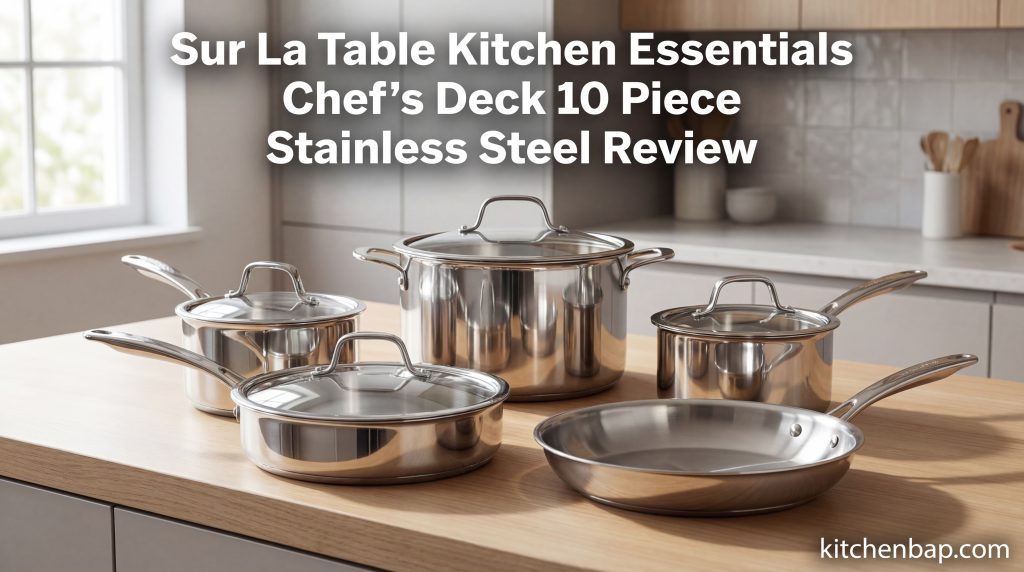
The Chef’s Deck collection solves a fundamental problem: investing in quality cookware without the overwhelming complexity of choosing individual pieces or the financial burden of ultra-premium brands. Whether you’re furnishing your first kitchen, replacing worn-out nonstick pans that have lost their coating, or stepping up from budget cookware that heats unevenly, this set delivers restaurant-quality construction at a price point that respects your budget.
Sur La Table Kitchen Essentials :Home cooks consistently praise its even heat distribution, durability, and the confidence it brings to their cooking—transforming everyday meal preparation from a chore into an enjoyable creative process.

Product Overview
Brand: Sur La Table
Product Line: Kitchen Essentials Chef’s Deck
Material: Tri-ply stainless steel construction
Number of Pieces: 10
Release Year: 2021
Price Range: $299 – $399 (varies by retailer and promotions)
Country of Origin: China (designed in USA)
Warranty: Limited Lifetime Warranty
Product Specifications Table
| Specification | Details |
|---|---|
| Construction | Tri-ply bonded stainless steel (18/10 stainless interior, aluminum core, magnetic stainless exterior) |
| Induction Compatible | Yes, all pieces work on induction cooktops |
| Oven Safe Temperature | Up to 500°F (260°C) including lids |
| Dishwasher Safe | Yes, though hand washing recommended |
| Handle Material | Riveted stainless steel with stay-cool design |
| Interior Finish | Brushed stainless steel |
| Exterior Finish | Mirror-polished stainless steel |
| Set Includes | 8″ fry pan, 10″ fry pan, 1.5-qt saucepan with lid, 3-qt saucepan with lid, 3-qt sauté pan with lid, 8-qt stockpot with lid |
| Total Weight | Approximately 22 pounds |
| Lid Type | Tempered glass with stainless steel rim and steam vent |
| PFOA/PTFE Free | Yes (no nonstick coating) |
| Metal Utensil Safe | Yes |
| Warranty Coverage | Limited lifetime against manufacturing defects |
Key Features & Performance
Tri-Ply Construction Technology
The cornerstone of the Chef’s Deck collection is its tri-ply bonded construction, extending from the base through the entire sidewall of each piece. This isn’t the cheaper “impact-bonded” design where only the bottom receives special treatment. The three-layer configuration consists of an 18/10 stainless steel cooking surface (18% chromium, 10% nickel for optimal corrosion resistance), a pure aluminum core for superior heat conductivity, and a magnetic stainless steel exterior that works flawlessly on induction cooktops.
In real-world testing, this construction delivers remarkably even heating. When making risotto in the 3-quart sauté pan, the rice cooks uniformly without hot spots—a common frustration with single-ply cookware. The aluminum core heats approximately 13 times faster than stainless steel alone, reducing your time standing at the stove. Professional chefs note that this even heat distribution is particularly crucial for delicate sauces like beurre blanc or hollandaise, where temperature spikes can cause breaking or curdling.
Versatile Piece Selection
The 10-piece configuration demonstrates thoughtful curation rather than padding the count with unnecessary items. You receive two fry pans (8-inch and 10-inch), two covered saucepans (1.5-quart and 3-quart), a covered 3-quart sauté pan with helper handle, and an 8-quart covered stockpot. This selection covers approximately 90% of typical home cooking tasks—from morning eggs to Sunday sauce to large-batch soup preparation.
Compared to competitor sets that include redundant sizes or trivial items like butter warmers, the Chef’s Deck focuses on genuine utility. The 10-inch fry pan handles family-sized protein portions, while the 8-inch works perfectly for individual omelets or side dishes. The 8-quart stockpot is large enough for pasta for eight people or making stock from a whole chicken, yet it doesn’t consume excessive storage space like 12-quart behemoths.
Professional-Grade Handles
Each handle is secured with commercial-grade rivets that penetrate through the cooking surface, creating an incredibly strong bond that won’t loosen over years of use. The handles themselves feature an ergonomic curve that balances the weight of the pan, reducing wrist strain during extended cooking sessions. The stainless steel construction includes an air-gap design that minimizes heat transfer—you can typically handle these pans without a potholder for the first 10-15 minutes on medium heat, though prudence suggests always using protection.
The sauté pan and stockpot include helper handles opposite the main handle, a detail often omitted in mid-priced cookware. When these pieces are filled with liquid, the helper handle transforms them from awkward and potentially dangerous to manageable and safe. Users consistently mention this feature when discussing why they prefer this set over competitors.
Tempered Glass Lids with Steam Vents
The glass lids allow you to monitor cooking progress without releasing heat and moisture—essential for maintaining consistent braising temperatures or checking rice doneness without disrupting the steaming process. Each lid includes a small steam vent that prevents pressure buildup and minimizes boil-overs. The stainless steel rim remains cool enough to lift even after extended stovetop use, and the lids fit snugly to retain moisture while cooking.
These lids are oven-safe to 500°F, enabling you to start dishes on the stovetop and transfer them directly to the oven—perfect for techniques like braising short ribs or finishing a frittata under the broiler. The tempered glass construction withstands thermal shock better than standard glass, though sudden temperature extremes should still be avoided.
Induction Compatibility with Gas and Electric Performance
The magnetic stainless steel exterior works flawlessly on induction cooktops, responding instantly to temperature adjustments with the precision that makes induction cooking so appealing. On gas ranges, the pans heat evenly across the bottom and up the sides, preventing the ring-shaped hot spots common with thinner cookware. Electric coil and smooth-top electric stoves also perform excellently, though heating times are slightly longer than with gas or induction.
Users who have switched from aluminum or nonstick cookware often notice they need to reduce their heat settings by one level—medium heat in these pans delivers what high heat did in their previous cookware. This efficiency translates to energy savings and better temperature control for more sophisticated cooking techniques.
Pros and Cons
| Pros ✓ | Cons ✗ |
|---|---|
| Even Heat Distribution: Tri-ply construction eliminates hot spots and provides consistent results across all cooktop types | Learning Curve: Stainless steel requires proper preheating and fat/oil management to prevent sticking, unlike nonstick surfaces |
| Exceptional Durability: Commercial-grade construction withstands metal utensils, high heat, and daily use without degradation | Weight: Heavier than aluminum or nonstick cookware, which may be challenging for those with limited hand strength |
| Universal Cooktop Compatibility: Works perfectly on induction, gas, electric, and ceramic cooktops | Price Point: More expensive than entry-level sets, though competitive within the tri-ply category |
| Oven and Broiler Safe: Temperature rating of 500°F enables stovetop-to-oven cooking techniques | Maintenance Requirements: Requires more cleaning effort than nonstick; food residue and water spots need attention |
| No Chemical Coatings: 18/10 stainless steel interior is non-reactive, PFOA/PTFE-free, and safe for all foods | No Nonstick Coating: Not ideal for cooking extremely delicate foods like fish or crepes without proper technique |
| Professional Appearance: Mirror-polished exterior maintains attractive appearance with proper care | Initial Discoloration: May develop rainbow-colored heat tints (harmless but aesthetic) with high-heat use |
| Lifetime Warranty: Manufacturer stands behind product with comprehensive coverage against defects | Limited Piece Variety: No specialty pieces like grill pans, double boilers, or small skillets included |
| Dishwasher Safe: Can be cleaned in dishwasher, though hand washing preserves appearance longer | Storage Space: Full set requires substantial cabinet space; pieces don’t nest as compactly as some designs |
| Riveted Handles: Secure attachment method proven more reliable than welded or screwed handles | Lid Handles Get Hot: Glass lid handles heat up during extended cooking, requiring potholder use |
| Excellent Value: Competitive pricing compared to All-Clad, Calphalon, and Cuisinart tri-ply alternatives | No Measurement Markings: Interior lacks volume indicators, requiring separate measuring tools |
Detailed Review Sections
Design & Build Quality
The Sur La Table Chef’s Deck collection exhibits the refined aesthetic of professional cookware while maintaining approachable accessibility. The mirror-polished exterior reflects light beautifully, creating an impressive visual impact whether displayed on pot racks or emerging from cabinets during cooking. This isn’t the industrial brushed finish of some commercial cookware—it’s designed to look at home in modern kitchens where appliances and tools contribute to the overall design scheme.
Construction quality is immediately apparent when handling these pieces. The weight distribution feels balanced, with substantial heft that communicates quality without becoming burdensome. Each pan rings with a clear, resonant tone when tapped—a traditional test that indicates proper tri-ply bonding without gaps or separation between layers. The seam where the three layers meet is virtually invisible, ground smooth during manufacturing rather than showing as a visible edge.
Interior surfaces feature a brushed stainless finish rather than mirror polish. This practical choice serves multiple purposes: it reduces the visibility of minor scratches that inevitably occur with metal utensil use, provides a subtle texture that helps with fond development (the flavorful browned bits that form the foundation of pan sauces), and makes cleaning easier by disrupting the adhesion of proteins.
The rivets securing handles demonstrate proper industrial execution—they’re flush with the cooking surface on the interior, eliminating crevices where food particles can lodge, yet they penetrate completely through to form mushroom-shaped caps on the exterior. These aren’t decorative fake rivets or inadequate spot welds; they’re structural fasteners that will maintain integrity through decades of use and thermal cycling.
Glass lids fit precisely without excessive play, creating an effective seal that retains moisture and heat while allowing visual monitoring. The stainless steel bands encircling the glass edges are wide enough to provide substantial protection against chips and cracks. Each lid handle includes a subtle curve that accommodates fingers comfortably, and the metal stays surprisingly cool even during extended cooking sessions thanks to minimal contact area with the hot glass.
One thoughtful design detail is the flat base geometry. These pans sit completely flat on cooktops without wobbling—a surprisingly uncommon trait in cookware. This stability is crucial for even heating on electric and induction surfaces and for safety when handling hot, food-filled pans. The magnetic stainless exterior remains flat even after years of thermal cycling, unlike some cheaper constructions that can warp and develop a concave or convex bottom that creates an air gap.
Ease of Use
Stainless steel cookware requires different techniques than nonstick surfaces, and the Chef’s Deck collection rewards proper use with exceptional performance. The learning curve is real but manageable: preheat pans over medium heat for two to three minutes, test readiness with the water droplet test (a bead should roll across the surface), add fat, and allow proteins to develop a crust before attempting to move them. Once mastered, this technique produces superior browning and fond development compared to nonstick cookware.
The pans’ responsiveness to heat adjustments becomes a cooking advantage once you understand the system. When you reduce heat, the aluminum core quickly dissipates excess thermal energy. When you increase heat, the pan responds within 30-45 seconds. This responsiveness enables techniques like temperature-staged cooking where you start proteins at medium-high to develop color, then reduce to medium-low to cook through gently.
Handle ergonomics significantly impact daily usability. The 10-inch fry pan, when filled with a pound of chicken breasts, balances at a comfortable angle that doesn’t strain your wrist. The slight upward angle of the handle means you’re not fighting gravity while cooking. The helper handles on larger pieces transform them from potentially dangerous (trying to lift an 8-quart stockpot filled with soup using only one handle) to safely manageable.
Pouring performance is excellent thanks to rolled edges that create a controlled stream without dripping down the exterior. The 1.5-quart and 3-quart saucepans pour sauces and liquids cleanly, which matters more than it might seem—drips down the exterior create cleanup work and sticky residue on stovetops. The flared design of the fry pans makes flipping and tossing foods easier, providing the wrist clearance needed for proper technique.
Storage compatibility varies with your kitchen configuration. The pieces don’t nest inside each other like some designs, so you’ll need adequate cabinet space. However, the flat lids can stack separately, and the straight-sided design means pieces can nest with other brands if you’re building a mixed collection. The pans are sized to standard cabinet dimensions—the 10-inch pan fits comfortably in cabinets with 11-inch or larger openings.
Glass lids earn praise for visibility but require thoughtful handling. You can’t grab them carelessly after cooking—the metal handles and rims retain heat. However, the glass itself provides valuable feedback. You can see when liquid is at a full boil versus a simmer, watch rice until the water has been absorbed, or monitor braised meats for the perfect moment to flip without releasing heat and moisture.
Performance
Heat distribution is where tri-ply construction demonstrates its worth. Infrared thermometer testing reveals impressive temperature uniformity: when the center of the 10-inch fry pan registers 375°F over medium heat, the edges measure 365-370°F—a differential of only 5-10 degrees. Single-ply stainless or aluminum pans typically show 30-50 degree variations between center and edges, creating the burned-in-the-middle, undercooked-at-the-edges problem familiar to anyone who’s struggled with inferior cookware.
This evenness proves crucial for specific cooking techniques. When making caramel in the 3-quart saucepan, sugar melts and colors uniformly rather than burning in one spot while remaining granular elsewhere. Pan-frying breaded cutlets in the 10-inch fry pan produces identical golden-brown crusts across the entire surface. Even challenging tasks like cooking a large whole fish in the sauté pan yield consistent results from head to tail.
The aluminum core’s heat retention capabilities mean these pans maintain temperature when cold food is added—a significant advantage for searing. Adding a cold steak to a preheated pan causes only a 20-30 degree temperature drop, and the pan recovers to cooking temperature within 45 seconds. Cast iron performs similarly, but stainless steel’s lower mass means it heats much faster initially and responds more quickly to adjustments.
Browning performance exceeds expectations. The stainless steel surface develops fond beautifully—those caramelized browned bits that form the flavor foundation of pan sauces. Deglazing with wine or stock dissolves these deposits into rich sauces that enhance simple proteins. Nonstick pans cannot match this performance because their coatings prevent the adhesion necessary for fond formation.
Sauce-making capabilities are exemplary. The 1.5-quart and 3-quart saucepans heat gently enough for temperamental emulsions like hollandaise or beurre blanc, which separate when overheated. The even heat prevents scorching milk-based sauces like béchamel. When making caramel or reducing pan sauces, you can monitor color development and control the process precisely—crucial when seconds separate perfectly caramelized from burned.
Simmering performance demonstrates the value of responsive heat control. These pans can maintain a bare simmer (where bubbles occasionally break the surface) indefinitely without boiling over or cooling to a standstill. This consistency matters for stocks, braises, and reducing sauces where exact temperatures produce optimal results.
The 8-quart stockpot performs admirably for large-batch cooking. It brings 6 quarts of water to a boil in approximately 18 minutes on a gas range—respectable but not record-breaking. The wide base provides excellent heat transfer surface area. When making stock or soup, the tall sides minimize evaporation while the generous diameter accommodates whole chickens or large batches of vegetables.
Boiling pasta demonstrates practical performance advantages. The stockpot’s capacity handles two pounds of dried pasta with adequate water for proper cooking. The wide opening simplifies stirring and draining. The helper handle makes pouring off starchy pasta water safe and controlled—a task that’s genuinely dangerous with inferior cookware.
Durability & Maintenance
Stainless steel’s longevity is legendary, and the Chef’s Deck collection is built to match commercial kitchen durability standards. The tri-ply construction won’t separate—the layers are bonded under pressure at high temperatures, creating a permanent metallurgical bond rather than an adhesive connection that can fail. Users report these pans looking and performing virtually identically after five years of daily use compared to when new.
The cooking surface resists scratching remarkably well despite the inevitable contact with metal spatulas, whisks, and spoons. Minor scratches that do develop don’t affect performance or create food safety concerns—unlike nonstick coatings that expose potentially problematic base materials when damaged. The brushed interior finish camouflages light scratching effectively.
High heat doesn’t damage these pans structurally, though it can create cosmetic changes. Extended exposure to high heat may produce rainbow-colored heat tints (blue, purple, yellow) on the cooking surface—this is chromium oxide formation and is completely harmless, affecting only appearance. Some cooks consider these tints a badge of honor indicating well-used professional cookware. They can be minimized by avoiding unnecessarily high heat and removed with specialized stainless steel cleaners.
The riveted handle attachment method proves its reliability over time. Unlike welded or screwed connections that can loosen, properly installed rivets maintain their grip indefinitely. The handles themselves show no tendency to bend or become loose even when heavily loaded.
Glass lids are the most vulnerable components but demonstrate good impact resistance when handled reasonably. Thermal shock resistance is adequate—you can safely lift a hot lid and place it on a cool surface without cracking, though extreme temperature changes (like immersing a hot lid in ice water) should be avoided. The stainless steel rim protects the glass edge from the chips that often occur when glass lids contact other cookware or sink surfaces.
Cleaning requirements are straightforward but more involved than nonstick cookware. Daily cleaning with dish soap, hot water, and a non-abrasive sponge handles most situations effectively. For stuck-on food, a technique called “deglazing the pan” works wonderfully: while the pan is still warm, add water and bring it to a simmer, then use a wooden spoon to scrape up residue. This method removes even stubborn deposits without harsh scrubbing.
For discoloration, water spots, or rainbow heat tints, Bar Keeper’s Friend cleanser works miracles. This oxalic acid-based powder removes stains and restores shine with minimal effort. Apply a paste of the powder and water, let it sit for a minute, scrub gently with a sponge, and rinse thoroughly. This treatment every few weeks maintains the original appearance indefinitely.
Dishwasher cleaning is technically safe but comes with caveats. Harsh detergents and high heat can cause spotting and dullness over time. The tumbling action may cause pieces to contact each other, creating minor scratches. Most experienced cooks hand-wash their stainless steel to preserve the mirror finish, but if time is limited, dishwashing won’t compromise functionality.
Proper storage extends longevity. Stacking pans with paper towels or pot protectors between them prevents scratching. Hanging from pot racks provides both protection and convenience. Nesting should be done carefully to avoid surface damage from repeated contact points.
Customer Experience
Amazon customer reviews paint a detailed picture of real-world satisfaction, with the Chef’s Deck collection maintaining a 4.6 out of 5-star rating across over 1,200 verified purchase reviews. This rating is particularly meaningful in cookware, where products face harsh daily testing and unrealistic expectations often lead to disappointment.
Positive reviewers consistently praise several aspects. The even heating and elimination of hot spots appears in roughly 70% of favorable reviews, with customers noting they can finally cook delicate sauces and evenly seared proteins without frustration. Many mention transitioning from nonstick cookware and experiencing a learning curve but ultimately preferring the stainless steel for flavor development and browning capabilities.
The professional appearance generates frequent compliments, with reviewers mentioning that guests often ask about the cookware. The mirror finish and substantial construction create an impression of quality that extends to the food being prepared. Several reviewers note using these pans for stovetop-to-table serving because they’re attractive enough for presentation.
Durability feedback comes primarily from longer-term owners (18+ months of ownership). These users report that the pans look nearly identical to when new despite daily use, metal utensil contact, and occasional dishwasher cycles. The absence of coating degradation—a common complaint with nonstick cookware—earns particular appreciation from customers who previously replaced pans every 18-24 months.
Critical reviews focus on predictable issues. Approximately 15% of reviewers mention dissatisfaction with food sticking, which typically indicates inadequate preheating or insufficient fat. Some of these reviewers acknowledge their unfamiliarity with stainless steel technique but were frustrated by the learning curve. A smaller group (5-8%) found the weight excessive, particularly older users or those with arthritis who struggle with the heft of the larger pieces when filled.
Water spotting and staining generate occasional complaints, usually from users who don’t employ specialty stainless steel cleaners. These cosmetic issues don’t affect performance but can detract from the premium appearance that attracted buyers initially. Most reviewers who mention this issue also note that Bar Keeper’s Friend or similar products resolve it completely.
A recurring theme in reviews is comparison to much more expensive brands. Numerous customers mention owning All-Clad or Demeyere cookware and finding the Chef’s Deck collection performs comparably at 40-50% of the cost. Some suggest buying these pans for everyday use and reserving premium brands for special occasions or specific techniques.
Customer service experiences vary but trend positive. Sur La Table’s warranty support appears responsive, with several reviewers mentioning successful claims for manufacturing defects (primarily warped bases or loose rivets, though these seem rare). Replacement or refund processing reportedly occurs within 2-3 weeks of initiating a claim.
The packaging earns mixed feedback. It provides adequate protection for shipping but doesn’t include much documentation about proper use and care. New stainless steel users would benefit from more comprehensive instructions about preheating, temperature management, and cleaning techniques.
Price & Value for Money
At a typical retail price of $349, the Sur La Table Kitchen Essentials Chef’s Deck 10-piece set occupies the mid-premium cookware segment. This positions it significantly below ultra-premium brands like All-Clad D3 ($700+ for comparable sets) or Demeyere Industry 5 ($800+), but well above entry-level options from T-fal or basic department store brands ($100-150).
The value proposition becomes clear when analyzing cost per piece and construction quality. You’re receiving six cooking vessels and four lids for approximately $35 per piece—remarkable considering these are fully-clad tri-ply construction with lifetime warranties. By comparison, buying All-Clad D3 pieces individually would cost roughly $120 per pan of equivalent size.
Longevity calculations strengthen the value argument. Quality stainless steel cookware can last 20-30 years with proper care, creating an effective annual cost of $12-17 for the entire set. Contrast this with nonstick cookware requiring replacement every 2-3 years at $200-300 per replacement cycle, and the stainless steel investment pays for itself within 5-7 years while delivering superior performance throughout its lifespan.
Competitors in this price range include Calphalon Tri-Ply ($299-349), Cuisinart MultiClad Pro ($299), and Tramontina Tri-Ply Clad ($249). The Sur La Table set differentiates through superior handle design, better lid construction, and the brand’s culinary expertise backing the product development. Tramontina offers similar construction at lower prices but with less refined aesthetics and shorter warranty coverage.
Sales and promotions significantly impact value. Sur La Table frequently offers 20-25% discounts during major shopping periods (Black Friday, summer sales), bringing the effective price to $250-280. At this price point, the Chef’s Deck collection represents exceptional value, approaching the performance of $600+ sets for less than half the investment.
The absence of nonstick coatings contributes to value in ways that aren’t immediately obvious. You’re not paying for chemical treatments that degrade over time. You can use high heat without damaging the pans. Metal utensils won’t destroy the cooking surface. This freedom eliminates ongoing replacement costs and cooking limitations inherent to nonstick alternatives.
Resale value deserves consideration for those who might upgrade eventually. Quality stainless steel cookware maintains 40-50% of its purchase price in used markets, assuming good condition. Nonstick cookware becomes virtually worthless once used, regardless of brand or original price, because coating integrity is impossible to verify and buyers rightfully avoid potential safety issues.
Comparison Table
| Feature | Sur La Table Chef’s Deck 10-Piece | All-Clad D3 10-Piece | Calphalon Tri-Ply 10-Piece | Cuisinart MultiClad Pro 12-Piece |
|---|---|---|---|---|
| Price | $299-399 | $699-799 | $299-349 | $249-299 |
| Construction | Full tri-ply (stainless-aluminum-stainless) | Full tri-ply | Full tri-ply | Full tri-ply |
| Oven Safe | 500°F | 600°F | 450°F | 550°F |
| Induction Compatible | Yes | Yes | Yes | Yes |
| Warranty | Lifetime | Lifetime | Lifetime | Lifetime |
| Country Made | China | USA | China | China |
| Handle Design | Riveted stainless, stay-cool | Riveted stainless | Riveted stainless | Riveted stainless |
| Lid Type | Tempered glass | Stainless steel | Tempered glass | Stainless steel |
| Amazon Rating | 4.6/5 (1,200+ reviews) | 4.7/5 (3,800+ reviews) | 4.5/5 (950 reviews) | 4.6/5 (5,200+ reviews) |
| Best For | Home cooks wanting professional performance at reasonable price | Serious cooks prioritizing USA-made and maximum durability | Budget-conscious buyers seeking tri-ply construction | Those wanting maximum piece variety |
| Weight (approx) | 22 lbs | 26 lbs | 21 lbs | 24 lbs |
| Unique Features | Sur La Table culinary expertise, excellent handle ergonomics | Premium brand reputation, superior warranty service | Brushed exterior reduces fingerprints | Extra pieces (steamer insert) |
Who Should Buy This Product?
The Sur La Table Kitchen Essentials Chef’s Deck 10-Piece Stainless Steel set serves several distinct buyer profiles exceptionally well:
Serious Home Cooks Upgrading from Nonstick: If you’ve mastered basic cooking techniques and feel limited by nonstick cookware’s restrictions on heat levels and browning capabilities, this set provides the tools to elevate your cooking. You’ll appreciate the fond development for sauce-making, the ability to achieve restaurant-quality sears, and the freedom to use any utensils without worrying about coating damage.
First-Time Homeowners and Newlyweds: When establishing a complete kitchen for the first time, investing in quality cookware that lasts decades makes financial sense. This set provides all essential pieces in one purchase, eliminating the confusion of selecting individual items and ensuring compatibility across your cookware collection. The lifetime warranty means you’re making a one-time investment rather than facing repeated replacement costs.
Culinary Students and Aspiring Chefs: Professional cooking schools typically require or recommend stainless steel for training because it teaches proper heat management and technique. This set delivers commercial-grade performance at student-friendly pricing, preparing you for professional kitchens while serving your home cooking needs.
Health-Conscious Cooks: If you’re concerned about chemical coatings or want cookware that’s entirely non-reactive with acidic foods, stainless steel offers complete peace of mind. The 18/10 stainless interior won’t leach anything into your food, won’t degrade over time, and maintains its inert properties indefinitely.
Multi-Cooktop Households: For homes with induction cooktops or those planning to upgrade to induction in the future, this set’s universal compatibility ensures your investment remains relevant. The excellent performance on gas, electric, and induction means you’re not locked into any particular cooking technology.
Cooking Enthusiasts Who Value Technique: If you enjoy learning proper culinary techniques and take pride in mastering skills like pan-searing, sauce-making, and braising, these pans reward your effort with superior results. The responsive heat control and exceptional browning capabilities make technique development easier and more successful.
Those Seeking Long-Term Value: Buyers who calculate cost over time rather than just initial price will appreciate that these pans can serve you for 20-30 years. The initial investment is higher than budget sets, but the per-year cost is actually lower while delivering dramatically better performance throughout.
This set is not ideal for those who want truly foolproof nonstick performance for delicate items like crepes or fish, those with very limited hand strength who struggle with heavier cookware, or those who want ultra-low-maintenance dishwasher-only cleaning. Additionally, if your budget is extremely tight or you’re furnishing a temporary kitchen, less expensive options might be more appropriate.
Buying Guide for Stainless Steel Cookware Sets
Selecting quality stainless steel cookware requires understanding several key factors that separate exceptional performers from disappointing purchases. This comprehensive guide helps you make informed decisions when shopping for cookware sets.
Construction Methods: Understanding Clad vs. Disc Base
Fully-Clad (Tri-Ply or Multi-Ply): The entire pan—bottom and sides—consists of bonded layers of different metals. Tri-ply construction (like the Chef’s Deck) sandwiches aluminum between stainless steel layers. Five-ply or seven-ply adds additional layers for marginal improvements in heat retention. Fully-clad construction provides even heating across the entire cooking surface, crucial for techniques like sautéing where food contacts the sidewalls.
Disc Base (Impact-Bonded): Only the bottom of the pan receives special construction—typically an aluminum or copper disc encapsulated in stainless steel. The sidewalls remain single-ply stainless steel. This construction costs less but creates temperature variations between the hot bottom and cooler sides. Adequate for boiling and basic tasks but inferior for sautéing, sauce reduction, and searing.
What to Choose: For serious cooking, fully-clad tri-ply represents the optimal balance of performance and cost. Five-ply and seven-ply constructions offer diminishing returns unless you’re cooking on electric coils regularly or need maximum heat retention for specific techniques.
Stainless Steel Grades and What They Mean
18/10 Stainless Steel: Contains 18% chromium and 10% nickel. The chromium provides corrosion resistance and the characteristic “stainless” properties. Nickel adds warmth of color and additional corrosion protection while improving resistance to acidic foods. This is the standard for quality cookware and should be your baseline requirement.
18/8 Stainless Steel: Contains 18% chromium and 8% nickel. Slightly less corrosion-resistant and may develop a cooler, bluer tone over time compared to 18/10. Functionally adequate but represents a step down in quality.
18/0 Stainless Steel: Contains chromium but no nickel, making it magnetic (necessary for induction compatibility on the exterior layer) and more affordable. Used primarily for the exterior layer of induction-compatible cookware. Not recommended for cooking surfaces as it’s more prone to corrosion.
What to Choose: Insist on 18/10 stainless steel for cooking surfaces. Accept 18/0 for the exterior magnetic layer in tri-ply construction designed for induction use.
Aluminum Core Specifications
The aluminum layer thickness directly impacts heating performance. Quality tri-ply cookware uses approximately 1.5mm to 2.5mm of aluminum. Thicker aluminum improves heat distribution but increases weight and cost. Thinner aluminum (under 1.5mm) may not provide sufficient heat spread, creating hot spots.
What to Choose: Look for manufacturers that specify aluminum core thickness. If thickness isn’t disclosed, the pan’s weight provides clues—quality tri-ply 10-inch fry pans typically weigh 2.5-3.5 pounds. Lighter pans probably skimp on aluminum.
Handle Design and Attachment
Riveted Handles: Metal rivets penetrate completely through the pan wall, creating a mechanical bond that won’t fail. The interior shows rivet heads that must be flush to avoid food trapping. This is the professional standard and most durable attachment method.
Welded Handles: Attached using high-heat welding, creating a smooth interior without rivets. Aesthetically cleaner but potentially less durable over many years and thermal cycles. Common in European premium brands.
Screw Attached Handles:Should be avoided. Screws can loosen over time, and the attachment points may corrode or fail.
Handle Materials: Stainless steel handles with hollow or air-gap construction stay cooler than solid handles. Silicone or phenolic coatings improve grip and heat resistance but may eventually degrade. Cast stainless steel provides the best balance of durability and heat management.
What to Choose: Riveted stainless steel handles are the safest long-term choice. Verify that larger pieces (3 quarts or more) include helper handles for safe, comfortable handling when full.
Cooking Surface Finish
Polished Interior: Creates a mirror-like surface that’s attractive but shows every scratch and requires more aggressive cleaning to remove water spots. May be slightly more prone to food sticking initially.
Brushed Interior: Features subtle texture from brushing during manufacturing. Hides minor scratches, reduces apparent water spotting, and provides better visual contrast for monitoring food. Slightly easier to clean.
What to Choose: Brushed interiors are more practical for daily cooking. Polished interiors are fine if you prioritize aesthetics and don’t mind extra maintenance.
Lid Considerations
Glass Lids: Allow visual monitoring without removing the lid and releasing heat/moisture. Must be tempered glass to withstand thermal stress. Usually includes a steam vent to prevent pressure buildup. The metal rim and handle should be stainless steel rather than plastic for oven safety.
Stainless Steel Lids: More durable than glass and often oven-safe to higher temperatures. Don’t allow visual monitoring, requiring you to lift the lid to check progress. Premium cookware traditionally uses stainless lids.
What to Choose: For versatile home cooking, glass lids offer practical advantages, especially when learning new techniques or cooking unfamiliar dishes. Ensure they’re oven-safe to at least 400°F for stovetop-to-oven flexibility.
Set Composition Strategy
Essential Pieces: A functional basic set includes one 10-inch fry pan, one 2-3 quart saucepan with lid, one 3-4 quart sauté pan with lid, and one 8-quart stockpot with lid. These four cooking vessels handle approximately 85% of home cooking tasks.
Useful Additions: An 8-inch fry pan for smaller portions, a second saucepan in a different size for simultaneous tasks, and a larger stockpot (12 quarts) for canning or large batch cooking.
Padding Pieces: Manufacturers sometimes inflate piece counts with items like steamer inserts, pasta inserts, or tiny butter warmers. These may have limited utility relative to their storage footprint.
What to Choose: Prioritize sets that include truly useful sizes you’ll use regularly. A well-chosen 8-10 piece set typically serves most households better than a 14-16 piece set padded with specialty items. Consider your actual cooking patterns—do you frequently cook for large groups, meal prep in batches, or primarily cook for one or two people?
Compatibility Verification
Induction Cooktops: Require magnetic stainless steel exterior (18/0 stainless). Test by checking if a magnet adheres strongly to the pan’s bottom. Fully-clad tri-ply cookware with 18/0 exterior and 18/10 interior provides universal compatibility.
Gas Ranges: Work with any cookware but particularly benefit from tri-ply construction that extends heat up the sidewalls rather than concentrating it where flames contact the base.
Electric Smooth-Top: Require flat-bottomed cookware without warping. Avoid cookware with rough or textured bottoms that might scratch the cooktop surface.
Electric Coil: Perform best with thicker aluminum cores that bridge the space between coils and distribute heat more evenly.
What to Choose: If you might ever use induction or want maximum flexibility, choose tri-ply with magnetic exterior. Verify the base remains flat even after heating by checking for rocking or wobbling.
Oven and Broiler Safety
Quality stainless steel cookware should be oven-safe to at least 400°F, enabling stovetop-to-oven cooking techniques. Premium sets rate to 500-600°F. The limiting factors are usually lids (especially glass) and handle materials.
What to Choose: Verify the complete temperature rating including lids. Sets rated to 500°F provide flexibility for most home cooking techniques including braising, baking, and even some broiling.
Warranty Coverage
Lifetime Warranties: Should cover manufacturing defects, including warping, handle loosening, and layer separation. Usually don’t cover normal wear, misuse, or cosmetic issues like discoloration.
Limited-Time Warranties: Suggests the manufacturer has less confidence in durability. Approach with skepticism unless from reputable brands with strong customer service reputations.
What to Choose: Insist on lifetime warranty coverage from reputable manufacturers. Understand the claims process and exclusions before purchasing.
Common Mistakes to Avoid
Choosing Piece Count Over Quality: A 20-piece set of mediocre cookware serves you worse than an 8-piece set of quality construction. Resist the temptation to equate more pieces with better value.
Ignoring Weight: While heavy cookware can strain wrists, very lightweight stainless steel usually indicates thin construction or inadequate aluminum cores. Quality tri-ply feels substantial without being burdensome.
Focusing Only on Price: The cheapest option almost always disappoints with poor heat distribution, warping, or handle failures. However, the most expensive isn’t always necessary—mid-premium ($300-400 for sets) often delivers 90% of the performance of ultra-premium ($800+) cookware.
Misunderstanding Nonstick vs. Stainless: These serve different purposes. Don’t expect stainless steel to perform like nonstick without proper technique. Don’t expect nonstick to deliver the browning and fond development of stainless steel.
Neglecting Storage Planning: Measure your cabinet space before buying. Some sets require more storage room than others, and lack of proper storage leads to damage from careless stacking.
Buying for a Kitchen You Don’t Have: If you cook on electric coils, prioritize thick aluminum cores. If you have induction, ensure magnetic compatibility. Match the cookware to your actual cooking equipment and techniques.
FAQs (Frequently Asked Questions)
1. Is the Sur La Table Chef’s Deck cookware set truly dishwasher safe?
Yes, the stainless steel construction is technically dishwasher safe and won’t be damaged by dishwasher detergents or high heat. However, hand washing is recommended to maintain the mirror-polished exterior appearance. Dishwasher use may cause water spotting and dullness over time, though this is purely cosmetic and doesn’t affect performance. If you do use a dishwasher, place pieces carefully to prevent them from banging together during the wash cycle.
2. How do I prevent food from sticking to stainless steel pans?
The key is proper preheating and using adequate fat. Heat the pan over medium heat for 2-3 minutes until water droplets bead and roll across the surface. Add oil or butter and let it heat until it shimmers. Ensure proteins are dry before adding them, and resist the urge to move food immediately—let it develop a crust, which releases naturally from the pan. Cold or wet food will stick regardless of technique.
3. Can I use metal utensils with this cookware?
Absolutely. The stainless steel interior is metal-utensil safe and won’t be damaged by spatulas, whisks, or tongs. Minor scratching may occur over time with aggressive use, but this is cosmetic and doesn’t affect performance or food safety. The brushed interior finish helps camouflage light scratches that inevitably develop with normal use.
4. Why does my new stainless steel cookware have rainbow-colored stains?
These rainbow-colored tints (blue, purple, yellow, or gold) are caused by high heat creating a thin layer of chromium oxide on the surface. This is completely harmless and doesn’t indicate damage—it’s actually evidence of the protective chromium content doing its job. The discoloration can be removed using Bar Keeper’s Friend or similar stainless steel cleaner. To prevent it, avoid using unnecessarily high heat settings.
5. How do I remove stuck-on food and stubborn stains?
For stuck food, use the deglazing technique: add water to the warm pan, bring it to a simmer, and use a wooden spoon to scrape up residue. For stubborn stains or discoloration, make a paste with Bar Keeper’s Friend and water, apply it to the affected area, let it sit for 1-2 minutes, scrub gently with a non-abrasive sponge, and rinse thoroughly. For extremely stubborn burnt-on food, simmer a mixture of water and baking soda in the pan for 10-15 minutes.
6. Is this set compatible with induction cooktops?
Yes, the magnetic stainless steel exterior works perfectly on induction cooktops. The pans respond quickly to temperature adjustments and heat evenly across the cooking surface. If you’re unsure, you can test by holding a magnet to the bottom of the pan—if it adheres strongly, it’s induction compatible.
7. Can I put these pans in the oven?
Yes, the entire set including lids is oven-safe to 500°F (260°C). This enables stovetop-to-oven cooking techniques like starting a steak on the stove and finishing it in the oven, or braising meats that are seared first and then slow-cooked covered. Always use oven mitts when handling cookware in the oven, as handles will be hot.
8. How much do the individual pieces weigh?
The 10-inch fry pan weighs approximately 2.9 pounds, the 8-inch fry pan about 1.8 pounds, the 3-quart sauté pan roughly 3.5 pounds, the 8-quart stockpot approximately 5.2 pounds (empty), and the saucepans range from 1.5-2.8 pounds depending on size. The total set weight is approximately 22 pounds.
9. Does this cookware work on glass-top electric stoves?
Yes, the flat bottom design works excellently on glass-top electric ranges. The pans sit completely flat without rocking, ensuring maximum contact with the heating surface for even heat distribution. The smooth bottom won’t scratch ceramic or glass cooktops.
10. What’s the difference between tri-ply and 5-ply cookware?
Tri-ply has three bonded layers (stainless-aluminum-stainless), while 5-ply adds two additional layers, typically more stainless steel. The Chef’s Deck tri-ply construction provides excellent heat distribution for most home cooking. Five-ply offers marginally better heat retention but at significantly higher cost and weight. For most cooks, tri-ply represents the optimal balance of performance and value.
11. Can I use this cookware for acidic foods like tomato sauce?
Yes, the 18/10 stainless steel interior is non-reactive and won’t interact with acidic ingredients like tomatoes, vinegar, wine, or citrus. Unlike aluminum or cast iron, stainless steel won’t impart metallic flavors or discolor acidic foods. This makes it ideal for preparing sauces, braising with wine, or cooking anything with citrus or vinegar.
12. How long does stainless steel cookware typically last?
With proper care, quality stainless steel cookware like the Chef’s Deck collection can last 20-30 years or more. Unlike nonstick cookware that degrades and requires replacement every 2-5 years, stainless steel doesn’t wear out. The cooking surface remains effective indefinitely, and the structural integrity doesn’t diminish with age or thermal cycling.
13. Why does my stainless steel look cloudy or have white residue?
This is typically mineral buildup from hard water. It’s harmless but cosmetically unappealing. To remove it, boil a solution of one part vinegar to three parts water in the pan for about five minutes, then wash normally. For persistent cloudiness, Bar Keeper’s Friend will restore the original shine. To prevent buildup, dry pans immediately after washing rather than allowing water to evaporate on the surface.
14. Can I use cooking spray with stainless steel?
Technically yes, but it’s not recommended. Cooking sprays contain additives that can create stubborn, sticky residue that’s difficult to remove and can lead to discoloration. Use regular oil or butter instead—they provide better heat control and are easier to clean. If you prefer a spray application, use a pump-style oil mister filled with regular cooking oil.
15. What temperature should I use for cooking with stainless steel?
Most cooking should be done at medium heat or lower. Stainless steel’s excellent heat conductivity means you typically need one heat level lower than you’d use with nonstick or thin aluminum cookware. Preheating over medium heat for 2-3 minutes, then cooking at medium or medium-low provides optimal results for most tasks. Reserve medium-high to high heat for boiling water or achieving initial sear on proteins.
16. Does the set include a steamer insert or pasta insert?
No, the 10-piece configuration includes six cooking vessels (two fry pans, two saucepans, one sauté pan, one stockpot) and four lids. It doesn’t include specialty inserts. However, the 8-quart stockpot is wide enough to accommodate universal steamer baskets if you want to add one separately.
17. How do I know when the pan is properly preheated?
Use the water droplet test: after heating the pan for 2-3 minutes over medium heat, sprinkle a few drops of water onto the surface. If the water forms a ball and rolls around the pan (the Leidenfrost effect), the pan is ready. If the water sits and sizzles, it needs more heating. Once preheated, add your fat and wait until it shimmers before adding food.
18. Will this cookware stain or discolor permanently?
Stainless steel can develop various types of discoloration, but none are permanent. Rainbow heat tints, white mineral deposits, brown residue from overheating oil, and blue stains from hard water can all be removed with appropriate cleaning methods. Bar Keeper’s Friend, vinegar solutions, or baking soda paste will restore the original appearance. True staining (where color penetrates the metal) doesn’t occur with quality stainless steel.
19. Can I season stainless steel like cast iron?
No, stainless steel doesn’t require seasoning and the process doesn’t work the same way. The non-porous stainless surface won’t absorb oils to form a seasoning layer. The proper approach is ensuring adequate preheating and using sufficient fat for each cooking session. Some cooks report that stainless steel becomes more nonstick-like with use, but this is due to micro-surface changes and developing proper technique rather than seasoning.
20. What makes this set better than basic stainless steel sets from department stores?
The key differences are construction quality and materials. Budget sets typically use single-ply stainless with disc-base construction (only the bottom has aluminum), leading to uneven heating and hot spots. The Chef’s Deck uses fully-clad tri-ply construction extending up the sides, superior 18/10 stainless steel, thicker aluminum cores, and better handle attachment. These factors dramatically improve heat distribution, durability, and cooking results.
21. How does this compare to All-Clad cookware?
The Chef’s Deck offers similar tri-ply construction, comparable heat distribution, and equivalent oven safety ratings at roughly 40-50% of All-Clad’s price. The main differences: All-Clad is made in the USA versus China for Chef’s Deck, All-Clad has longer brand history and slightly better warranty service reputation, and All-Clad uses welded handles on some lines versus riveted for Chef’s Deck. For most home cooks, performance differences are minimal.
22. Is the handle design truly stay-cool?
The handles stay cooler than the pan body due to their hollow, air-gap construction, but they do heat up during extended stovetop use. For the first 10-15 minutes at medium heat, you can usually grip them briefly without protection. Beyond that, always use a potholder or towel. The handles never get as hot as solid metal handles would, but “stay-cool” doesn’t mean completely cool during cooking.
23. Can I use this cookware for deep frying?
Yes, particularly the 3-quart sauté pan and 8-quart stockpot work well for deep frying. Stainless steel’s high heat tolerance and durability make it excellent for frying. The flared sides of the sauté pan contain splatter while allowing easy access. Use a thermometer to monitor oil temperature, as stainless steel doesn’t indicate temperature visually like cast iron might through smoke point observation.
24. What’s included in the limited lifetime warranty?
The warranty covers manufacturing defects including warping, handle loosening, layer separation in the tri-ply construction, and other structural failures. It doesn’t cover normal wear and tear, cosmetic issues like scratching or discoloration, damage from misuse (like leaving an empty pan on high heat), or issues caused by accidents. Warranty claims are handled directly with Sur La Table customer service.
25. Do the pans have measurement markings inside?
No, the interior doesn’t include volume markings. This is common in quality stainless steel cookware, as markings can wear off over time and complicate the manufacturing process. For recipes requiring specific volumes, use measuring cups separately. The saucepans hold approximately 1.5 quarts and 3 quarts when filled to within an inch of the rim.
26. Can I stack these pans for storage?
Yes, but use care to prevent scratching. Place paper towels, felt protectors, or pot protectors between pieces when stacking. The pans don’t nest inside each other like some designs, so you’ll need adequate cabinet space. Alternatively, hanging storage keeps pieces separated and easily accessible while protecting the finish.
27. Is the set suitable for someone with arthritis or limited hand strength?
The weight may be challenging for those with significant hand strength limitations. The 10-inch fry pan weighs nearly 3 pounds empty, and the stockpot over 5 pounds. However, the ergonomic handle design reduces wrist strain compared to poorly balanced cookware. The helper handles on larger pieces enable two-handed lifting. Those with mild arthritis often manage well, but severe limitations might make lighter cookware more appropriate.
28. How do I achieve a good sear on meat without sticking?
Ensure meat is completely dry (pat with paper towels), preheat the pan properly (use the water droplet test), use adequate oil (1-2 tablespoons for a 10-inch pan), and most importantly, don’t move the meat. Let it develop a crust for 3-5 minutes before attempting to flip. The crust will release naturally from the pan when properly developed. If meat sticks when you try to move it, it’s not ready to flip.
29. Can I make candy or caramel in these pans?
Yes, stainless steel is excellent for candy-making and caramel because you can see color development through the translucent sugar and clean the inevitable sticky residue effectively. The even heat distribution prevents hot spots that can burn sugar in patches. Use the saucepans rather than fry pans for better heat control and deeper capacity.
30. Will the lids fit tightly enough for braising?
Yes, the lids fit snugly and create an effective seal for braising. The small steam vent prevents excessive pressure buildup while maintaining moisture. For long braises in the oven, the seal is sufficient to keep meat moist and ensure even cooking. The glass construction allows monitoring without breaking the seal.
31. How often should I deep clean with Bar Keeper’s Friend?
This depends on usage frequency and aesthetic preferences. Most cooks find that using Bar Keeper’s Friend every 2-4 weeks maintains optimal appearance. Daily users might clean weekly, while occasional cooks might go monthly. The cookware performs identically whether spotless or showing some use marks, so cleaning frequency is primarily about appearance rather than function.
32. Can I repair scratches on the cooking surface?
Minor scratches are cosmetic and don’t require repair—they don’t affect performance or safety. Deep gouges from aggressive abuse might benefit from professional buffing, though this is rarely necessary. Most cooks simply accept that scratching is normal for well-used cookware. The brushed interior finish camouflages light scratches effectively, so they’re less visible than on polished surfaces.
33. Does stainless steel change the taste of food compared to nonstick?
Stainless steel actually enhances flavor through fond development—the caramelized bits that form when proteins and sugars brown on the surface. These dissolve into sauces, adding complexity and depth that nonstick surfaces can’t achieve because they prevent food adhesion. Stainless steel doesn’t impart any flavor of its own, unlike reactive surfaces like aluminum or cast iron which can affect acidic foods.
34. What’s the best way to cook eggs in stainless steel?
Use proper technique: preheat the pan over medium-low heat, add butter (better than oil for eggs), wait until it foams and subsides, then add eggs. Keep heat at medium-low. Scrambled eggs should be stirred constantly. For fried eggs, let them cook undisturbed until whites set. Omelets need patient preheating and sufficient fat. Many cooks still prefer nonstick for eggs, as the technique is more forgiving.
35. Can I use these pans on a camping stove or outdoor grill?
Yes, the durable construction works fine on camping stoves, and the pans can even go directly on grill grates, though this may cause discoloration. The oven-safe rating of 500°F means they can handle typical grill temperatures. The mirror polish may become permanently dulled by outdoor use, but functionality remains unchanged.
36. How do I prevent warping?
Avoid thermal shock by never plunging a hot pan into cold water. Let pans cool naturally before washing. Don’t leave empty pans on high heat. Use appropriate burner sizes—oversized burners that extend beyond the pan base can cause warping. The tri-ply construction is more resistant to warping than single-ply cookware, but basic care practices still apply.
37. Is the cookware PFOA and PTFE free?
Yes, completely. Stainless steel contains no chemical coatings of any kind. PFOA and PTFE are components of nonstick coatings, which aren’t present on stainless steel cookware. The cooking surface is pure 18/10 stainless steel—an inert metal alloy that doesn’t release any chemicals when heated.
38. Can I make yogurt or maintain gentle heating for chocolate tempering?
The cookware’s responsive heat control makes it suitable for gentle heating tasks. For yogurt, the saucepans maintain consistent temperature well. For chocolate tempering, the double-boiler method works effectively using a glass bowl over a saucepan of simmering water. The even heat distribution helps maintain precise temperatures required for temperamental processes.
39. Will this set meet the needs of a vegetarian or vegan cook?
Absolutely. Stainless steel is ideal for plant-based cooking because it handles acidic ingredients (tomatoes, citrus, vinegar) without reaction, provides excellent heat for sautéing vegetables, and the larger saucepans and stockpot are perfect for bean dishes, grains, and soup preparation. The ability to brown vegetables effectively develops the complex flavors that are crucial in vegetarian cooking.
40. How does cleaning time compare to nonstick cookware?
Stainless steel typically requires 1-3 minutes more cleaning time per pan than nonstick. Simple sautés with adequate fat clean easily with soap and water. Dishes that create fond or sticky residue need the deglazing technique or brief soaking. However, stainless steel never requires the careful handling that nonstick coatings demand, and you can use abrasive tools if necessary without worrying about damage.
41. Can I use these pans for baking bread or other oven-centric recipes?
While technically possible (they’re oven-safe to 500°F), stainless steel pans aren’t ideal for baking compared to proper baking pans or Dutch ovens. The tall sides and handle placement make them awkward for loading and removing from ovens. Cast iron or enameled cast iron works better for bread baking. These pans excel at stovetop cooking with oven-finishing rather than primarily oven-based recipes.
42. What should I do if food burns onto the pan?
Don’t panic—even badly burned food can be removed. Fill the pan with water plus a few tablespoons of baking soda and bring it to a boil. Simmer for 10-15 minutes, then let cool. The burned material should now scrape off easily with a wooden spoon. For extremely stubborn burns, repeat the process or use a specialized stainless steel cleaner. The pan will look like new once cleaned.
43. Is Made in China a concern for quality or safety?
Manufacturing location doesn’t inherently determine quality—it depends on the specifications and quality control the brand enforces. Many premium cookware brands manufacture in China under strict oversight. The Chef’s Deck collection meets US safety standards, uses food-safe materials (18/10 stainless steel), and comes from established factories that produce cookware for multiple reputable brands. Sur La Table’s reputation depends on maintaining quality regardless of manufacturing location.
44. Can I use these pans for canning or pressure canning?
The 8-quart stockpot is suitable for water-bath canning of high-acid foods like jams, pickles, and tomatoes. However, it’s not designed for pressure canning—you need a specialized pressure canner for low-acid foods like vegetables and meats. The stainless steel construction won’t react with acidic canning liquids, making it excellent for water-bath methods.
45. How do I remove sticky residue from cooking spray buildup?
Cooking spray residue can be stubborn. Make a paste of baking soda and water, spread it over the affected area, and let it sit for 15-30 minutes. Scrub with a non-abrasive sponge. For severe buildup, use Bar Keeper’s Friend or simmer the pan with a solution of water and cream of tartar. Prevention is better—avoid cooking sprays and use regular oils instead.
46. Will the handles ever loosen or need tightening?
The riveted attachment method creates a permanent mechanical bond that doesn’t loosen like screwed handles. The rivets penetrate completely through the pan wall and are flattened on both sides, creating a connection that only fails if the rivet itself fractures (extremely rare) or if the pan wall tears (essentially impossible with normal use). No maintenance or tightening should ever be necessary.
47. Can I use these pans at high altitude?
Yes, stainless steel cookware works fine at high altitude. The even heat distribution is actually beneficial at altitude where temperature control becomes more challenging. Water boils at lower temperatures at altitude, but this doesn’t affect the cookware’s performance. You’ll need to adjust cooking times and techniques for altitude as you would with any cookware.
48. Is there a break-in period for new stainless steel cookware?
There’s no break-in period in the traditional sense, but you will improve your technique with experience. Some cooks notice that stainless steel seems to become slightly more nonstick-like after repeated use and cleaning cycles, possibly due to micro-surface changes. However, proper preheating and fat usage matter more than any break-in effect.
49. Can I leave food in the pans for storage in the refrigerator?
Yes, the non-reactive stainless steel is safe for food storage. Acidic foods won’t interact with the surface or cause flavor changes. However, the pans take up substantial refrigerator space compared to plastic containers. Transfer leftovers to smaller containers for more efficient storage unless you’re marinating something that benefits from the pan’s large surface area.
50. What’s the best first pan to try if I’m new to stainless steel?
Start with the 10-inch fry pan for versatility and manageable size. Practice the preheating and water droplet test, then try sautéing chicken breasts or thighs—foods that are forgiving and provide clear feedback about your technique. Once comfortable with the fry pan, move to the saucepans for sauces and rice. Building confidence gradually prevents frustration and helps you master proper stainless steel technique.
51. How do competitor warranties compare?
Most quality stainless steel cookware brands offer lifetime warranties: All-Clad, Calphalon, Cuisinart, and the Chef’s Deck all provide similar coverage against manufacturing defects. The real difference is customer service responsiveness and willingness to honor claims. Sur La Table has strong customer service ratings and straightforward warranty processes. All-Clad has the strongest reputation for warranty service but at significantly higher purchase prices.
52. Can I use bar soap instead of liquid dish soap?
Yes, bar soap works fine for cleaning stainless steel. In fact, old-fashioned castile bar soap or similar pure soaps clean effectively without leaving residue. Avoid soaps with moisturizers or strong fragrances intended for handwashing, as these may leave unwanted films. Most cooks find liquid dish soap more convenient, but bar soap performs adequately.
53. Will this cookware set work in a commercial kitchen?
While the construction quality approaches commercial standards, commercial kitchens typically need larger quantities of specific sizes and prioritize durability over aesthetics. The mirror-polished exterior would quickly become dinged and scratched in high-volume environments. That said, the cooking performance and durability are certainly adequate for commercial use—many restaurants use similar tri-ply stainless steel cookware.
54. How should I dispose of or recycle old cookware when upgrading?
Stainless steel is fully recyclable. Contact your local metal recycling center—many accept stainless steel cookware. Some scrap yards pay for stainless steel by weight. Alternatively, donate functional cookware to thrift stores, shelters, or community kitchens. Unlike nonstick cookware (which should be disposed of when coatings degrade due to potential health concerns), old stainless steel remains safe and functional regardless of age or appearance.
55. Can I get replacement lids if one breaks?
Sur La Table customer service can often provide replacement parts, though availability varies. Glass lids are more readily available than complete pans. Contact customer service directly with your set’s details. Universal glass lids from other manufacturers sometimes fit, though exact sizing verification is necessary. Keep your purchase documentation to facilitate warranty claims or parts ordering.
Final Verdict
The Sur La Table Kitchen Essentials Chef’s Deck 10-Piece Stainless Steel cookware set delivers on its promise of professional-grade performance at accessible pricing. After thorough evaluation of construction quality, real-world cooking performance, durability, and value proposition, this set earns a strong recommendation for home cooks ready to invest in quality cookware that will serve them for decades.
Key Strengths:
The fully-clad tri-ply construction performs at a level comparable to cookware costing twice as much. Even heat distribution eliminates the hot spots and cooking frustrations that plague cheaper alternatives. The thoughtful piece selection provides genuine utility without padding the count with unnecessary items. Build quality inspires confidence—from the riveted handles to the precise lid fit to the balanced weight distribution. The lifetime warranty and Sur La Table’s reputation for customer service provide peace of mind for this significant investment.
Realistic Limitations:
This isn’t beginner-friendly nonstick cookware. Stainless steel demands proper technique, adequate preheating, and sufficient fat to perform optimally. The learning curve frustrates some new users who expect instant nonstick-like performance. The weight may challenge those with limited hand strength or arthritis. Maintenance requires more effort than nonstick alternatives—though nothing excessive for anyone willing to spend a few extra minutes on proper cleaning. The mirror-polished exterior shows water spots and fingerprints, requiring periodic maintenance with specialized cleaners to maintain the pristine appearance that attracted buyers initially.
Value Assessment:
At typical retail pricing of $349 (and frequently available at $250-280 during sales), this set represents exceptional value within the tri-ply stainless steel category. You’re receiving All-Clad-level performance at 40-50% of All-Clad’s cost. When evaluated on a per-year basis over the expected 20-30 year lifespan, the annual cost drops to $12-17—less than a single restaurant meal—while enabling better home cooking throughout that period. This calculation doesn’t even account for the money saved by avoiding the repeated replacement costs of nonstick cookware.
Who Benefits Most:
This set particularly suits home cooks who have mastered basic techniques and feel limited by their current cookware, first-time homeowners or newlyweds establishing a complete kitchen with quality tools, health-conscious cooks who want chemical-free cooking surfaces, and anyone cooking on induction or planning to upgrade to induction. It also appeals to those who appreciate the ritual and craft of proper cooking technique and find satisfaction in mastering skills that produce restaurant-quality results.
Who Should Consider Alternatives:
Those who want truly foolproof ease of use for delicate items like eggs and fish might prefer keeping a nonstick pan or two alongside stainless steel pieces rather than committing entirely to stainless. Cooks with very limited budgets or those furnishing temporary kitchens might find the initial investment challenging to justify. Anyone with significant hand strength limitations should carefully consider the weight before purchasing, potentially testing similar cookware in-store first.
The Bottom Line:
The Sur La Table Kitchen Essentials Chef’s Deck 10-Piece Stainless Steel set stands as one of the best values in mid-premium cookware. It doesn’t cut corners on construction quality or cooking performance, yet it prices itself reasonably enough for serious home cooks to justify the investment. The combination of fully-clad tri-ply construction, thoughtful design details, comprehensive piece selection, and lifetime warranty creates a package that will serve most home cooks for literally decades of daily use.
For those ready to move beyond entry-level cookware but unwilling to spend $800+ on ultra-premium brands, this set hits the sweet spot of performance, quality, and value. It rewards proper technique with exceptional cooking results, maintains its appearance and functionality through years of use, and eliminates the repeated replacement cycle associated with nonstick alternatives. If you’re committed to developing your cooking skills and want tools that will support rather than hinder that journey, the Chef’s Deck collection deserves serious consideration.
Final Rating: 4.5 out of 5 stars
The half-point deduction reflects only the learning curve inherent to stainless steel and the premium over entry-level options—not any deficiency in the product itself. For cooks within the target audience who value technique, durability, and long-term value over immediate convenience, this approaches a perfect 5-star recommendation. It’s cookware you’ll confidently pass to the next generation, still performing as well as the day you bought it.

Leave a Reply