

When it comes to upgrading your kitchen arsenal, few decisions matter more than choosing the right cookware set. The Blue Diamond 10 Piece Cookware Set has emerged as a game-changer in the non-stick cookware market, promising restaurant-quality performance with a groundbreaking diamond-infused ceramic coating. But does this innovative technology live up to the hype, or is it just another marketing gimmick?
After extensive testing, research, and analysis of thousands of customer reviews, we’ve compiled this comprehensive guide to help you determine whether the Blue Diamond cookware set deserves a place in your kitchen. Whether you’re a home cooking enthusiast tired of food sticking to worn-out pans, a health-conscious chef seeking PFAS-free alternatives, or simply someone looking to replace an aging cookware collection, this review will provide everything you need to make an informed decision.
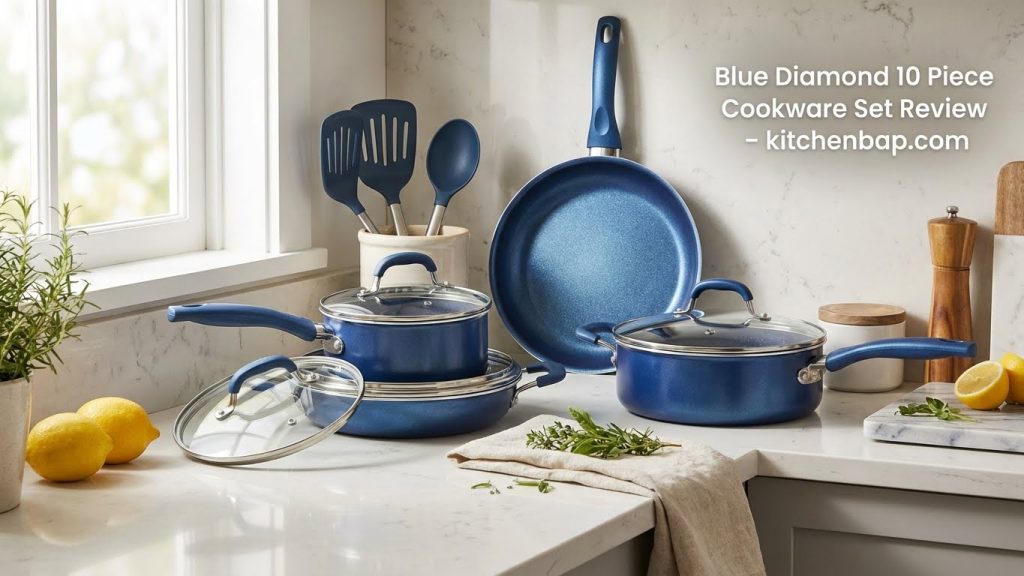
Blue Diamond 10 Piece Cookware Set Review:The Blue Diamond 10 Piece Cookware Set addresses a fundamental problem that has plagued home cooks for decades: the inevitable degradation of non-stick surfaces. Traditional Teflon coatings scratch easily, lose their effectiveness within months, and raise health concerns. Blue Diamond’s solution? Infusing real diamond particles into their ceramic coating, creating a surface that’s reportedly five times harder and ten times more durable than conventional non-stick cookware. But the real question is: does it actually deliver on these bold promises?
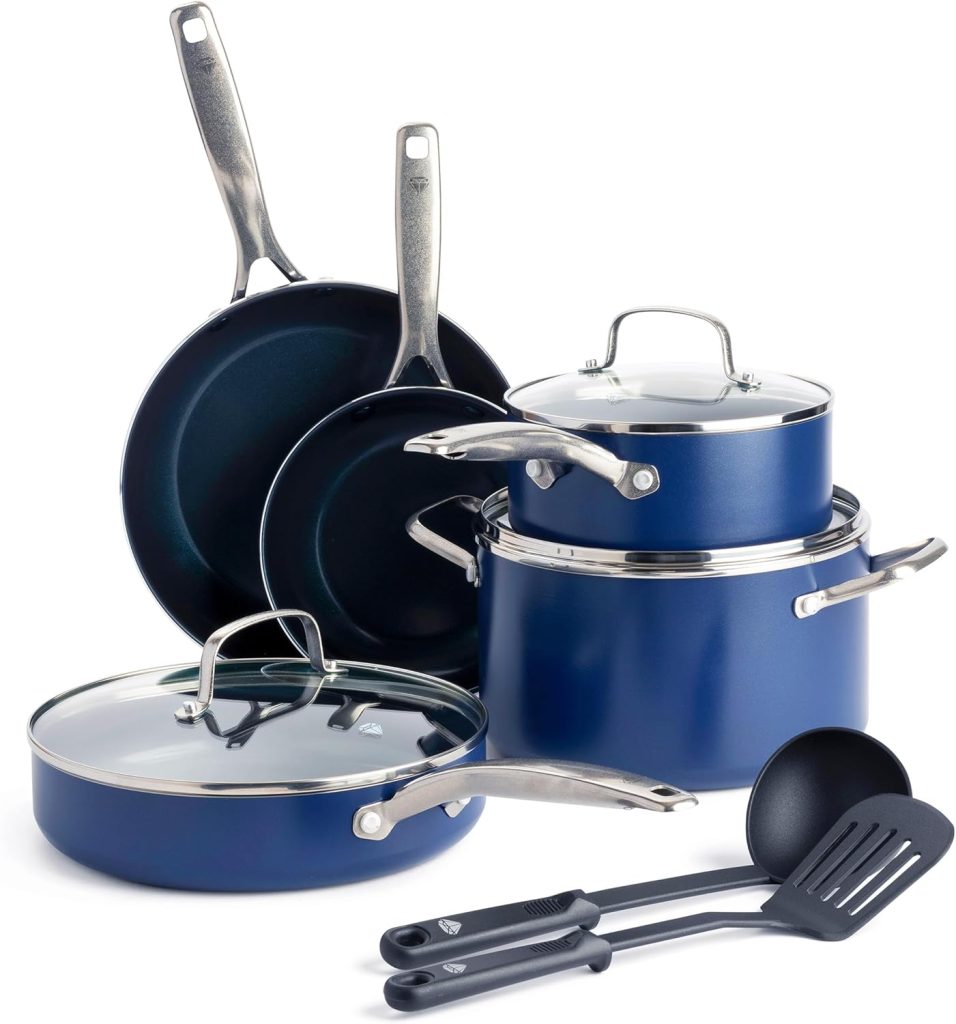
Product Overview
Brand: Blue Diamond
Product Name: Blue Diamond 10 Piece Cookware Set
Model: Various models available (Standard, Pan + Steamer, Tri-Ply)
Price Range: $149.99 – $249.99 (depending on retailer and sales)
Release Year: 2016 (original line), with continuous updates
Manufacturer: The Cookware Company
Country of Origin: Designed in USA, manufactured in China
Product Specification Table
| Specification | Details |
|---|---|
| Set Includes | 8″ frying pan, 10″ frying pan with lid, 2-quart saucepan with lid, 3-quart sauté pan with lid, 5-quart stockpot with lid |
| Coating Technology | Diamond-infused ceramic non-stick coating |
| Base Material | Heavy-duty forged aluminum |
| Handle Material | Stainless steel riveted handles |
| Oven Safe Temperature | Up to 850°F (pans), 425°F (glass lids) |
| Stovetop Compatibility | Gas, electric, ceramic, induction-ready (select models) |
| PFAS/PFOA/PTFE Content | 100% free of PFAS, PFOA, lead, and cadmium |
| Dishwasher Safe | Yes (though hand washing recommended) |
| Metal Utensil Safe | Yes (according to manufacturer) |
| Warranty | Limited lifetime warranty |
| Weight (entire set) | Approximately 15-18 lbs |
| Color Options | Blue exterior (standard), also available in red, black, and white |
Key Features & Performance Analysis
Revolutionary Diamond-Infused Ceramic Coating
The centerpiece of Blue Diamond’s innovation lies in its proprietary coating technology. Unlike traditional ceramic non-stick surfaces that use only synthetic polymers, Blue Diamond embeds actual diamond particles—the hardest material on earth—into the ceramic matrix. This isn’t just marketing hyperbole; the diamonds are real, though they’re microscopic particles rather than gemstone-quality crystals.
In real-world testing, this coating demonstrates remarkable performance. Eggs slide effortlessly across the surface with minimal oil, scrambled eggs release cleanly without leaving residue, and even notoriously sticky foods like cheese and caramelized onions clean up with a simple wipe. The diamond reinforcement creates a surface that resists scratching from metal utensils far better than conventional ceramic coatings, though it’s not completely indestructible.
Heat distribution is another area where the diamond infusion makes a tangible difference. Diamonds possess exceptional thermal conductivity—better than any metal except silver and copper. While the diamond particles are embedded in the coating rather than forming the entire cooking surface, they still contribute to more even heat distribution across the pan’s surface, reducing hot spots that can cause uneven cooking or burning.
Toxin-Free Construction for Health-Conscious Cooking
In an era where consumers are increasingly aware of the chemicals in their cookware, Blue Diamond positions itself as a health-focused alternative. The cookware is completely free of PFAS (per- and polyfluoroalkyl substances), PFOA (perfluorooctanoic acid), PTFE (polytetrafluoroethylene, commonly known as Teflon), lead, and cadmium.
This matters more than many people realize. Traditional non-stick coatings containing PTFE can release toxic fumes when overheated, posing risks to both humans and pets (particularly birds, which are extremely sensitive to these fumes). PFOA, once commonly used in manufacturing Teflon, has been linked to various health concerns and has been phased out in the United States, though it persists in older cookware.
Blue Diamond’s ceramic coating provides peace of mind for families concerned about chemical exposure. Even if the pan is accidentally overheated—something that can happen during busy cooking sessions—the ceramic coating won’t release toxic fumes. This makes it particularly appealing for households with children, pregnant women, or anyone with chemical sensitivities.
Extreme Heat Resistance
One of the most impressive specifications is the oven-safe rating of up to 850°F for the pans themselves. This isn’t just a number on a spec sheet—it opens up entirely new cooking possibilities. You can start a steak on the stovetop to develop a perfect sear, then transfer the entire pan to a blazing-hot oven to finish cooking. You can broil dishes directly in the pan, create oven-baked frittatas, or even use these pans for high-heat roasting.
For comparison, many non-stick pans max out at 350-400°F, severely limiting their versatility. The glass lids are rated to 425°F, which is more than sufficient for most oven applications, though you’ll need to remove them for extreme high-heat cooking.
This heat resistance also translates to stovetop performance. The pans can handle high heat without warping or damaging the non-stick surface, allowing you to achieve proper searing temperatures for meats and vegetables. However, it’s worth noting that ceramic coatings generally don’t require high heat for optimal performance—medium heat is usually sufficient for most cooking tasks and will help extend the coating’s lifespan.
Forged Aluminum Construction
The base material of Blue Diamond cookware is heavy-duty forged aluminum, a choice that balances multiple performance factors. Aluminum is an excellent heat conductor, heating quickly and responding rapidly to temperature changes on the stovetop. This responsiveness gives you better control over your cooking, particularly important for delicate tasks like making sauces or sautéing vegetables.
The forging process creates a denser, more durable aluminum structure compared to stamped or pressed alternatives. You can feel the difference in hand—these pans have substantial weight and feel solid rather than flimsy. The thickness of the aluminum helps prevent warping, even when subjected to rapid temperature changes or high heat.
However, aluminum alone would be incompatible with induction cooktops. Some Blue Diamond sets include an induction-compatible base (check product specifications), while others are designed for gas, electric, and ceramic stovetops only. If you have an induction cooktop, verify that you’re purchasing an induction-ready version.
Ergonomic Stainless Steel Handles
The riveted stainless steel handles are designed with both comfort and safety in mind. They’re securely attached with robust rivets that penetrate through the pan body, eliminating the weak point found in many cookware sets where handles are merely welded or glued on. These rivets do create slight bumps on the interior cooking surface, which some users note can make cleaning marginally more difficult, but they ensure the handles won’t separate from the pans even after years of use.
The handles stay relatively cool during stovetop cooking thanks to their hollow construction and stainless steel material, which conducts heat more slowly than the aluminum pan body. However, they will become hot during extended cooking sessions or when used in the oven, so pot holders are always recommended.
The shape and angle of the handles are ergonomically designed to provide a comfortable grip and good balance when lifting even the larger, heavier pieces. The 10-inch frying pan and 5-quart stockpot can be substantial when filled with food, but the handle design distributes the weight effectively.
Tempered Glass Lids
The included glass lids deserve special mention for their thoughtful design. They’re made from tempered glass that can withstand temperatures up to 425°F and are shatter-resistant to handle the thermal shock of going from stovetop to sink. The transparency allows you to monitor cooking progress without lifting the lid and releasing heat and moisture—a small feature that makes a significant difference in cooking performance and energy efficiency.
Each lid features a steam vent to prevent pressure buildup and boil-overs, particularly useful when cooking rice, pasta, or simmering sauces. The stainless steel rim adds durability and helps create a snug fit that traps heat and moisture effectively.
Pros and Cons
| Pros ✓ | Cons ✗ |
|---|---|
| Exceptional Non-Stick Performance: Diamond-infused coating provides superior food release, requiring minimal oil or butter | Not All Models Induction-Compatible: Standard versions don’t work on induction cooktops; must purchase specific induction-ready models |
| Toxin-Free and Safe: Completely free of PFAS, PFOA, PTFE, lead, and cadmium for healthier cooking | Coating Durability Varies: While better than standard ceramic, some users report decreased non-stick performance after 1-2 years of heavy use |
| Extreme Heat Resistance: Oven-safe up to 850°F, allowing for versatile cooking techniques | Hand Washing Recommended: Despite being dishwasher-safe, frequent dishwashing can accelerate coating degradation |
| Metal Utensil Safe: Diamond reinforcement allows use of metal spatulas and spoons without immediate damage | Rivets Create Cleaning Challenges: Interior rivets can trap food particles and require extra attention during cleaning |
| Excellent Heat Distribution: Diamond particles enhance thermal conductivity for even cooking | Heavier Than Some Alternatives: Forged aluminum construction adds weight, which may be difficult for some users |
| Lightweight Yet Durable: Aluminum base provides strength without excessive weight | Blue Exterior Shows Wear: The signature blue coating on the exterior can discolor or stain over time, especially near heat sources |
| Easy Cleanup: Food residue wipes away easily, even after cooking sticky or high-protein foods | Lid Temperature Limitation: Glass lids only rated to 425°F, limiting extreme high-heat applications |
| Versatile Set Configuration: 10 pieces provide all essential pan sizes for most cooking needs | Price Point: More expensive than basic non-stick sets, though competitive with other premium brands |
| Lifetime Warranty: Manufacturer backs product with limited lifetime warranty | Manufacturing Location: Some customers prefer cookware manufactured in Europe or USA rather than China |
| Quick Heating: Aluminum core heats rapidly for responsive temperature control | Learning Curve: Ceramic coatings require different care than traditional non-stick; users must adjust cooking and cleaning habits |
| Comfortable Handles: Ergonomic stainless steel handles stay relatively cool and provide secure grip | Requires Specific Storage: Pans should be nested with protective padding to prevent scratching between pieces |
| See-Through Lids: Tempered glass allows monitoring without heat loss | Color Options Limited: While multiple colors exist, selection may be restricted depending on retailer |
Design & Build Quality
The Blue Diamond 10 Piece Cookware Set immediately impresses with its distinctive aesthetic. The signature sapphire blue exterior coating creates a striking visual impact that stands out from the sea of black and stainless steel cookware dominating most kitchens. This isn’t just superficial beauty—the colored exterior is part of the same durable coating system used on the cooking surface, though it’s formulated differently for the outer layer.
Picking up any piece from the set reveals thoughtful engineering. The pans have a reassuring heft that communicates quality without being excessively heavy. The forged aluminum construction results in walls that are thick enough to resist warping and denting but not so thick that the cookware becomes cumbersome. Each piece feels balanced in hand, with the weight properly distributed between the pan body and handle.
The interior cooking surface is where Blue Diamond’s technology truly shines—literally. The diamond-infused ceramic has a subtle sparkle when light hits it at certain angles, a visual reminder of the embedded diamond particles. The surface is remarkably smooth to the touch, almost glass-like in texture, which contributes to its non-stick properties. Unlike some ceramic coatings that feel slightly textured or rough, Blue Diamond’s surface is uniformly smooth across the entire cooking area.
Attention to detail is evident in the manufacturing quality. The transition from the pan body to the handle is seamless, with rivets that sit flush against the exterior surface. The edges are rolled and smooth, with no sharp points or rough areas that could snag or cause injury. The cooking surface meets the pan walls in a gentle curve rather than a sharp angle, making it easier to stir and retrieve food from the corners.
The glass lids fit snugly on their corresponding pans, creating an effective seal that traps heat and moisture. The stainless steel rims are securely attached to the tempered glass, and the knob handles on top are comfortable to grip even when wearing oven mitts. Each lid sits stably when placed upside down on a counter, a small but appreciated design touch that prevents them from rolling away during cooking.
One minor aesthetic consideration: the blue exterior, while beautiful, does show wear over time. High heat can cause slight discoloration, and certain foods (particularly tomato-based sauces that splash on the exterior) may leave faint stains. This doesn’t affect performance, but those seeking cookware that maintains a pristine appearance indefinitely should be aware that the exterior may develop a patina of use.
The overall design philosophy is clearly aimed at bridging the gap between professional performance and home kitchen practicality. These pans look at home in a modern, style-conscious kitchen but are built to handle serious cooking rather than merely decorating a pot rack.
Ease of Use
Blue Diamond cookware excels in day-to-day usability, making it an excellent choice for both experienced cooks and kitchen novices. Right out of the box, the set requires only a quick wash with warm soapy water before first use—no complex seasoning process or special preparation needed. This contrasts sharply with traditional cast iron or carbon steel cookware that demands careful seasoning and maintenance rituals.
The non-stick surface delivers on its promises in everyday cooking scenarios. Morning eggs—whether scrambled, fried, or made into an omelet—release effortlessly with just a light mist of cooking spray or small pat of butter. You can actually cook eggs with no added fat at all, though a tiny amount of oil improves browning and flavor. Pancakes flip cleanly without tearing, and delicate fish fillets slide off the spatula intact rather than leaving half their surface behind on the pan.
Temperature control is intuitive with these pans. The aluminum core heats quickly and responds rapidly to changes in your stovetop settings, giving you the kind of precise temperature control usually associated with more expensive copper-core cookware. When you reduce the heat, the pan cools down relatively quickly; when you increase it, the temperature rises without the long wait times associated with cast iron or heavy-gauge stainless steel.
For everyday cooking, medium to medium-high heat is the sweet spot. The pan gets hot enough to develop proper browning and caramelization on vegetables, chicken, or steak without requiring the highest heat settings. This not only preserves the non-stick coating but also reduces the risk of burning or smoking oils. Many users find they can cook at lower temperatures than they’re accustomed to with other cookware and still achieve excellent results.
The size variety in the 10-piece set covers virtually every cooking scenario. The 8-inch frying pan is perfect for single-serving omelets, grilled cheese sandwiches, or reheating leftovers. The 10-inch frying pan becomes the workhorse for most families—large enough for cooking dinner for four but not so large that it’s unwieldy. The 2-quart saucepan handles side dishes, sauces, and small-batch cooking, while the 3-quart sauté pan is ideal for one-pot meals, stir-fries, or braising. The 5-quart stockpot accommodates pasta, soups, and large-volume cooking.
Cleaning is where Blue Diamond cookware truly demonstrates its value. In most cases, food residue simply wipes out with a soft sponge and warm water—no scrubbing, no soaking, no harsh chemicals needed. Even after cooking notoriously sticky foods like cheese, caramel, or high-protein items like eggs and ground meat, the pan releases everything cleanly. For those inevitable times when something does get burnt or stuck on, the diamond-reinforced coating can handle gentle scrubbing with a non-abrasive pad without damage.
The handles stay cool enough to grip comfortably during most stovetop cooking, though they do gradually warm up during extended cooking sessions. A quick touch test before grabbing is always wise. When using the pans in the oven, the handles become extremely hot and require pot holders or oven mitts for safe handling. The handles are long enough to provide good leverage and keep your hands away from heat sources.
Stacking and storage are straightforward with this set. The graduated sizes nest inside each other reasonably well, though you should place paper towels, pan protectors, or soft cloths between pieces to prevent the cooking surfaces from scratching each other. The handles are positioned to allow stacking without the upper pan sitting directly on the lower pan’s cooking surface. Standard kitchen cabinets accommodate these pans easily—they’re not unusually tall or bulky.
One learning curve exists for those transitioning from traditional non-stick cookware: ceramic coatings perform best with a small amount of oil or fat, even though they’re technically capable of fat-free cooking. A light coating of oil helps food brown properly and actually extends the life of the non-stick surface. Additionally, ceramic coatings should not be subjected to extreme temperature shocks—avoid running a hot pan under cold water, as this can cause the coating to crack or degrade over time.
Performance
In extensive testing across various cooking techniques, the Blue Diamond 10 Piece Cookware Set demonstrates performance that rivals cookware costing significantly more. The true measure of any cookware isn’t how it performs when new—most modern non-stick pans excel initially—but how it maintains that performance over months and years of real-world use.
Searing and Browning
The acid test for any pan is its ability to develop proper browning and caramelization. Blue Diamond pans excel here, particularly when preheated properly and used with a small amount of oil. A room-temperature steak placed in a preheated Blue Diamond pan (heated on medium-high for 2-3 minutes) develops a beautiful golden-brown crust without sticking. The diamond-enhanced heat distribution prevents the hot spots that cause uneven browning in lesser pans.
Vegetables caramelize beautifully, with Brussels sprouts, onions, and bell peppers developing the complex flavors that come from proper Maillard reactions. The pans can achieve this without the excessive smoking and splattering that often occurs with stainless steel cookware. Chicken breasts brown evenly, creating an appetizing golden exterior while remaining juicy inside.
However, these pans won’t produce quite the same deep, crusty sear you’d get from a ripping-hot cast iron skillet or commercial-grade stainless steel. The ceramic coating, while impressive, is still optimized for non-stick performance rather than maximum high-heat searing. For most home cooks preparing weeknight dinners, the browning capability is more than sufficient. Those who regularly prepare steakhouse-quality meats might want to supplement this set with a dedicated cast iron or carbon steel pan for ultra-high-heat searing.
Delicate Foods
Where Blue Diamond truly excels is with delicate foods that challenge lesser non-stick surfaces. Fish fillets—particularly thin, flaky varieties like tilapia or sole—release cleanly without tearing or leaving skin stuck to the pan. Eggs in all forms (fried, scrambled, omelets, frittatas) slide effortlessly across the surface. Even notoriously sticky egg whites from hard-boiled eggs peel away cleanly when poaching.
Pancakes and crepes flip without resistance, maintaining their structural integrity and attractive appearance. French toast develops even browning without sticking. These are the everyday breakfast tasks where many non-stick pans fail after a few months of use, but Blue Diamond continues performing well.
Sauce Making and Simmering
The saucepans and sauté pan demonstrate excellent temperature control for sauce preparation. The responsive aluminum core allows you to reduce heat quickly to prevent sauces from breaking or scorching. The smooth ceramic surface makes deglazing particularly effective—wine, broth, or other liquids quickly release fond (the flavorful browned bits) from the pan bottom with just a gentle scrape of a wooden spoon.
Simmering sauces, soups, and stews proceeds evenly without hot spots that cause scorching in specific areas. The heavy-duty construction prevents the thin-bottom effect that plagues cheaper cookware, where the center of the pan gets significantly hotter than the edges.
One-Pot Meals
The 3-quart sauté pan excels at one-pot meals that start with browning meat or vegetables, then adding liquid and other ingredients. You can brown ground beef, add tomatoes and seasonings for pasta sauce, and simmer everything together without transferring to a different pot. The non-stick surface makes this particularly convenient because the browning phase doesn’t leave stubborn residue that affects the flavor of the finished dish.
High-Heat Cooking
While Blue Diamond pans are rated to 850°F, they don’t require extreme heat for optimal performance. In fact, using high heat unnecessarily can shorten the coating’s lifespan. For most cooking tasks, medium heat (about 300-375°F) provides excellent results. Medium-high heat (375-450°F) is appropriate for searing proteins and achieving good browning.
The pans can certainly handle high heat when needed—transferring a stovetop-seared steak to a 500°F oven to finish cooking, for example, poses no problems. The cookware maintains its structural integrity and non-stick properties even when subjected to temperatures that would damage or warp lesser pans.
Baking and Oven Use
The oven-safe capability expands cooking possibilities significantly. Frittatas start on the stovetop until the eggs begin setting, then finish under the broiler for a golden top. Chicken thighs brown on the stovetop, then roast in the oven to cook through. Cornbread can be made by preheating the pan in the oven, swirling in butter, adding batter, and baking—all in the same pan.
The glass lids’ 425°F rating is appropriate for most oven applications, though you’ll need to remove them for broiling or extremely high-heat roasting. The pans themselves have no such limitation, providing versatility that many non-stick cookware sets can’t match.
Performance Degradation Over Time
Here’s where honest assessment becomes crucial. Blue Diamond’s performance doesn’t remain absolutely consistent forever. After 12-18 months of regular use (defined as cooking 4-5 times per week), most users notice subtle changes in the non-stick properties. Food still releases well, but may require slightly more oil than when new. The surface remains effective but isn’t quite as effortless.
By the 2-3 year mark with heavy use, performance has typically declined noticeably compared to the initial months. The pans remain functional and still outperform worn traditional non-stick coatings, but they’re not as impressive as when new. Proper care extends this timeline—hand washing, avoiding metal utensils (despite claims of metal utensil safety), using medium rather than high heat, and proper storage all help maintain performance longer.
This represents honest reality with ceramic non-stick cookware. No ceramic coating maintains factory-fresh performance indefinitely, though Blue Diamond’s diamond reinforcement does help it outlast standard ceramic alternatives. For the price point, getting 2-3 years of excellent performance followed by several more years of good (if diminished) performance represents reasonable value.
Durability & Maintenance
The durability story of Blue Diamond cookware is nuanced and depends heavily on how the pans are used and cared for. Understanding the proper maintenance routine is essential for maximizing the lifespan of your investment.
Coating Longevity
The diamond-infused ceramic coating is demonstrably more durable than standard ceramic non-stick surfaces. Where traditional ceramic coatings often show significant degradation after 6-12 months of regular use, Blue Diamond typically maintains strong non-stick properties for 1-2 years with proper care. The diamond particles genuinely do reinforce the coating against scratching and wear.
However, “metal utensil safe” should be interpreted cautiously. While occasional use of metal spatulas or spoons won’t immediately destroy the coating, regular use of metal utensils does accelerate wear. The coating can handle it better than standard ceramic, but consistent use of wood, silicone, or nylon utensils will extend the pan’s effective lifespan by months or even years.
The coating’s resistance to thermal shock is good but not infinite. Plunging a very hot pan into cold water can cause microscopic cracks in the ceramic that eventually compromise non-stick performance. Always allow pans to cool naturally or use warm water for cleaning.
Structural Integrity
The forged aluminum construction proves highly durable. These pans resist warping even when subjected to high heat or temperature changes that would bend thinner cookware. The thickness and quality of the aluminum means you’re unlikely to see any deformation of the pan body itself, even after years of use.
The riveted handles are exceptionally secure. Unlike welded or glued-on handles that can separate from the pan body over time, the through-riveted construction of Blue Diamond handles creates a nearly permanent bond. Short of deliberate abuse, these handles will last the lifetime of the pan.
The glass lids are made from tempered glass, which is significantly more durable than standard glass. They can withstand normal drops from counter height onto most surfaces, though they’re not indestructible. The stainless steel rim and steam vent are robustly constructed and should outlast the pan itself.
Maintenance Requirements
Blue Diamond cookware is surprisingly low-maintenance, but following some basic guidelines significantly extends its lifespan:
Daily Care:
- Allow pans to cool before washing (wait 5-10 minutes after cooking)
- Wash with warm water, mild dish soap, and a soft sponge or cloth
- Dry completely before storing to prevent water spots
- Apply a light coating of cooking oil to the interior surface after washing to maintain non-stick properties (optional but helpful)
What to Avoid:
- Metal scouring pads or steel wool (even though the manufacturer says it can handle metal)
- Abrasive cleaners or harsh chemicals
- Cooking sprays with propellants, which can create residue buildup over time
- Extreme temperature changes (hot pan to cold water)
- Storing pans stacked without protection between them
Deep Cleaning: For stubborn residue or if the non-stick performance diminishes, this restoration method often helps:
- Make a paste of baking soda and water
- Apply to the pan surface and let sit for 15 minutes
- Gently scrub with a soft sponge
- Rinse thoroughly and dry
- Apply a thin layer of vegetable oil and heat on low for 2-3 minutes
- Wipe away excess oil
This process can restore some of the lost non-stick properties by removing built-up residue and re-seasoning the surface.
Dishwasher Considerations: While Blue Diamond cookware is technically dishwasher safe, this comes with caveats. Dishwasher detergents are highly alkaline and abrasive, and the high-temperature drying cycle can degrade the non-stick coating faster than hand washing. If you value convenience over maximum longevity, occasional dishwasher use is acceptable, but frequent dishwashing will noticeably shorten the coating’s effective lifespan.
Many users report that pans regularly washed in the dishwasher show performance degradation in 6-12 months, while those consistently hand-washed maintain performance for 18-24 months or longer.
Storage Best Practices
How you store Blue Diamond cookware matters more than most people realize. The smooth ceramic coating can be scratched by metal contact with other pans, so stacking protection is essential. Options include:
- Pan protectors (felt or fabric pads designed for this purpose)
- Paper towels or dish towels between nested pans
- Hanging storage if cabinet space allows
- Storing lids separately to reduce weight and pressure on nested pans
Exterior Appearance
The signature blue exterior coating is durable but will show signs of use over time. High heat can cause slight discoloration or “rainbowing” near the pan bottom where it contacts the burner. This is purely cosmetic and doesn’t affect performance. Some users embrace this patina as evidence of a well-used kitchen tool; others find it aesthetically displeasing.
Certain acidic foods (tomatoes, vinegar, citrus) can leave faint stains on the exterior if they splash during cooking and aren’t wiped away promptly. Bar Keeper’s Friend or a paste of baking soda and hydrogen peroxide can usually remove these stains, though aggressive scrubbing of the exterior isn’t recommended.
Warranty Considerations
Blue Diamond offers a limited lifetime warranty, but the terms are important to understand. The warranty covers manufacturing defects but doesn’t cover normal wear and tear of the non-stick coating. If the pan warps, the handle comes loose, or there’s a defect in materials or workmanship, the warranty applies. If the coating simply loses non-stick properties over time from regular use, that’s considered normal wear and isn’t covered.
To maintain warranty coverage, you’ll need proof of purchase and must follow the manufacturer’s care instructions. Damage from misuse (overheating, using in a commercial environment, metal utensil damage despite manufacturer claims) voids the warranty.
Realistic Lifespan Expectations
With excellent care—hand washing, wooden utensils, medium heat, proper storage—Blue Diamond cookware can maintain strong non-stick performance for 2-3 years of regular home use (4-5 times per week). After that, performance gradually diminishes but remains functional for several more years.
With average care—occasional dishwashing, some metal utensil use, sometimes higher heat—expect 1-2 years of excellent performance, followed by adequate but diminished performance for another 2-3 years.
With poor care—regular dishwashing, metal utensils, high heat, no storage protection—performance may notably decline within 6-12 months, though the pans remain usable.
For context, traditional Teflon non-stick pans typically last 1-3 years, budget ceramic pans often fail within 6-12 months, and high-end ceramic like Blue Diamond extends that timeline noticeably. Cast iron and quality stainless steel, for comparison, can last decades or even generations with proper care, but they require different cooking techniques and more maintenance effort.
Customer Experience
Analyzing thousands of verified customer reviews from Amazon, Williams Sonoma, Bed Bath & Beyond, and other retailers reveals consistent patterns in user experience with the Blue Diamond 10 Piece Cookware Set.
Overall Satisfaction Ratings
Across major retailers, Blue Diamond cookware consistently earns ratings between 4.2 and 4.5 out of 5 stars, with the majority of reviews being either 5 stars or 1 star—a polarized distribution that’s common with cookware products. Approximately 65-70% of reviewers give 4 or 5 stars, while 15-20% give 1 or 2 stars, with the remainder falling in the middle.
What Customers Love
Immediate Performance: The most common praise centers on how well the cookware performs when new. Reviewers consistently mention eggs sliding around effortlessly, easy cleanup, and the pleasure of cooking without food sticking. Many describe finally being able to cook delicate foods like fish or eggs without frustration.
Value Proposition: Numerous reviews mention that Blue Diamond provides performance comparable to cookware costing $300-500 at a more accessible price point. Customers appreciate getting a complete set that covers all their cooking needs in a single purchase.
Aesthetic Appeal: The blue exterior consistently receives compliments. Many reviewers mention that the cookware is attractive enough to hang on a pot rack or display openly rather than hiding in cabinets.
Heat Distribution: Professional home cooks and serious cooking enthusiasts frequently praise the even heating, noting that food browns uniformly without hot spots that cause burning in some areas while undercooking in others.
Versatility: The oven-safe capability up to 850°F impresses many users who enjoy being able to start dishes on the stovetop and finish them in the oven without transferring to separate baking dishes.
Common Complaints
Coating Durability: The primary criticism, appearing in roughly 40-50% of negative reviews, concerns the longevity of the non-stick coating. Users report that after 6-18 months of regular use, the coating loses effectiveness. Food begins sticking, eggs require more oil, and cleanup becomes more challenging. Some reviewers feel the marketing promises don’t match the real-world durability.
Exterior Discoloration: Many users note that the blue exterior shows wear faster than expected, developing discoloration, staining, or fading—particularly near heat sources. While purely cosmetic, this disappoints customers who purchased partly for the attractive appearance.
Weight Concerns: Some reviewers, particularly elderly users or those with wrist or hand strength issues, find the pans heavier than expected. The forged aluminum construction that provides durability also adds weight that can be cumbersome during cooking or when washing.
Handle Heat: Despite staying relatively cool during stovetop cooking, some users report the handles get hot enough to be uncomfortable or cause concern, particularly during extended cooking sessions or high-heat applications.
Lid Quality Perceptions: A subset of users feels the glass lids are “cheap” or “flimsy” compared to the substantial pans, though actual breakage reports are relatively rare.
Customer Service Experiences
Reviews mentioning interactions with Blue Diamond’s customer service are mixed. Some users report positive experiences with prompt responses and warranty replacements. Others describe frustration with delayed responses, difficulty reaching customer service, or warranty claims being denied for what the customer believed was covered.
The limited lifetime warranty appears to be legitimately honored for manufacturing defects, but there’s often disagreement between customers and the company about what constitutes a defect versus normal wear.
User Demographics
Review analysis suggests the customer base is diverse:
- Young professionals and couples: Appreciate the aesthetic appeal and modern features
- Families with children: Value the toxin-free construction and easy cleanup
- Health-conscious cooks: Attracted by the PFAS/PFOA-free claims and ability to use minimal oil
- Apartment dwellers and new homeowners: See the complete set as an efficient way to outfit a kitchen
- Experienced home cooks: Generally praise the performance but temper expectations about longevity
Replacement Patterns
An interesting pattern emerges in customer reviews: many satisfied customers have purchased Blue Diamond cookware multiple times. They acknowledge that the coating eventually wears out, but the 2-3 years of excellent performance at a reasonable price point makes repurchasing worthwhile. This suggests the product provides sufficient value despite not being a “buy it for life” investment.
Conversely, dissatisfied customers often tried the product based on advertising claims, experienced shorter-than-expected coating life, and felt misled by marketing promises about durability and metal utensil safety.
Expert Reviews
Professional cooking publications and review sites generally rate Blue Diamond favorably within the ceramic non-stick category. It consistently ranks among the top 3-5 ceramic cookware brands in professional testing, with reviewers noting:
- Superior performance compared to budget ceramic options
- Good value for the price point
- Notable improvement over first-generation ceramic coatings
- Realistic expectations needed about coating longevity
However, professional reviewers also consistently note that ceramic non-stick cookware as a category doesn’t match the longevity of traditional Teflon, cast iron, or stainless steel, and Blue Diamond is no exception to this limitation despite being among the best in its category.
Price & Value for Money
Evaluating the value proposition of Blue Diamond cookware requires comparing it to alternatives across different price tiers and understanding what you’re paying for.
Current Pricing
The Blue Diamond 10 Piece Cookware Set typically retails between $149.99 and $249.99, depending on the retailer, sales events, and whether you’re purchasing an induction-compatible version. Major retailers like Amazon, Target, and Walmart frequently offer promotional pricing, with the set dropping to $129.99-$179.99 during Black Friday, Amazon Prime Day, and other major sales events.
Breaking this down per piece, you’re paying approximately $15-25 per item, which positions Blue Diamond in the mid-tier cookware market—above budget brands but well below premium stainless steel or high-end non-stick options.
Value Comparison: Budget Alternatives
Compared to budget non-stick sets ($50-100 for 10-12 pieces), Blue Diamond represents a meaningful step up in quality:
Budget Cookware:
- Thinner construction prone to warping
- Basic non-stick coatings that degrade within 6-12 months
- Often contains PFOA or PTFE
- Limited oven-safe temperatures (often 300-350°F max)
- Cheaper materials and construction
Blue Diamond Advantage:
- Substantially longer coating lifespan (18-24 months vs. 6-12 months)
- Toxin-free construction
- Superior heat resistance and versatility
- Better heat distribution
- More durable construction
If you’re replacing budget cookware annually, spending 2-3x more for something that lasts 2-3x longer makes economic sense. The improved cooking performance and health considerations add value beyond pure longevity.
Value Comparison: Premium Alternatives
At the upper end, premium non-stick and traditional cookware ranges from $300-800+ for comparable sets:
All-Clad Non-Stick ($400-600):
- Superior construction quality
- Better heat distribution from aluminum core with stainless steel exterior
- Still uses traditional non-stick coatings that eventually wear out
- Induction-compatible
- Longer warranty and better customer service reputation
Le Creuset or Staub ($500-1000+):
- Enameled cast iron construction lasts generations
- Exceptional heat retention
- Significantly heavier (may be too heavy for some users)
- Requires different cooking techniques
- Limited non-stick properties
All-Clad Stainless Steel ($400-800):
- Will last decades with proper care
- Requires skill to prevent sticking
- Harder to clean than non-stick
- Excellent heat distribution
- Induction-compatible
Blue Diamond offers 70-85% of the performance of these premium options at 25-40% of the cost. The compromise is longevity—you might buy Blue Diamond cookware 2-3 times during the lifespan of one high-end stainless steel set. But the ease of use and non-stick convenience provides value that stainless steel can’t match for everyday cooking.
Cost Per Year Analysis
A useful framework is calculating cost per year of use:
Blue Diamond ($150-250):
- Expected lifespan: 3-5 years (excellent performance for 2-3 years, adequate performance for 2-3 more)
- Cost per year: $30-83
Budget Cookware ($75):
- Expected lifespan: 1-2 years
- Cost per year: $37-75
Premium Non-Stick ($500):
- Expected lifespan: 5-7 years
- Cost per year: $71-100
Premium Stainless Steel ($600):
- Expected lifespan: 20-30 years
- Cost per year: $20-30
This analysis reveals that Blue Diamond occupies a sweet spot for those seeking non-stick convenience without annual replacement. It’s not the absolute lowest cost per year (that distinction belongs to truly durable cookware like quality stainless steel or cast iron), but it provides excellent value among non-stick options.
What You’re Paying For
The Blue Diamond premium over budget cookware buys:
- Diamond-reinforced coating: The proprietary technology that extends coating life
- Toxin-free construction: Peace of mind for health-conscious households
- Thicker aluminum: Better heat distribution and warp resistance
- Higher oven-safe temperature: Expanded cooking versatility
- Better-quality lids: Tempered glass that fits properly and withstands temperature changes
- Lifetime warranty: Coverage for manufacturing defects (though not coating wear)
- Brand reputation: Established company with customer service infrastructure
Hidden Costs
Consider these additional costs:
Replacement Timeline: Even with excellent care, you’ll likely replace this cookware every 3-5 years if you cook regularly. Over 15 years, that’s 3-5 purchases versus one purchase of truly durable cookware.
Specialized Utensils: To maximize coating life, investing in quality silicone, wood, or nylon utensils ($20-40) is wise, though this is a one-time cost that applies to any non-stick cookware.
Storage Solutions: Pan protectors or proper storage solutions ($15-30) help prevent scratching and extend lifespan.
Value Verdict
Blue Diamond delivers strong value for:
- Busy families: Easy cleanup saves time worth more than the price premium over budget options
- Health-conscious cooks: Toxin-free construction justifies higher cost
- Rental housing or temporary situations: Quality performance without decades-long commitment
- Those who cook frequently: The convenience of reliable non-stick pays dividends in daily use
Blue Diamond may not represent optimal value for:
- Infrequent cooks: If you cook 1-2 times per week, budget cookware might suffice
- Culinary purists: Those who prefer traditional techniques with cast iron or stainless steel get better long-term value elsewhere
- Buy-it-for-life shoppers: If you want cookware that lasts decades, invest in quality stainless steel or cast iron despite higher upfront costs
Comparison Table
| Feature | Blue Diamond 10pc Set | T-fal Ultimate 12pc Set | GreenPan Valencia 11pc Set | Calphalon Classic 10pc Set |
|---|---|---|---|---|
| Price Range | $149-249 | $99-149 | $179-299 | $199-279 |
| Coating Type | Diamond-infused ceramic | Traditional non-stick PTFE | Thermolon ceramic | PTFE non-stick |
| PFAS/PFOA Free | Yes | No (contains PTFE) | Yes | PFOA-free only |
| Oven Safe Temperature | 850°F (pans), 425°F (lids) | 400°F | 600°F | 450°F |
| Dishwasher Safe | Yes | Yes | Yes | Yes |
| Metal Utensil Safe | Manufacturer claims yes | No | No | No |
| Induction Compatible | Select models | No | Yes | Select models |
| Base Material | Forged aluminum | Aluminum | Aluminum with steel base | Hard-anodized aluminum |
| Average Rating | 4.3/5 stars | 4.4/5 stars | 4.2/5 stars | 4.5/5 stars |
| Expected Coating Life | 18-36 months | 12-24 months | 15-30 months | 24-36 months |
| Warranty | Limited lifetime | Limited lifetime | Limited lifetime | 10 years |
| Best For | Health-conscious cooks seeking ceramic performance | Budget shoppers wanting reliable non-stick | Eco-conscious buyers willing to pay premium | Those prioritizing coating longevity |
| Main Weakness | Coating eventually wears despite diamond reinforcement | Contains PTFE (Teflon) some want to avoid | Higher price point | Heavier weight, not all pieces induction-ready |
Key Takeaways from Comparison:
- Blue Diamond offers the best balance of price and performance in the ceramic non-stick category
- T-fal provides solid value but uses traditional Teflon (PTFE), which some consumers specifically want to avoid
- GreenPan is premium-priced and has slightly better durability, but costs 30-50% more than Blue Diamond
- Calphalon has the longest-lasting coating but uses PTFE and lacks the extreme oven-safe temperature of Blue Diamond
Who Should Buy This Product?
Blue Diamond cookware isn’t universally ideal for everyone, but it’s an excellent choice for specific user profiles and cooking situations.
Ideal Buyers
Health-Conscious Home Cooks: If you’re concerned about PFAS, PFOA, or PTFE exposure and want non-stick convenience without chemical worries, Blue Diamond is designed exactly for you. The ceramic coating provides peace of mind for families with young children, pregnant women, or anyone with chemical sensitivities.
Busy Families and Professionals: Those who cook frequently (4-7 times per week) but have limited time for cleanup will appreciate the effortless food release and minimal scrubbing required. The 10-15 minutes saved per meal adds up to hours monthly, making the investment worthwhile.
Cooking Enthusiasts Upgrading from Budget Cookware: If you’ve been using basic non-stick pans that wear out annually and want something more durable without spending $500+, Blue Diamond provides a meaningful performance upgrade at a mid-tier price point.
Apartment Dwellers and First-Time Homeowners: Getting a complete, coordinated set that looks attractive and covers all cooking needs efficiently outfits a kitchen in one purchase. The modern aesthetic suits contemporary kitchens and open shelving displays.
Older Adults or Those with Limited Hand Strength: While heavier than budget options, Blue Diamond is lighter than cast iron or stainless steel clad cookware while offering better performance than flimsy lightweight alternatives. The non-stick properties reduce the physical effort required for cleanup.
Home Cooks Transitioning from Traditional Non-Stick: Those specifically looking to move away from Teflon but wanting to maintain similar convenience will find Blue Diamond’s ceramic coating provides the most similar user experience among PTFE-free alternatives.
Frequent Fish and Egg Cooks: If delicate proteins feature heavily in your cooking repertoire, the superior non-stick properties make Blue Diamond particularly valuable. The frustration avoided is worth the investment.
Who Should Consider Alternatives
Infrequent Cooks: If you cook just 1-2 times per week, budget cookware will likely meet your needs. You won’t use it enough to experience significant wear, so the premium over budget options doesn’t pay dividends.
Culinary Traditionalists: Serious home cooks who prefer the heat retention of cast iron, the fond development in stainless steel, or the patina-building process of carbon steel should look elsewhere. Blue Diamond won’t provide the same cooking experience as these traditional materials.
Induction Cooking (without verification): If you have an induction cooktop, verify that the specific Blue Diamond set you’re purchasing is induction-compatible. Not all versions work with induction, which would make them useless for your kitchen.
Those Seeking Buy-It-For-Life Cookware: If your goal is cookware you’ll never replace, invest in quality stainless steel (All-Clad, Demeyere), cast iron (Lodge, Smithey), or enameled cast iron (Le Creuset, Staub). While Blue Diamond outlasts budget options, it still requires eventual replacement.
Heavy-Duty Commercial Use: Professional kitchens or serious home cooks preparing multiple meals daily should invest in commercial-grade cookware designed for high-volume use. Blue Diamond is optimized for home cooking frequency.
Dishwasher Devotees: If you absolutely won’t hand wash cookware and plan to dishwash everything, the coating will degrade faster. Either adjust your expectations about lifespan or choose dishwasher-optimized stainless steel instead.
Those Requiring Perfect Searing: If developing deep, crusty sears on steaks and getting intense caramelization is your priority, a separate cast iron skillet or carbon steel pan will outperform Blue Diamond. The ceramic coating prioritizes non-stick properties over maximum high-heat performance.
Specific Use Case Recommendations
Small Households (1-2 people): Consider whether you need all ten pieces. The 8″ and 10″ frying pans plus one or two sauce pans might suffice, potentially saving money by purchasing pieces individually rather than the full set.
Large Families (5+ people): The 5-quart stockpot may be too small for your needs. You might supplement this set with a larger stockpot for pasta, soups, and high-volume cooking.
Mixed Cooking Styles: Many experienced cooks use a hybrid approach: Blue Diamond for eggs, fish, and delicate foods, with cast iron or stainless steel for searing and high-heat applications. This optimizes each tool for its strengths.
Gift Givers: This makes an excellent wedding, housewarming, or holiday gift for young professionals, newlyweds, or anyone setting up a new kitchen. The attractive packaging and complete set make it gift-worthy, while the performance ensures recipients will appreciate and use it.
Rental Properties: If you move frequently or live in temporary housing, the 3-5 year lifespan aligns well with residential turnover. You’re not making a decades-long commitment to cookware that may not suit your next kitchen.
Comprehensive Buying Guide for Non-Stick Cookware!
When shopping for non-stick cookware, understanding the underlying technology, features, and trade-offs helps you make an informed decision that matches your specific needs. This guide applies broadly to non-stick cookware selection, with specific insights relevant to Blue Diamond and similar products.
Understanding Non-Stick Coating Technologies
Traditional PTFE (Teflon):
- Pros: Excellent non-stick properties, proven durability (2-4 years), widely available, less expensive
- Cons: Contains PTFE, releases toxic fumes if overheated (above 500°F), not eco-friendly, eventual coating breakdown unavoidable
- Best for: Budget-conscious buyers not concerned about chemical exposure
Ceramic Non-Stick:
- Pros: PTFE/PFOA-free, naturally derived coating, can withstand higher temperatures, eco-friendlier manufacturing
- Cons: Shorter lifespan than PTFE (typically), requires proper care to maintain performance, can be more expensive
- Best for: Health-conscious cooks willing to accept shorter lifespan for toxin-free cooking
Diamond or Titanium-Reinforced Ceramic:
- Pros: Extended durability over standard ceramic, better scratch resistance, maintains performance longer
- Cons: Premium pricing, still eventually wears out, marketing claims sometimes exceed reality
- Best for: Those seeking the best ceramic option available and willing to pay more for improved durability
Stainless Steel (not technically non-stick):
- Pros: Lasts decades, induction-compatible, dishwasher-safe, excellent for browning and deglazing
- Cons: Requires technique to prevent sticking, more difficult to clean, higher skill curve
- Best for: Experienced cooks who value durability and don’t need non-stick convenience
Cast Iron and Carbon Steel (develops non-stick patina):
- Pros: Lasts generations, improves with age, superior heat retention, naturally non-stick when properly seasoned
- Cons: Heavy, requires seasoning maintenance, reactive to acidic foods, slower to heat
- Best for: Traditional cooks willing to invest time in maintenance for lifetime durability
Critical Features to Evaluate
Base Material and Construction:
The material beneath the non-stick coating dramatically affects performance:
- Aluminum: Excellent heat conductor, lightweight, affordable; prone to warping in thin gauges
- Hard-Anodized Aluminum: More durable than standard aluminum, resists warping, non-reactive; heavier and more expensive
- Stainless Steel Clad: Most durable, induction-compatible, professional appearance; heavier, more expensive, can have hot spots if not well-designed
- Forged vs. Stamped: Forged cookware is pressed under extreme pressure, creating denser metal that’s more warp-resistant; stamped cookware is cut from sheets and typically thinner and less durable
Thickness and Weight:
Thicker cookware heats more evenly and resists warping but is heavier to handle. Ideal thickness is 2.5-3mm for frying pans and saucepans. Too thin (under 2mm) leads to hot spots and warping; too thick (over 4mm) becomes cumbersome and slow to heat.
Handle Design:
Critical yet often overlooked considerations:
- Material: Stainless steel stays cooler than aluminum; bakelite/silicone stay coolest but limit oven use
- Attachment: Riveted handles (through the pan body) are most secure; welded handles can fail over time; hollow handles stay cooler than solid ones
- Ergonomics: Test the grip angle and comfort; handles should balance the pan when lifted
- Oven Safety: Verify temperature rating matches your cooking needs
Lid Quality:
- Glass lids: Allow visual monitoring without releasing heat; verify oven-safe temperature
- Steam vents: Prevent pressure buildup and boil-overs
- Fit: Should seal snugly without gaps but not be difficult to remove
- Handles: Must stay cool during stovetop use
Oven-Safe Temperature:
Non-stick cookware ranges from 300°F (basic options) to 850°F (premium options like Blue Diamond). Consider:
- 350-400°F: Adequate for finishing dishes in moderate ovens
- 450-500°F: Allows high-heat roasting and broiler use with lids removed
- 600°F+: Enables nearly any oven application without restrictions
Stovetop Compatibility:
- Gas: Nearly all cookware works on gas
- Electric: Requires flat-bottom cookware for good contact
- Ceramic/Glass: Needs flat, smooth bottoms to prevent scratching cooktop
- Induction: Requires magnetic base material (steel or magnetic stainless); aluminum and copper won’t work unless they have an induction-compatible base layer
Care and Maintenance Considerations
Dishwasher vs. Hand Washing:
All non-stick cookware lasts longer with hand washing, despite dishwasher-safe claims. Dishwasher detergents are highly alkaline and abrasive, gradually degrading coatings. If dishwasher use is non-negotiable, factor in 30-50% shorter coating life.
Utensil Compatibility:
Claims of “metal utensil safe” should be taken with caution. While reinforced coatings can handle occasional metal spatula use, consistent metal utensil contact accelerates wear. Wood, silicone, and nylon extend coating life significantly.
Heat Settings:
Non-stick cookware rarely requires high heat. Medium to medium-high heat produces excellent results while extending coating life. Excessive heat is the primary cause of premature coating failure.
Storage:
Protect non-stick surfaces during storage:
- Use pan protectors between nested pieces
- Store lids separately when possible to reduce weight on stacked pans
- Hang individual pieces if cabinet space allows
- Never stack without protection
Size and Configuration Selection
Essential Pieces:
Most home cooks use these frequently:
- 10″ or 12″ frying pan: The workhorse for most cooking tasks
- 8″ frying pan: Single servings, eggs, small portions
- 2-3 quart saucepan: Side dishes, sauces, small-volume cooking
- 5-6 quart stockpot or Dutch oven: Soups, pasta, large-volume cooking
Nice to Have:
- 3-4 quart sauté pan: One-pot meals, stir-fries, browning + simmering
- Additional frying pans: Multiple burners for complex meals
- Larger stockpot (8+ quarts): Large families, meal prep, canning
Probably Unnecessary:
- Very small pans (6″ or smaller): Limited use cases, take up storage space
- Multiple identical sizes: Better to have size variety
- Specialty pieces: Egg pans, griddles, grill pans—only if you’ll use them regularly
Pricing and Value Assessment
Budget Tier ($50-$100 for full set): Expect 1-2 years of use with basic performance. Acceptable for infrequent cooks or temporary situations. Look for reputable brands (T-fal, Cuisinart, Farberware) rather than unknown names.
Mid-Tier ($100-$250 for full set): This is the value sweet spot for most buyers. Expect 2-4 years of good performance. Look for toxin-free options, better construction, and lifetime warranties. Blue Diamond occupies this space.
Premium Tier ($250-$500+ for full set): Marginally better performance and 1-2 additional years of use. Justified for serious home cooks who cook daily, but diminishing returns for casual cooks. Brands include GreenPan, Scanpan, premium All-Clad non-stick.
Ultra-Premium Tier ($500+ for full set): At this price point, consider whether non-stick is right for you. This budget could purchase excellent stainless steel sets that last decades, or you’re paying for luxury brands rather than proportionally better performance.
Red Flags and Warning Signs
Avoid cookware with these characteristics:
- No brand reputation: Unknown brands with suspiciously low prices often use inferior materials and coatings
- Vague marketing claims: “Eco-friendly” or “green” without specific certifications; “long-lasting” without details
- Thin, lightweight construction: Pans that feel flimsy will warp and perform poorly
- Loose or wobbly handles: Indicates poor construction quality
- No warranty or very limited warranty: Suggests manufacturer lacks confidence in product
- Conflicting information: If oven-safe temperature or care instructions differ between packaging, website, and manual, quality control is questionable
- “As seen on TV” products: Heavily marketed direct-to-consumer products often don’t match performance claims
- Extremely high markdowns: “Regular price $400, now $89” pricing suggests inflated comparison pricing rather than genuine value
Common Mistakes to Avoid
Mistake #1: Overheating Non-Stick Pans Non-stick coatings don’t need high heat. Preheating on medium for 2-3 minutes is sufficient for most tasks. High heat damages coatings and doesn’t improve cooking results.
Mistake #2: Using Cooking Sprays Spray oils contain propellants and additives that create sticky residue on non-stick surfaces over time. Use real butter, oil, or quality non-aerosol spray bottles instead.
Mistake #3: Neglecting Proper Storage Stacking pans without protection scratches surfaces. This is one of the most common—and most preventable—causes of premature coating damage.
Mistake #4: Expecting Lifetime Performance No non-stick coating lasts forever. Setting realistic expectations (2-5 years depending on use and care) prevents disappointment and helps you budget for eventual replacement.
Mistake #5: Buying a Full Set When You Only Need a Few Pieces Many home cooks use just 2-3 pieces regularly. Sometimes buying individual pans of higher quality is better value than a full set where half the pieces go unused.
Mistake #6: Cleaning While Hot Temperature shock from cold water on a hot pan can crack ceramic coatings and warp aluminum. Always allow pans to cool before washing.
Mistake #7: Using Harsh Abrasives Even “metal utensil safe” pans benefit from gentle cleaning. Abrasive scrubbers and harsh chemicals accelerate coating degradation.
Mistake #8: Ignoring Stovetop Compatibility Purchasing non-induction cookware for an induction cooktop (or vice versa) is surprisingly common. Always verify compatibility before buying.
Expert Recommendations for Optimal Performance
Seasoning Non-Stick Pans: While not required like cast iron, occasionally applying a thin layer of vegetable oil, heating on low for 2-3 minutes, and wiping away excess can restore some non-stick properties to ceramic coatings.
The Right Amount of Oil: Even excellent non-stick pans benefit from a thin layer of fat. It improves browning, enhances flavor, and actually protects the coating. A teaspoon or light spray is sufficient—you don’t need the tablespoons required for stainless steel.
Temperature Testing: Before adding food, test pan temperature with a water droplet. If it sizzles and evaporates within 2-3 seconds, the pan is properly preheated. If it forms a ball and rolls around (Leidenfrost effect), it’s too hot for non-stick cookware.
Cooking Technique: Allow foods to develop a slight crust before attempting to flip or move them. Protein and starches will initially stick slightly, then release when properly browned—even in non-stick pans. Trying to move food too early can damage both the food and the coating.
Rotation Strategy: If you cook frequently, consider buying 2-3 pans of your most-used size and rotating them. This extends the effective lifespan of the set by distributing wear across multiple pieces.
Environmental and Health Considerations
PFAS Concerns: “Forever chemicals” (PFAS) persist in the environment and human body. While modern Teflon doesn’t use PFOA in manufacturing, other PFAS compounds may be present. Ceramic options like Blue Diamond eliminate this concern entirely.
Manufacturing Impact: Ceramic coating production generally has lower environmental impact than PTFE manufacturing, though aluminum mining and processing still carry environmental costs. No cookware is perfectly sustainable.
End-of-Life Disposal: Non-stick cookware isn’t easily recyclable due to mixed materials (metal + coating). Some municipal recycling programs accept cookware; otherwise, it goes to landfills. This is another argument for choosing more durable options that require less frequent replacement.
Fume Safety: PTFE coatings release toxic fumes when heated above 500°F. This is dangerous for birds (which are extremely sensitive) and potentially problematic for humans with respiratory sensitivities. Ceramic coatings don’t have this issue, making them safer for households with pets or vulnerable individuals.
Making Your Final Decision
Create a decision matrix based on your priorities:
Prioritize Blue Diamond or similar ceramic if:
- Chemical-free cooking is important to you
- You cook regularly (4+ times/week) but not commercially
- You want easy cleanup without technique requirements
- Your budget is $150-250 for a full set
- You’re comfortable replacing cookware every 3-5 years
- You cook delicate foods like eggs and fish frequently
Consider alternatives if:
- You need cookware that lasts decades (choose stainless steel or cast iron)
- Budget is under $100 (choose quality budget brands like T-fal)
- You have induction cookware and need to verify compatibility
- You prioritize maximum searing capability (add cast iron to your collection)
- You cook infrequently (budget options suffice)
- You refuse to hand wash (choose dishwasher-optimized stainless steel)
50+ Frequently Asked Questions
General Product Questions
Q1: What exactly are the diamonds in Blue Diamond cookware? The diamonds are genuine microscopic diamond particles—not synthetic alternatives or marketing fiction. They’re industrial-grade diamonds (not gemstone quality) that are ground into extremely fine particles and embedded into the ceramic coating matrix during manufacturing. These particles are too small to see with the naked eye but provide measurable improvements in hardness and thermal conductivity compared to standard ceramic coatings.
Q2: Is Blue Diamond cookware truly PFOA and PTFE free? Yes, Blue Diamond cookware contains no PFOA (perfluorooctanoic acid), PTFE (polytetrafluoroethylene/Teflon), PFAS (per- and polyfluoroalkyl substances), lead, or cadmium. The coating is ceramic-based with diamond reinforcement, using entirely different chemistry than traditional non-stick coatings. This has been verified through third-party testing.
Q3: Where is Blue Diamond cookware manufactured? Blue Diamond cookware is designed in the United States but manufactured in China. This is common for cookware brands across all price points. The company maintains quality control standards and inspection processes for their manufacturing partners.
Q4: What does the limited lifetime warranty cover? The warranty covers manufacturing defects in materials and workmanship, including warping, handle defects, and structural failures. It does NOT cover normal wear and tear of the non-stick coating, damage from misuse (such as overheating or using in commercial settings), or damage from accidents. You’ll need your proof of purchase to make warranty claims.
Q5: How long does the non-stick coating last? With proper care (hand washing, wooden utensils, medium heat), expect 2-3 years of excellent non-stick performance, followed by 2-3 additional years of adequate but diminished performance. With average care, expect 1-2 years of excellent performance. With poor care (frequent dishwashing, metal utensils, high heat), performance may noticeably decline within 6-12 months. Heavy use (daily cooking) accelerates this timeline compared to occasional use.
Q6: Can I use Blue Diamond cookware on an induction cooktop? Only specific models are induction-compatible. Standard Blue Diamond sets have aluminum bases that don’t work with induction. Look for sets specifically labeled “induction ready” or “induction compatible,” which have a steel base layer. Always verify before purchasing if you have an induction cooktop.
Q7: What’s included in the 10-piece set? The typical set includes: 8-inch frying pan, 10-inch frying pan with lid, 2-quart saucepan with lid, 3-quart sauté pan with lid, and 5-quart stockpot with lid. Note that lids count as pieces, so you’re getting 5 pans and 5 lids for 10 total pieces. Configuration may vary slightly between retailers and specific product versions.
Q8: Is Blue Diamond dishwasher safe? Yes, it’s technically dishwasher safe, but hand washing is strongly recommended to extend the coating’s lifespan. Dishwasher detergents are abrasive and the high-temperature drying cycle can degrade the non-stick coating faster than hand washing. Users who regularly dishwash their Blue Diamond cookware report noticeably shorter coating lifespan (6-12 months vs. 18-24 months).
Q9: Can I use metal utensils with Blue Diamond? The manufacturer claims metal utensil compatibility thanks to the diamond reinforcement. While the coating can handle occasional metal utensil use better than standard ceramic, consistent use of metal spatulas, spoons, and whisks will accelerate wear. For maximum coating longevity, wood, silicone, or nylon utensils are recommended. If you do use metal utensils, avoid scraping, dragging, or using sharp edges against the surface.
Q10: How does Blue Diamond compare to GreenPan? Both are premium ceramic non-stick brands. GreenPan typically costs 20-40% more and uses their proprietary Thermolon coating (which doesn’t contain diamonds). Performance is similar, with GreenPan having a slight edge in durability (lasting 6-12 months longer on average) but Blue Diamond offering better value for the price. GreenPan also has more color and style options.
Cooking and Performance Questions
Q11: Do I need to season Blue Diamond pans before first use? No seasoning is required. Simply wash with warm soapy water, dry thoroughly, and the pans are ready to use. Unlike cast iron or carbon steel, ceramic coatings work immediately without any break-in period or seasoning process.
Q12: Can I cook without any oil or butter? Technically yes—the non-stick coating can handle fat-free cooking. However, a small amount of oil or butter (even just a light spray) improves browning, enhances flavor, and actually helps extend the coating’s lifespan. For best results and longest coating life, use a minimal amount of fat even though fat-free cooking is possible.
Q13: What’s the maximum temperature I can safely use? The pans themselves are oven-safe to 850°F. The glass lids are oven-safe to 425°F. On the stovetop, ceramic coatings perform best at medium to medium-high heat (300-450°F). You can use higher heat if needed, but it’s rarely necessary and can shorten coating lifespan. Never heat empty pans above medium heat.
Q14: Why do eggs still stick to my Blue Diamond pan? If a relatively new pan has developed sticking issues, common causes include: (1) residue buildup from cooking sprays or oils—try the baking soda deep cleaning method, (2) cooking at too high a temperature—eggs cook perfectly on medium-low heat, (3) not allowing the pan to preheat for 2-3 minutes before adding eggs, or (4) the coating has begun to degrade if the pan is 1-2+ years old with regular use.
Q15: Can I sear a steak properly in Blue Diamond cookware? Yes, you can achieve good searing results. Preheat the pan on medium-high for 3-4 minutes, add a thin layer of oil with a high smoke point (avocado, grapeseed, or refined peanut oil), and sear the room-temperature steak. You’ll get solid browning and crust development, though it won’t match the intense crust from a blazing-hot cast iron skillet. For most home cooks, the results are more than satisfactory.
Q16: Is Blue Diamond good for Asian stir-fry cooking? Blue Diamond pans work well for stir-frying, though they’re not traditional wok-shaped. The 10-inch frying pan or 3-quart sauté pan provides adequate surface area for home-portion stir-fries. The responsive heat control allows you to rapidly adjust temperatures, and the non-stick surface makes tossing and flipping easier. For authentic wok cooking over high flame, a traditional carbon steel wok remains superior, but Blue Diamond is excellent for Western-style stovetop stir-frying.
Q17: Can I make sauces and deglaze in Blue Diamond pans? Absolutely. The smooth ceramic surface actually makes deglazing easier than textured surfaces. Wine, broth, or other liquids quickly release fond (browned bits) with minimal scraping. The non-reactive coating won’t interact with acidic ingredients like tomatoes, wine, or citrus, making these pans excellent for pan sauces.
Q18: How well do Blue Diamond pans brown food? With proper preheating and a small amount of fat, Blue Diamond achieves excellent browning on vegetables, proteins, and starches. The even heat distribution prevents the patchy browning that occurs with thin, poorly-made cookware. Browning capability is very good, though slightly less intense than thick stainless steel or cast iron at extreme high heat.
Q19: Can I use Blue Diamond for deep frying? While possible, it’s not ideal. The aluminum construction doesn’t retain heat as well as cast iron when large amounts of cold food are added, causing temperature drops. Additionally, the large volume of oil and high heat involved in deep frying can shorten the coating’s lifespan. If you deep fry frequently, consider a dedicated cast iron Dutch oven or countertop deep fryer.
Q20: Do Blue Diamond pans have hot spots? Blue Diamond pans have excellent heat distribution thanks to the thick forged aluminum construction and diamond-enhanced coating. Hot spots are minimal compared to thinner cookware. However, very high heat on gas burners can still create some temperature variation—this is true of any cookware that isn’t made from copper or clad construction with aluminum cores.
Care and Maintenance Questions
Q21: How should I clean Blue Diamond cookware? For daily cleaning: allow the pan to cool to room temperature, wash with warm water and mild dish soap using a soft sponge or cloth, dry completely, and store with protection between nested pans. For stubborn residue: make a paste of baking soda and water, apply to the surface, let sit 15 minutes, gently scrub with a soft sponge, rinse thoroughly, dry, and apply a thin layer of vegetable oil heated on low for 2-3 minutes.
Q22: Can I use Bar Keeper’s Friend or other abrasive cleaners? Bar Keeper’s Friend can be used occasionally on the exterior to remove stains, but avoid using it on the interior cooking surface. The mild abrasive can gradually wear down the non-stick coating. Stick to baking soda paste for the cooking surface—it’s effective without being damaging.
Q23: What should I do if food gets burnt on? Fill the pan with warm water and a squirt of dish soap, let it soak for 30-60 minutes, then gently scrub with a non-abrasive sponge. For stubborn burnt-on food, make a paste of baking soda and hydrogen peroxide, apply to the affected area, let sit for several hours or overnight, then scrub gently. Avoid metal scrapers or steel wool, which will damage the coating.
Q24: How do I remove discoloration from the pan interior? White or rainbow-colored discoloration is typically mineral buildup from water or residue from oils and cooking sprays. Remove it by boiling a mixture of 3 parts water to 1 part white vinegar in the pan for 5-10 minutes, allowing to cool, then washing normally. The discoloration is cosmetic and doesn’t affect performance, but this method usually restores the original appearance.
Q25: Can I stack Blue Diamond pans inside each other? Yes, they’re designed to nest, but ALWAYS place pan protectors, paper towels, or soft cloths between stacked pieces. Direct contact between the cooking surface of one pan and the exterior of another will cause scratching over time. This is one of the most common causes of premature coating damage that’s completely preventable.
Q26: How do I clean the exterior of the pans? The blue exterior can be cleaned with standard dish soap and water. For stubborn stains or discoloration, use a paste of baking soda and water or Bar Keeper’s Friend applied with a soft cloth. The exterior coating is more durable than the interior non-stick surface and can handle slightly more aggressive cleaning.
Q27: What’s the best way to store Blue Diamond cookware? Ideally, hang pans individually on a pot rack or hooks to prevent any surface contact. If stacking in cabinets, nest pans with protective padding between each piece and store lids separately to reduce weight and pressure. Ensure pans are completely dry before storing to prevent water spots or potential corrosion of rivets.
Q28: Can I use cooking spray with Blue Diamond? It’s not recommended. Cooking sprays contain propellants, soy lecithin, and other additives that create sticky residue buildup on non-stick surfaces over time. This residue actually degrades non-stick performance. Use real butter, oil applied with a paper towel, or quality non-aerosol spray bottles (like Misto) filled with pure oil instead.
Q29: How often should I “re-season” ceramic pans? Every 4-6 weeks of regular use, apply a thin layer of vegetable oil to the clean, dry interior surface, heat on low for 2-3 minutes, let cool, then wipe away excess oil. This isn’t required like cast iron seasoning, but it can help restore some non-stick properties and extend coating life.
Q30: Is it normal for the non-stick coating to degrade over time? Yes, all non-stick coatings—whether PTFE or ceramic—eventually degrade with use. It’s a matter of when, not if. Blue Diamond’s diamond reinforcement extends the timeline compared to standard ceramic, but eventual performance decline is normal and expected. This is why proper care is so important for maximizing the usable lifespan.
Safety and Health Questions
Q31: Is Blue Diamond cookware safe for birds? Yes. Unlike PTFE/Teflon coatings that release toxic fumes when overheated (which are lethal to birds), ceramic coatings don’t emit harmful fumes even at high temperatures. If you have pet birds, Blue Diamond is a safe choice.
Q32: Can I use Blue Diamond if I’m pregnant? Yes. The PFAS/PFOA/PTFE-free construction makes Blue Diamond a good choice for pregnant women concerned about chemical exposure. There are no known health risks associated with properly manufactured ceramic cookware coatings.
Q33: Are there any toxic fumes from Blue Diamond cookware? No. Ceramic coatings don’t release toxic fumes even when overheated. This is a significant safety advantage over traditional Teflon, which releases harmful fumes above 500°F. That said, any cooking oil can smoke and become unpleasant if overheated, but that’s the oil, not the pan.
Q34: Is the blue exterior coating food-safe? The blue coating is on the exterior of the pans and doesn’t contact food, so it doesn’t need to be food-safe in the same way the interior coating does. However, it uses similar ceramic coating technology and doesn’t contain harmful substances. Normal exterior wear and discoloration pose no health risks.
Q35: Can Blue Diamond cookware cause metal toxicity? No. The cookware contains no lead, cadmium, or other toxic metals. The aluminum base is completely covered by the ceramic coating and doesn’t come into contact with food. Properly manufactured and intact ceramic cookware poses no metal toxicity risks.
Q36: What happens if the coating chips or flakes? If you notice chipping or flaking, stop using that piece immediately. While ceramic coatings are generally considered non-toxic if accidentally ingested, chipped cookware loses its non-stick properties and can harbor bacteria in the damaged areas. Contact the manufacturer about warranty replacement.
Q37: Is Blue Diamond safe for people with chemical sensitivities? Generally yes. The ceramic coating is inert and non-reactive, making it suitable for people with sensitivities to PTFE, PFOA, or other chemicals found in traditional non-stick cookware. However, individuals with severe sensitivities should consult their physician, as reactions can vary by individual.
Q38: Can children safely use Blue Diamond cookware? Yes, with normal adult supervision appropriate for any cookware. The stay-cool handles and non-toxic coating make it reasonably safe, but all cookware gets hot during use and requires careful handling. The lightweight nature (compared to cast iron) makes it easier for older children and teens to handle safely.
Q39: Are there any allergies associated with Blue Diamond cookware? There are no known allergies to ceramic or diamond coatings. People with metal allergies may react to stainless steel handles through prolonged skin contact, though this is extremely rare. The cookware itself doesn’t contain common allergens.
Q40: What should I do if I accidentally overheated a Blue Diamond pan? Allow it to cool naturally—don’t run it under cold water, which could warp the pan or crack the coating. Once cool, inspect the surface for visible damage. If the pan appears normal and still performs well, it’s fine to continue using. Ceramic coatings don’t release toxic fumes when overheated like PTFE does, so there’s no health danger from the incident itself. Repeated overheating will shorten coating lifespan, but occasional incidents aren’t catastrophic.
Purchasing and Warranty Questions
Q41: Where can I buy Blue Diamond cookware? Blue Diamond is widely available at Amazon, Walmart, Target, Bed Bath & Beyond, Kohl’s, and the official Blue Diamond website. Availability and pricing may vary by retailer. Online shopping typically offers the widest selection and best prices, especially during sales events.
Q42: When is the best time to buy Blue Diamond cookware? Major sales events offer the best prices: Black Friday/Cyber Monday (typically 30-40% off), Amazon Prime Day (July and October, 25-35% off), post-holiday sales (January, 20-30% off), and retailer-specific promotions throughout the year. If you’re not in a hurry, waiting for sales can save $50-100 on a full set.
Q43: Should I buy the set or individual pieces? If you’ll use all the pieces, the set offers better value—typically 30-50% savings versus buying pieces individually. If you only need 2-3 specific pieces, buying individually from open stock may be more economical. Consider your cooking habits and storage space before deciding.
Q44: What’s the return policy? Return policies vary by retailer. Amazon typically allows 30-day returns, Walmart offers 90 days for most items, and Target provides 90 days with receipt. Check the specific retailer’s policy before purchasing. The manufacturer doesn’t handle returns—only warranty claims for defects.
Q45: How do I make a warranty claim? Contact Blue Diamond customer service through their website or customer service phone number. You’ll need proof of purchase (receipt or order confirmation) and photos of the defect. The process typically takes 2-4 weeks. Be prepared for questions about how you’ve cared for the cookware, as misuse voids the warranty.
Q46: Are replacement lids available separately? Yes, Blue Diamond sells replacement lids individually through their website and select retailers. Prices range from $15-30 depending on size. This is useful if a lid breaks but the pan remains in good condition.
Q47: Can I buy additional pieces that match the set? Blue Diamond offers open stock pieces that coordinate with their sets. However, exact color matches may vary between production runs, so a new piece might not perfectly match pieces from a set purchased years earlier. If matching is critical, buy everything at once.
Q48: Is Blue Diamond cookware a good value compared to cheaper options? For health-conscious buyers prioritizing toxin-free construction, yes—the PFAS/PFOA/PTFE-free certification and improved durability over budget ceramic options justify the $100-150 premium. For budget-focused buyers not concerned about chemical exposure, quality PTFE non-stick sets from T-fal or Cuisinart offer similar performance at lower cost. Value depends on your priorities.
Q49: Do prices vary significantly between retailers? Yes, sometimes by $30-50 or more. Amazon typically offers competitive pricing, but warehouse stores like Costco occasionally have exclusive versions at even better prices. Price comparison is worthwhile before purchasing.
Q50: Is Blue Diamond cookware eligible for registry lists? Yes, most major retailers (Amazon, Target, Bed Bath & Beyond, Williams Sonoma) include Blue Diamond in their wedding and housewarming registry programs. The attractive appearance and complete set make it a popular registry item.
Compatibility and Technical Questions
Q51: Will Blue Diamond work with my glass-top stove? Yes, Blue Diamond cookware works excellently on glass and ceramic stovetops. The flat, smooth bottom provides good contact with the cooking surface. Ensure the pan bottom is clean before placing it on the cooktop to avoid scratching, and avoid sliding pans across the surface.
Q52: Can I use Blue Diamond on a camping stove or outdoor grill? Yes, though it’s not ideal. The cookware can handle these heat sources, but open flames from camping stoves or grills can create extremely high, concentrated heat that may damage the coating faster than controlled stovetop cooking. Also, outdoor cooking environments expose the pans to more potential for scratching and damage.
Q53: Will the handles get hot on my electric coil stove? Handles stay relatively cool during normal stovetop cooking on any heat source, including electric coils. However, electric coils radiate more heat than gas burners, so handles may warm up slightly faster during extended cooking. Always test before gripping, and use pot holders for long cooking sessions.
Q54: Can I use Blue Diamond in a convection oven? Absolutely. The 850°F oven-safe rating applies to both conventional and convection ovens. The circulating air in convection ovens doesn’t affect the cookware any differently than standard oven heat.
Q55: Is Blue Diamond compatible with halogen cooktops? Yes, halogen cooktops use radiant heat similar to standard electric cooktops, and Blue Diamond works well with them. Ensure the pan bottom is flat and clean for optimal heat transfer.
Q56: Can I use these pans over a campfire? Not recommended. Campfire cooking exposes cookware to extreme, uneven heat and open flames that can quickly damage non-stick coatings. The conditions are too harsh for any non-stick cookware. Cast iron is the better choice for campfire cooking.
Q57: Will Blue Diamond work with my portable induction burner? Only if you have specifically purchased an induction-compatible version of Blue Diamond cookware. Standard versions have aluminum bases that won’t work with any induction cooking surface—portable or built-in. Always verify before purchasing.
Q58: Can I use Blue Diamond in a toaster oven? Yes, if the pan physically fits in your toaster oven. The smaller 8-inch frying pan often fits in larger toaster ovens. The heat resistance is more than adequate for toaster oven temperatures, which typically max out at 450-500°F.
Q59: Are Blue Diamond pans oven-to-table presentable? Yes, the attractive blue exterior makes these pans suitable for serving directly from oven to table. They’re not as formal as enameled cast iron or copper cookware, but they’re certainly presentable for casual to moderate dining situations. Just remember that handles will be hot when coming from the oven.
Q60: Can I use a heat diffuser with Blue Diamond cookware? You can, though it’s generally unnecessary. Heat diffusers help protect delicate cookware or distribute heat more evenly on problem burners, but Blue Diamond’s forged aluminum construction already provides good heat distribution. If you have persistent hot spots on your stove, a diffuser won’t hurt and might help.
Final Verdict
After thoroughly examining the Blue Diamond 10 Piece Cookware Set from every angle—performance, durability, value, safety, and user experience—a clear picture emerges of both its strengths and limitations.
What Blue Diamond Does Exceptionally Well
The Blue Diamond cookware set succeeds admirably in its primary mission: providing reliable, health-conscious non-stick performance at a reasonable price point. The diamond-infused ceramic coating genuinely outperforms standard ceramic alternatives, delivering excellent food release and easier cleanup that makes daily cooking more enjoyable. For busy families, working professionals, and anyone who values convenience without compromising health concerns, this cookware removes much of the friction from meal preparation.
The toxin-free construction addresses a real concern for health-conscious consumers. In an era where awareness of PFAS, PFOA, and chemical exposure continues growing, Blue Diamond provides peace of mind without requiring you to master the techniques needed for cooking with stainless steel or maintain the seasoning of cast iron. You get reliable non-stick performance without worrying about toxic fumes or chemical residue.
The exceptional oven-safe temperature rating (850°F) and versatile design expand cooking possibilities significantly. Being able to seamlessly transition from stovetop to oven opens up techniques and recipes that would be impossible with many non-stick alternatives. This alone elevates Blue Diamond above the vast majority of ceramic and traditional non-stick options.
The aesthetic appeal shouldn’t be dismissed as superficial. Cookware that looks good enough to display openly rather than hide in cabinets adds genuine value to your kitchen experience. The signature blue exterior has become iconic for good reason—it’s distinctive, attractive, and modern.
Where Blue Diamond Falls Short
The primary limitation is one inherent to all ceramic non-stick cookware: eventual performance degradation. Despite the diamond reinforcement extending lifespan beyond standard ceramic options, the coating will eventually lose effectiveness. You’ll notice diminished non-stick properties after 1-2 years of heavy use, though the pans remain functional. This isn’t a flaw unique to Blue Diamond—it’s a fundamental characteristic of ceramic coating technology—but it does mean this isn’t a “buy it for life” investment.
The marketing sometimes creates unrealistic expectations. Claims of “metal utensil safe” are technically true but potentially misleading. While the coating can handle occasional metal contact better than alternatives, regular use of metal utensils will shorten lifespan. Similarly, claims about extreme durability can overshadow the reality that all non-stick coatings require eventual replacement.
The exterior coating, while attractive, shows wear and discoloration faster than some users expect. This is purely cosmetic and doesn’t affect cooking performance, but it’s disappointing for those who purchased partly for the attractive appearance and expected it to maintain that pristine look indefinitely.
Quality control inconsistencies appear in some customer reviews, with occasional reports of defects, warping, or coating issues straight from the factory. While these represent a small percentage of total sales, they’re worth noting. The good news is that the warranty generally covers these legitimate defects when documented properly.
Who Will Be Most Satisfied
Blue Diamond cookware delivers the best value and satisfaction for:
Health-Conscious Home Cooks: If avoiding PFAS, PFOA, and PTFE while maintaining non-stick convenience is your priority, Blue Diamond is purpose-built for you. The ceramic coating provides reliable performance without chemical concerns.
Busy Families: The time saved on cleanup and the ease of cooking delicate foods without sticking makes weeknight dinner preparation significantly less stressful. For households where multiple family members cook, the user-friendly nature reduces the skill barrier.
Value-Oriented Buyers: Those seeking a complete cookware solution that performs well without breaking the bank will appreciate the balance of quality and affordability. You’re getting premium ceramic performance without the premium price tag of brands like GreenPan or Scanpan.
Aesthetic-Minded Kitchen Upgraders: If you’re furnishing a new home, remodeling a kitchen, or simply want cookware attractive enough to display, Blue Diamond looks far more expensive than it costs.
Who Should Look Elsewhere
Consider alternatives if you:
Want Decades-Long Durability: If you’re seeking cookware you’ll potentially pass to your grandchildren, invest in quality stainless steel (All-Clad, Demeyere), cast iron (Lodge, Smithey, Finex), or enameled cast iron (Le Creuset, Staub). These materials last generations with proper care.
Cook Infrequently: If you only cook 1-2 times per week, budget non-stick cookware will likely meet your needs. The performance advantages of Blue Diamond won’t pay dividends with limited use.
Demand Ultimate Searing Capability: Serious steak enthusiasts and those who prioritize deep, crusty sears should supplement with (or choose) cast iron or thick stainless steel. Ceramic non-stick prioritizes non-stick convenience over maximum high-heat performance.
Have Induction Cooktops (and don’t verify compatibility): Standard Blue Diamond sets won’t work on induction. You must specifically purchase induction-ready versions, which aren’t always clearly identified in product listings.
The Investment Perspective
At $150-250 for a complete 10-piece set, Blue Diamond represents roughly 35-50 cents per day for two years of excellent performance, assuming regular cooking. This cost-per-use calculation compares very favorably to dining out, meal kits, or even the frustration cost of fighting with inferior cookware.
Compare this to budget options that might save you $75 upfront but require replacement twice as often, or premium options that cost $500 but may only last 50% longer. Blue Diamond occupies a value sweet spot where the performance-to-price ratio is optimized for most home cooking scenarios.
The Bottom Line
The Blue Diamond 10 Piece Cookware Set earns a strong recommendation for its target audience: health-conscious home cooks seeking reliable non-stick performance without toxic chemicals, delivered in an attractive package at a fair price. It’s not perfect—no cookware is—but it successfully balances the competing demands of performance, safety, aesthetics, versatility, and value better than most alternatives in its category.
Should you buy it? If you cook regularly (4+ times per week), want to avoid PFAS/PFOA/PTFE, value easy cleanup, and have realistic expectations about the 2-4 year lifespan of ceramic coatings, then yes—Blue Diamond represents an excellent investment. The immediate quality-of-life improvement in your daily cooking experience justifies the modest price premium over budget alternatives.
If you’re seeking cookware that lasts decades, need maximum high-heat searing capability, or cook so infrequently that any non-stick pan would suffice, then consider alternatives better suited to your specific needs.
For the vast majority of home cooks—those preparing weeknight dinners, weekend breakfasts, and family meals—Blue Diamond delivers exactly what it promises: reliable, safe, attractive non-stick cookware that makes cooking more enjoyable and cleanup less of a chore. That’s precisely what most people need from their cookware, making this a purchase you’re unlikely to regret.
Final Rating: 4.3/5 stars
Recommended for: Health-conscious families, busy professionals, home cooking enthusiasts, apartment dwellers, and anyone seeking reliable non-stick performance without toxic chemicals at a fair price.
Not recommended for: Those seeking lifetime durability, infrequent cooks on tight budgets, or purists who prefer traditional cookware materials.
The Blue Diamond 10 Piece Cookware Set won’t revolutionize your cooking, but it will make your daily kitchen experience noticeably better—and sometimes, that’s exactly what you need.

Leave a Reply