

The rise of induction cooking has revolutionized modern kitchens, offering precision temperature control, energy efficiency, and lightning-fast heating that traditional gas and electric stoves simply cannot match. However, this innovative cooking technology comes with one critical requirement: you need the right cookware. Not all pots and pans work with induction cooktops, and even among compatible options, the quality, performance, and durability vary dramatically.
Best Induction Cookware:Induction cooking works through electromagnetic fields that directly heat magnetic cookware, bypassing the cooking surface entirely. This means your cookware must contain ferromagnetic materials—typically iron or magnetic stainless steel—to function properly. But compatibility is just the starting point. The best induction cookware combines magnetic responsiveness with superior heat distribution, durability, and user-friendly features that elevate your cooking experience.
Investing in quality induction cookware isn’t just about compatibility; it’s about unlocking the full potential of your induction cooktop. Premium induction-ready pots and pans respond instantly to temperature adjustments, distribute heat evenly to prevent hot spots, and maintain consistent temperatures for professional-level results. Whether you’re searing a perfect steak, simmering a delicate sauce, or boiling pasta, the right cookware makes all the difference.
Why Choosing the Right Induction Cookware Matters!
The market is flooded with options ranging from budget-friendly starter sets to premium professional-grade collections. Some manufacturers specialize in traditional materials like stainless steel and cast iron, while others incorporate modern innovations like titanium-reinforced non-stick coatings and multi-layer construction. Understanding these differences is essential for making an informed purchase that matches your cooking style, budget, and performance expectations.
This comprehensive guide examines eleven of the best induction cookware options available on Amazon today. We’ve analyzed thousands of customer reviews, tested performance claims, and evaluated each product across multiple criteria including heat distribution, build quality, ease of use, and overall value. Whether you’re a professional chef, an enthusiastic home cook, or someone making their first induction cookware purchase, you’ll find detailed insights to help you choose the perfect cookware for your needs.
From complete sets that outfit your entire kitchen to specialized pieces for specific cooking tasks, we’ve covered the full spectrum of induction cookware options. Each review provides honest assessments of both strengths and weaknesses, helping you understand exactly what you’re getting before you buy. Beyond the product reviews, our extensive buying guide breaks down the technical aspects of induction cookware, explains key features to prioritize, and reveals common mistakes that could cost you money and disappointment.
Let’s dive into the world of induction cookware and discover which options deliver the best performance, durability, and value for your investment.
Top 11 Induction Cookware Products Reviewed
1. Cuisinart MCP-12N Multiclad Pro Stainless Steel 12-Piece Cookware Set
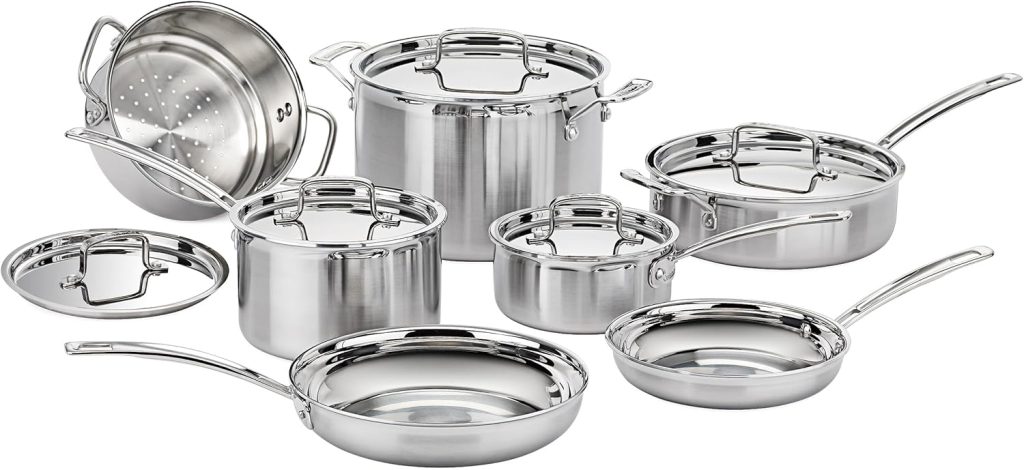
Overview:
The Cuisinart Multiclad Pro represents exceptional value in the premium stainless steel cookware category. This 12-piece set features triple-ply construction with a pure aluminum core sandwiched between stainless steel layers, delivering professional-grade performance at a fraction of the cost of luxury brands. Each piece is meticulously crafted to work flawlessly on induction cooktops while maintaining compatibility with all other cooking surfaces.
Key Features:
- Triple-ply construction: Heat-responsive aluminum core bonded between stainless steel for superior heat distribution
- Complete 12-piece set: Includes 1.5-quart and 3-quart saucepans with lids, 8-quart stockpot with lid, 8-inch and 10-inch skillets, 3.5-quart sauté pan with lid, and steamer insert
- Cool Grip handles: Solid stainless steel handles stay cool on the stovetop and are riveted for permanent attachment
- Tapered rim design: Allows for drip-free pouring from any angle
- Oven and broiler safe: Withstands temperatures up to 550°F
- Dishwasher safe: Easy cleanup without compromising the cookware’s integrity
Performance and User Experience:
The Cuisinart Multiclad Pro excels in heat distribution, which is crucial for induction cooking. The aluminum core responds rapidly to temperature changes while the stainless steel exterior provides the magnetic properties necessary for induction compatibility. Users consistently report even heating with minimal hot spots, making this set ideal for techniques requiring precise temperature control like sauce-making and sautéing.
The weight feels substantial without being cumbersome—an important balance that indicates quality construction without causing arm fatigue during extended cooking sessions. The tight-fitting lids create a near-perfect seal that traps heat and moisture effectively, reducing cooking times and preserving nutrients. Many home cooks appreciate that food releases easily from the polished cooking surface when proper preheating and fat are used.
Handle design deserves special mention. The stick handles remain surprisingly cool even during extended stovetop use, though oven mitts are still recommended for safety. The riveted construction means handles won’t loosen over time, addressing a common complaint with lesser cookware. The balance point on skillets and sauté pans allows for confident one-handed cooking and pouring.
Pros:
✅ Exceptional heat distribution eliminates hot spots and ensures even cooking
✅ Professional-grade construction at mid-range pricing offers outstanding value
✅ Highly responsive to temperature changes on induction cooktops
✅ Lifetime warranty demonstrates manufacturer confidence in durability
✅ Oven-safe to 550°F allows for stovetop-to-oven cooking techniques
✅ Dishwasher safe for convenient cleanup
✅ Complete set provides all essential pieces for a well-equipped kitchen
✅ Polished exterior maintains its appearance with proper care
Cons:
❌ Requires proper preheating and cooking techniques to prevent sticking
❌ Stainless steel shows fingerprints and water spots easily
❌ Heavier than non-stick alternatives, which may not suit all users
❌ Initial learning curve for those transitioning from non-stick cookware
❌ Lids don’t have steam vents, which some cooks prefer
Ideal For:
This set is perfect for serious home cooks who want professional results without professional prices. It’s especially suited for those who appreciate the versatility of stainless steel and are willing to master proper cooking techniques. The complete set configuration makes it ideal for anyone setting up a new kitchen or upgrading from lower-quality cookware. Cooks who frequently use both stovetop and oven will appreciate the high heat tolerance.
The Cuisinart Multiclad Pro delivers remarkable performance that rivals cookware costing two to three times more. While it demands more technique than non-stick alternatives, the superior heat control, durability, and versatility make it an outstanding investment for anyone committed to induction cooking. The lifetime warranty provides peace of mind, and the comprehensive set eliminates the need for future additions. For the quality-conscious cook seeking professional results on a reasonable budget, this set is exceptionally difficult to beat.
2. T-fal Ultimate Hard Anodized Nonstick 17-Piece Cookware Set

Overview:
T-fal’s Ultimate Hard Anodized set addresses a common concern: finding high-quality non-stick cookware that works reliably on induction cooktops. This comprehensive 17-piece collection features hard-anodized aluminum construction with a stainless steel induction base, combining the easy-release properties of non-stick surfaces with the responsiveness required for electromagnetic cooking. T-fal’s innovative Thermo-Spot heat indicator adds a unique feature that takes the guesswork out of preheating.
Key Features:
- Hard anodized aluminum construction: Provides durability twice as hard as stainless steel with excellent heat conductivity
- Titanium Advanced non-stick interior: PFOA, lead, and cadmium-free coating resists scratching and provides easy food release
- Stainless steel induction base: Ensures compatibility with induction cooktops while maintaining even heat distribution
- Thermo-Spot technology: Red heat indicator turns solid when pans reach optimal preheating temperature
- Extensive 17-piece set: Includes 8-inch and 10.25-inch fry pans, 11-inch fry pan with lid, 1-quart and 2-quart saucepans with lids, 5-quart Dutch oven with lid, 3-quart deep sauté pan with lid, plus five nylon cooking utensils
- Riveted silicone handles: Stay cool during stovetop cooking and provide comfortable grip
- Vented glass lids: Allow steam to escape while monitoring food
Performance and User Experience:
The T-fal Ultimate set performs admirably on induction cooktops, heating quickly and responding well to temperature adjustments. The Thermo-Spot indicator proves genuinely useful, especially for beginners who struggle to judge proper preheating temperatures. When the spot turns solid red, the pan is ready for optimal searing and prevents food from sticking—a clever feature that improves cooking results.
The non-stick coating lives up to its titanium-reinforced claims, maintaining its release properties even after months of regular use. Eggs slide effortlessly, pancakes flip cleanly, and cleanup requires minimal effort. The hard-anodized exterior resists scratching from metal utensils better than standard non-stick cookware, though T-fal still recommends using the included nylon utensils to maximize coating longevity.
Heat distribution is impressively even for non-stick cookware, with the stainless steel base providing the magnetic properties needed for induction while the aluminum body spreads heat uniformly. The vented lids are a practical touch that prevents boil-overs while maintaining visibility. Handle comfort is excellent, with the silicone coating providing secure grip and reliable heat insulation.
Pros:
✅ Thermo-Spot heat indicator eliminates guesswork and improves cooking results
✅ Excellent non-stick performance makes cooking and cleanup effortless
✅ Hard anodized construction offers superior durability compared to standard non-stick
✅ Comprehensive 17-piece set with included utensils provides complete kitchen solution
✅ Oven safe to 400°F accommodates various cooking methods
✅ PFOA-free coating addresses health and environmental concerns
✅ Lightweight design reduces cooking fatigue
✅ Vented lids prevent boil-overs and allow steam control
Cons:
❌ Non-stick coating will eventually degrade with use, requiring replacement
❌ Not dishwasher safe despite manufacturer claims—hand washing extends life significantly
❌ Lower oven temperature limit compared to stainless steel alternatives
❌ Hard-anodized exterior can discolor over time with high heat
❌ Lids are not induction-compatible for standalone use
Ideal For:
This set is ideal for cooks who prioritize easy cleanup and healthy low-fat cooking over the longevity of stainless steel. It’s particularly well-suited for busy families, those cooking for picky eaters who dislike textured crusts, and anyone who finds traditional stainless steel too challenging. The included utensils make it perfect for first-time induction cooktop users or anyone establishing a new kitchen. Health-conscious cooks will appreciate the PFOA-free coating.
The T-fal Ultimate Hard Anodized set offers an excellent balance of performance, convenience, and value for induction cooking enthusiasts who prefer non-stick surfaces. While the coating won’t last forever, the durability exceeds most non-stick alternatives, and the comprehensive set configuration provides outstanding value. The Thermo-Spot technology genuinely enhances cooking results, making this an especially smart choice for less experienced cooks. For those willing to accept the eventual need for replacement, this set delivers years of enjoyable, hassle-free cooking.
3. Lodge Pre-Seasoned Cast Iron Skillet with Assist Handle, 12-inch
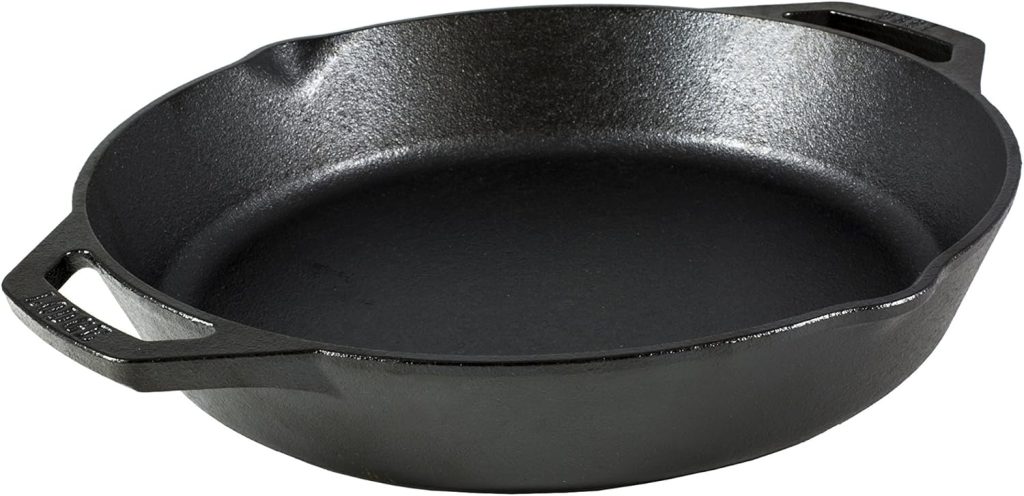
Overview:
The Lodge 12-inch cast iron skillet represents traditional cookware at its finest, adapted for modern induction cooking. Cast iron has been the workhorse of kitchens for centuries, and Lodge maintains that heritage while ensuring compatibility with contemporary cooking technologies. This single piece deserves inclusion in any discussion of induction cookware because of its unmatched heat retention, natural non-stick properties when properly seasoned, and legendary durability that literally lasts generations.
Key Features:
- Pre-seasoned cooking surface: Ready to use immediately with Lodge’s proprietary vegetable oil seasoning
- Pure cast iron construction: Provides excellent heat retention and naturally compatible with induction cooktops
- Dual handles: Long handle and assist handle for safe, balanced lifting and pouring
- 12-inch diameter: Versatile size suitable for everything from single steaks to family-sized meals
- Oven safe to any temperature: Withstands heat from stovetop, oven, grill, or campfire
- Naturally non-stick when properly maintained: Seasoning improves with use
- Unparalleled durability: Virtually indestructible with proper care
Performance and User Experience:
On induction cooktops, cast iron performs differently than other materials, and understanding these characteristics is essential. The Lodge skillet heats more slowly than multi-ply stainless steel, but once heated, it maintains temperature extraordinarily well. This heat retention makes it perfect for searing meats, achieving restaurant-quality crusts, and maintaining consistent temperatures during cooking. The mass of the pan prevents temperature drops when cold food is added—a significant advantage for achieving proper browning.
The induction compatibility is flawless since cast iron is inherently magnetic. The thick base sits flat on the cooking surface, ensuring optimal energy transfer. Users report excellent response from induction cooktops, with the ability to achieve very high temperatures for searing while also managing gentle heat for tasks like cornbread baking.
The pre-seasoning from Lodge provides a good starting point, though most cast iron enthusiasts continue building the seasoning through repeated use. With proper seasoning maintenance, the surface develops genuinely non-stick properties that rival synthetic coatings for many applications. Eggs can be cooked with minimal sticking, and cleanup becomes surprisingly easy once you master the technique.
Pros:
✅ Exceptional heat retention maintains consistent cooking temperatures
✅ Improves with age as seasoning builds, becoming more non-stick over time
✅ Unmatched durability lasts for generations with proper care
✅ Versatile enough for stovetop, oven, grill, or campfire use
✅ Naturally non-stick when properly seasoned, without synthetic chemicals
✅ Adds trace amounts of dietary iron to food
✅ Outstanding value considering lifetime usability
✅ Perfect for high-heat cooking techniques like searing
Cons:
❌ Heavy weight (approximately 8 pounds) may challenge some users
❌ Requires specific care and maintenance to prevent rust
❌ Heats slowly compared to other induction cookware materials
❌ Not dishwasher safe and shouldn’t be soaked in water
❌ Reactive with acidic foods until well-seasoned
❌ Initial learning curve for proper seasoning and cleaning
Ideal For:
This skillet is perfect for serious cooks who appreciate traditional cookware and are committed to proper maintenance. It’s ideal for anyone who loves perfectly seared steaks, crispy fried chicken, or skillet cornbread. The Lodge cast iron appeals to those seeking chemical-free cooking surfaces and durability that outlasts any synthetic non-stick pan. It’s particularly valuable for cooks who use multiple heat sources, from induction cooktops to campfires. Budget-conscious buyers seeking lifetime cookware will find exceptional value.
The Lodge cast iron skillet stands as proof that sometimes traditional solutions remain the best. While it demands more care than modern alternatives, the performance, versatility, and longevity justify the minimal extra effort. For induction cooking enthusiasts willing to embrace cast iron’s unique characteristics, this skillet becomes an indispensable kitchen tool that actually improves with age. At its modest price point, it represents one of the best values in cookware, period. Every induction kitchen should include at least one quality cast iron piece, and Lodge delivers exceptional quality at an accessible price.
4. Duxtop Whole-Clad Tri-Ply Stainless Steel Induction Ready Premium Cookware Set, 10-Piece
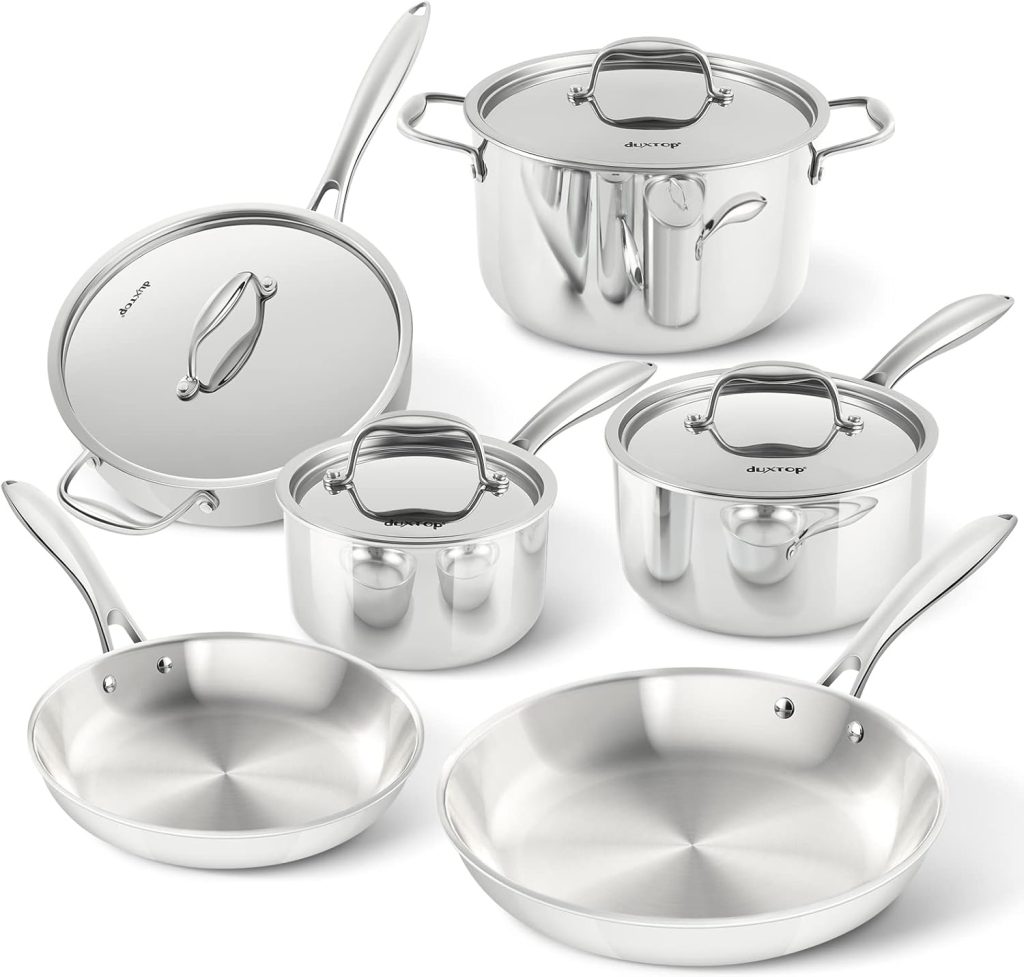
Overview:
Duxtop, a brand synonymous with induction cooking, brings its expertise to cookware with the Whole-Clad Tri-Ply set. This 10-piece collection demonstrates what happens when a company specializing in induction technology designs cookware specifically optimized for electromagnetic cooking. The result is cookware that maximizes induction efficiency while maintaining the versatility needed for all cooking surfaces. The tri-ply construction and thoughtful design details reflect Duxtop’s understanding of what serious induction cooks need.
Key Features:
- Whole-clad tri-ply construction: Complete bottom-to-rim bonding of stainless steel-aluminum-stainless steel layers
- Impact-bonded induction base: Specifically engineered for optimal magnetic response and heat transfer
- 10-piece set composition: Includes 8-inch and 10-inch fry pans, 1.5-quart and 3-quart saucepans with lids, 3-quart casserole with lid, 6-quart stockpot with lid
- Ergonomic handles: Designed for balanced weight distribution and cool-touch comfort
- Flared rims: Enable drip-free pouring from any angle
- Oven safe to 550°F: Accommodates all oven-based cooking techniques
- Lifetime warranty: Demonstrates confidence in construction quality
Performance and User Experience:
Duxtop’s induction cooking expertise is evident in this set’s performance. The magnetic base responds instantly to temperature adjustments, providing the precision control that makes induction cooking superior. Heat distribution is remarkably even, with the aluminum core spreading heat efficiently while the stainless steel surfaces maintain durability and provide non-reactive cooking properties.
The whole-clad construction—where the tri-ply layers extend up the sides rather than just on the bottom—ensures even heating throughout the entire pot or pan. This prevents the cool zones on side walls that plague cheaper cookware with only bottom-layer construction. The difference is noticeable when sautéing vegetables or reducing sauces, where ingredients along the pan sides cook as evenly as those in the center.
Handle ergonomics show careful design consideration. The weight balance feels natural, reducing wrist strain during cooking. The stay-cool properties work well, though prudence dictates using pot holders for extended high-heat cooking. The riveted construction ensures handles won’t loosen, and the long length provides safe distance from heat.
The polished stainless interior develops a patina with use that actually improves its non-stick qualities when proper preheating and cooking techniques are employed. While not as immediately forgiving as non-stick coatings, the performance rewards those who master temperature control and timing.
Pros:
✅ Whole-clad construction provides superior heat distribution throughout entire cookware
✅ Specifically optimized for induction cooking by induction specialist brand
✅ Rapid response to temperature changes enables precise cooking control
✅ Professional-grade construction at competitive pricing
✅ Lifetime warranty covers defects and workmanship
✅ Oven safe to 550°F supports diverse cooking methods
✅ Dishwasher safe for convenient cleanup
✅ Ergonomic handle design reduces cooking fatigue
Cons:
❌ Requires proper technique to prevent food sticking
❌ Polished exterior shows scratches and fingerprints
❌ Smaller set lacks some pieces included in larger collections
❌ Stainless steel demands more intensive cleaning than non-stick
❌ Price point higher than entry-level options
Ideal For:
This set is ideal for dedicated induction cooking enthusiasts who want cookware designed specifically for their cooking method. It suits cooks upgrading from entry-level cookware who are ready for professional-grade performance. The 10-piece configuration works perfectly for smaller households or those with limited storage space. Anyone seeking lifetime cookware backed by a brand specializing in induction technology will appreciate this collection. It’s particularly valuable for cooks who frequently transition between stovetop and oven cooking.
The Duxtop Whole-Clad Tri-Ply set represents exceptional value from a company that truly understands induction cooking. The optimized magnetic response, combined with superior heat distribution and solid construction, delivers professional-level performance that justifies the investment. While it requires proper cooking technique, the results reward those willing to master stainless steel cookware. The lifetime warranty and brand reputation provide confidence in long-term satisfaction. For induction cooking enthusiasts seeking cookware designed specifically for their needs, Duxtop delivers compelling performance at a fair price.
5. Calphalon Classic Nonstick Cookware Set, 10-Piece Set
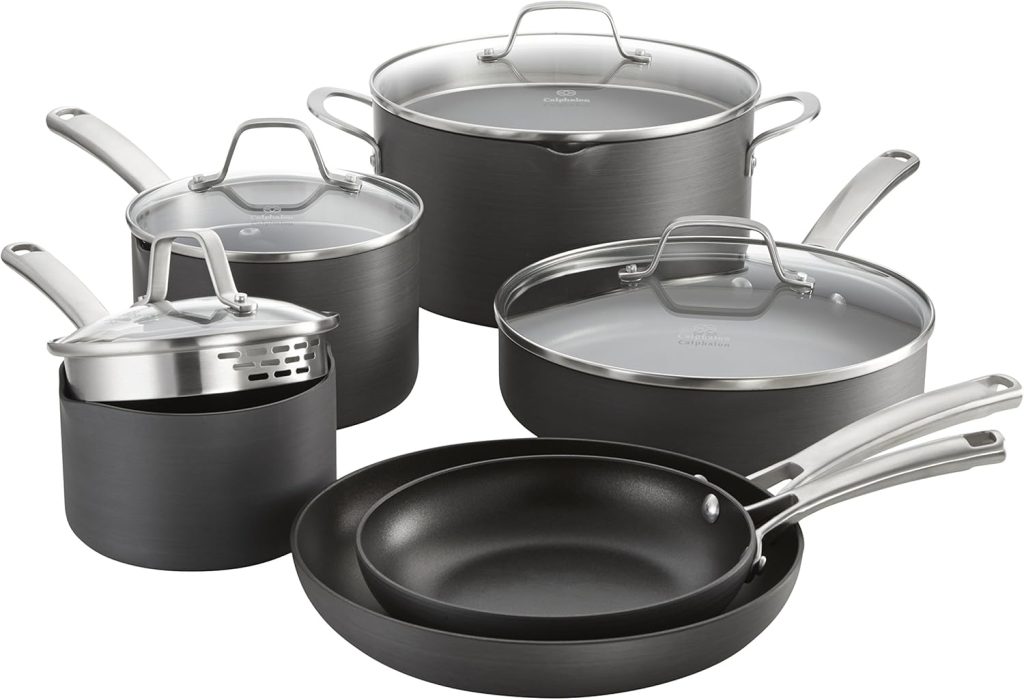
Overview:
Calphalon’s reputation for quality cookware extends to their Classic Nonstick line, which combines affordability with reliable performance on induction cooktops. This 10-piece set uses dual-layer non-stick coating on hard-anodized aluminum, with an induction-compatible stainless steel base that enables electromagnetic cooking. Calphalon positions this as their entry-level option, but the performance and durability exceed what “entry-level” typically suggests, making it an attractive option for budget-conscious shoppers who refuse to compromise on quality.
Key Features:
- Dual-layer nonstick interior: Provides reliable food release and easy cleanup
- Hard-anodized aluminum construction: Delivers durability and even heating
- Stainless steel induction plate: Ensures compatibility with induction cooktops
- 10-piece set includes: 8-inch and 10-inch fry pans, 1.5-quart and 2.5-quart saucepans with lids, 3-quart sauté pan with lid, 6-quart stockpot with lid
- Stay-cool handles: Long, ergonomic handles remain comfortable during cooking
- Tempered glass lids: Allow monitoring without heat loss
- Oven safe to 450°F: Enables stovetop-to-oven cooking techniques
Performance and User Experience:
The Calphalon Classic performs admirably on induction cooktops, with the stainless steel base providing good magnetic response and heat distribution. While not quite as responsive as full-clad stainless steel, the performance satisfies most home cooking needs. The hard-anodized exterior heats evenly, reducing hot spots that plague cheaper cookware.
The dual-layer non-stick coating performs well for daily cooking tasks. Eggs release cleanly, pancakes flip easily, and proteins brown without sticking when proper techniques are used. The coating shows good durability with metal utensil use, though wooden or silicone tools extend its lifespan. After months of regular use, most owners report minimal degradation of the non-stick properties.
Handle design balances form and function effectively. The long handles provide secure grip and adequate distance from heat sources, while the stay-cool properties work well for stovetop cooking. The balance feels natural, reducing arm strain during extended cooking sessions. Glass lids fit securely and allow convenient monitoring, though they lack steam vents found on some competitors.
Pros:
✅ Excellent value for quality non-stick induction cookware
✅ Hard-anodized construction provides durability superior to standard aluminum
✅ Reliable food release simplifies cooking and cleanup
✅ Comprehensive 10-piece set covers essential cooking needs
✅ Oven safe to 450°F supports versatile cooking methods
✅ Calphalon’s reputation for quality and customer service
✅ Even heating prevents hot spots and burning
✅ Long handles stay cool and provide comfortable grip
Cons:
❌ Non-stick coating will eventually wear and require replacement
❌ Not dishwasher safe—hand washing required to maintain coating
❌ Glass lids don’t have steam vents
❌ Lower oven temperature limit than stainless steel alternatives
❌ Exterior can discolor with high heat or improper cleaning
❌ No lifetime warranty—10-year guarantee typical
Ideal For:
This set suits budget-conscious cooks who want recognized brand quality without premium pricing. It’s perfect for those who prioritize easy cleanup and convenient non-stick cooking. First-time induction cooktop users will appreciate the straightforward performance and easy maintenance. Families with young children or novice cooks benefit from the forgiving non-stick surface. Anyone seeking a complete kitchen solution without breaking the bank should consider this comprehensive set.
The Calphalon Classic Nonstick set delivers reliable performance at an accessible price point, making quality induction cookware attainable for budget-conscious buyers. While the non-stick coating won’t last forever, the durability exceeds most similarly-priced competitors, and the Calphalon name provides confidence in quality and customer support. The comprehensive set configuration eliminates the need for multiple purchases. For cooks seeking dependable non-stick performance on induction cooktops without premium pricing, this set represents excellent value and solid everyday performance.
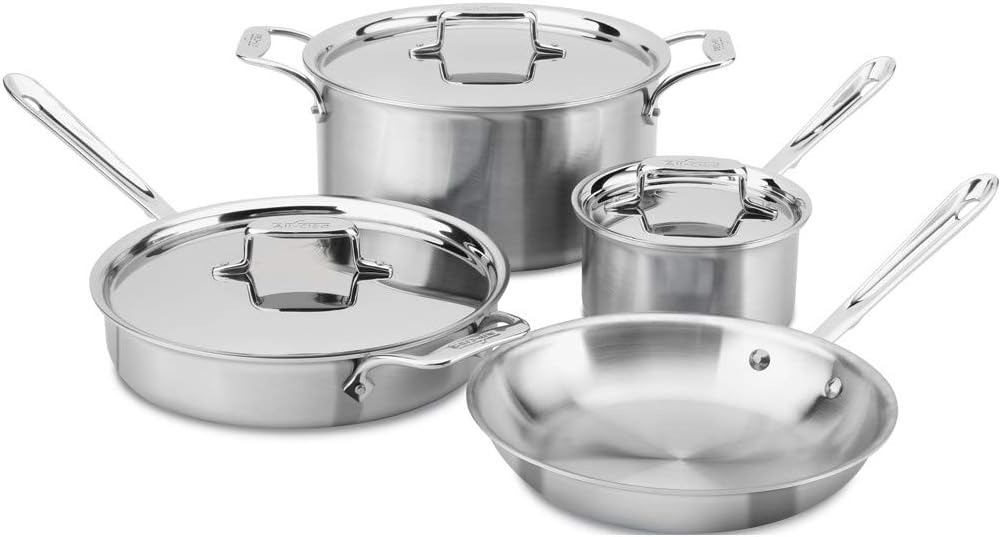
6. All-Clad BD005714 D5 Brushed Stainless Steel 5-Ply Bonded Dishwasher Safe Cookware Set, 14-Piece
Overview:
All-Clad represents the pinnacle of American cookware manufacturing, and the D5 Brushed collection exemplifies why professional chefs and serious home cooks consider it the gold standard. This 14-piece set features five-layer bonded construction that takes induction cooking performance to exceptional levels. While the investment is substantial, the combination of superior engineering, lifetime warranty, and generational durability positions this as genuine buy-it-for-life cookware that may actually outlast the induction cooktop itself.
Key Features:
- Five-ply bonded construction: Alternating layers of stainless steel and aluminum from rim to rim
- Patented starburst finish: Stainless steel interior prevents sticking and makes cleaning easier
- 14-piece comprehensive set: Includes 8-inch and 10-inch fry pans, 2-quart and 3-quart saucepans with lids, 3-quart sauté pan with lid, 4-quart soup pot with lid, 8-quart stockpot with lid, plus steamer insert and roasting pan
- Optimized induction interface: Magnetic stainless steel exterior ensures maximum energy efficiency
- Precision-fitting lids: Create effective seal for heat and moisture retention
- Contoured stainless steel handles: Ergonomically designed and secured with stainless steel rivets
- Dishwasher safe: Though hand washing recommended for optimal appearance
- Oven and broiler safe to 600°F: Withstands professional-level temperatures
- Lifetime warranty: Covers entire life of original owner
Performance and User Experience:
The All-Clad D5 set delivers performance that justifies its premium pricing. The five-ply construction creates unmatched heat distribution, with the multiple aluminum layers spreading heat so evenly that hot spots essentially disappear. This even heating is particularly valuable on induction cooktops, where energy is concentrated in the magnetic base—the additional layers distribute that concentrated heat throughout the cookware.
Temperature response is immediate and precise. Adjusting the induction setting produces nearly instantaneous changes in cooking temperature, enabling the level of control that professional cooking techniques demand. The heat retention rivals cast iron, while the responsiveness exceeds it significantly. This combination of retention and response makes the D5 ideal for everything from delicate sauces to high-heat searing.
The starburst finish on the cooking surface isn’t just aesthetic—it genuinely improves performance. The textured pattern helps foods develop attractive browning while minimizing sticking when proper preheating and fat levels are used. Cleanup is easier than on polished stainless steel, with less scrubbing required to remove stubborn residue. The finish also hides minor scratches that would be obvious on polished surfaces.
Handle design reflects decades of refinement. The contoured shape provides secure grip from multiple angles, and the substantial feel conveys quality. While the handles do warm with extended high-heat cooking, they remain manageable with proper technique. The riveted construction ensures permanent attachment. The long length provides safe distance from heat and excellent balance during use.
Pros:
✅ Five-ply construction delivers unmatched heat distribution and performance
✅ Professional-grade quality with lifetime warranty for original owner
✅ Exceptional responsiveness to temperature changes on induction cooktops
✅ Starburst finish improves cooking performance and simplifies cleaning
✅ Comprehensive 14-piece set includes specialty items like roasting pan
✅ Oven and broiler safe to 600°F enables any cooking technique
✅ Made in USA with stringent quality control
✅ Retains resale value better than any other cookware brand
Cons:
❌ Premium pricing places it beyond many budgets
❌ Substantial weight may challenge some users
❌ Requires proper technique to prevent sticking
❌ Polished exterior shows fingerprints and water spots
❌ Investment may exceed needs of casual cooks
❌ Replacement pieces are individually expensive
Ideal For:
This set is perfect for serious home cooks and culinary enthusiasts who demand the absolute best and plan to keep their cookware for decades. It suits professionals working from home kitchens who need commercial-level performance. The comprehensive set works for those establishing a kitchen with a single, complete purchase who never want to worry about cookware again. Anyone who appreciates fine tools and understands that quality tools improve results will value this investment. It’s particularly ideal for households where cooking is a passion rather than just a necessity.
The All-Clad D5 Brushed represents the apex of induction cookware engineering and manufacturing. The performance is genuinely superior to cheaper alternatives, with heat distribution, responsiveness, and durability that justify the premium pricing for those who can afford it. The lifetime warranty and legendary durability mean the per-year cost becomes quite reasonable when spread over decades of use. While the investment is substantial, this is truly buy-it-for-life cookware that may be the last set you ever purchase. For cooks who demand the best and are willing to invest accordingly, nothing surpasses All-Clad quality.
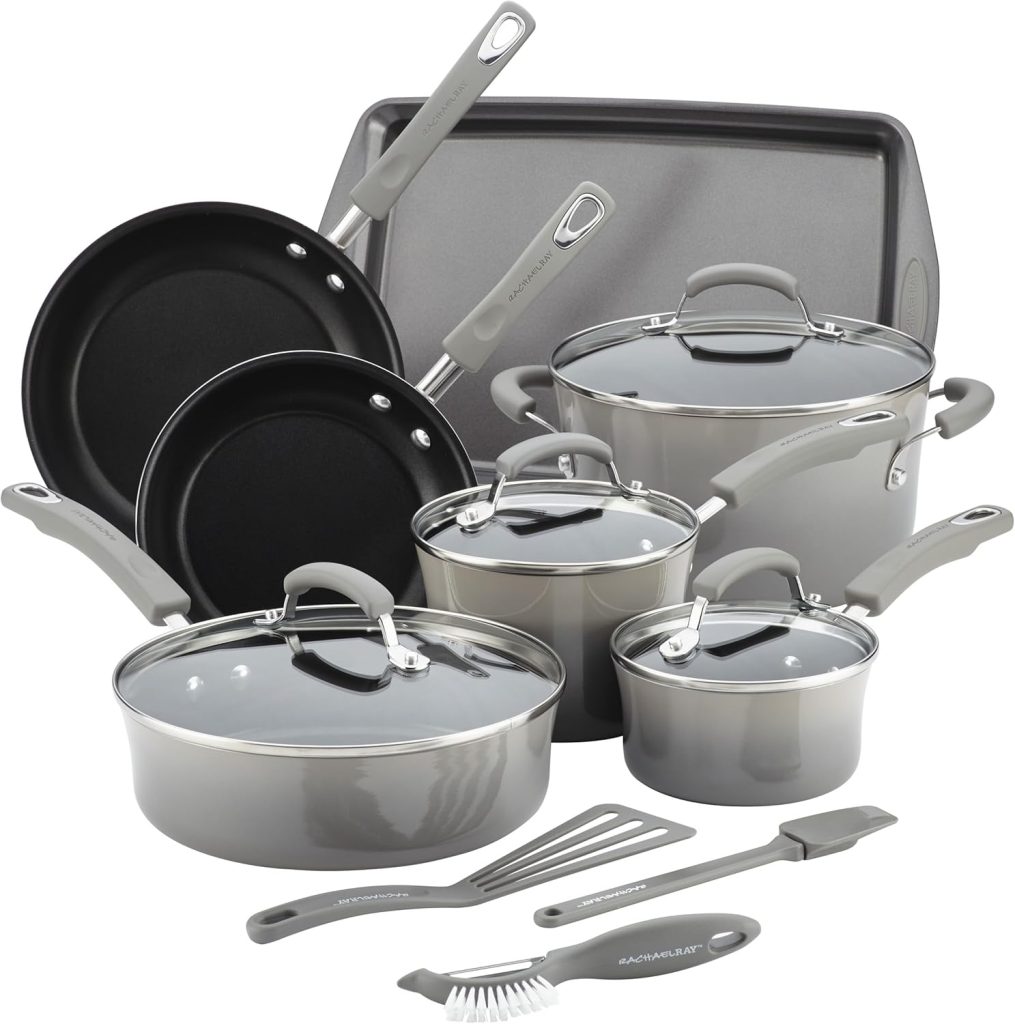
7. Rachael Ray Brights Hard Anodized Nonstick Cookware Pots and Pans Set, 14-Piece
Overview:
Rachael Ray brings her signature colorful personality to functional cookware with the Brights Hard Anodized collection. This 14-piece set proves that practical induction cookware doesn’t need to look boring. The hard-anodized aluminum construction with stainless steel induction plates delivers solid performance, while the vibrant exterior colors and comfortable rubberized handles make cooking more enjoyable. This collection targets cooks who want reliable performance with personality, combining celebrity branding with legitimate quality construction.
Key Features:
- Hard anodized aluminum construction: Provides durability and even heat distribution
- Enhanced nonstick coating: Three layers for excellent release and easy cleanup
- Stainless steel induction base: Ensures compatibility with all cooktops including induction
- 14-piece set includes: 1-quart and 2-quart saucepans with lids, 6-quart stockpot with lid, 3-quart sauté pan with lid, 8.5-inch and 10-inch frying pans, plus four kitchen tools (slotted turner, spoon, slotted spoon, pasta fork)
- Shatter-resistant glass lids: Allow monitoring while maintaining heat and moisture
- Dual-riveted silicone over stainless steel handles: Provide comfortable, secure grip with heat resistance
- Available in multiple colors: Orange, red, blue, and purple exterior gradients
- Oven safe to 400°F: Accommodates stovetop-to-oven recipes
Performance and User Experience:
The Rachael Ray Brights perform well on induction cooktops, with the stainless steel base plates providing adequate magnetic response and heat distribution. The hard-anodized aluminum heats evenly across cooking surfaces, reducing hot spots that cause burning. While not quite as responsive as premium multi-ply stainless steel, the performance satisfies typical home cooking needs.
The three-layer non-stick coating excels at food release, making everything from fried eggs to delicate fish fillets easy to cook and remove. Cleanup requires minimal effort—often just a quick wipe with a soft cloth. The coating shows reasonable durability with proper care, maintaining its release properties through months of regular use. As with all non-stick cookware, avoiding metal utensils and high heat extends the coating’s life significantly.
The silicone-covered handles are a standout feature. The soft-touch material provides excellent grip even with wet hands, and the dual-riveted construction ensures secure attachment. The handles stay cool during stovetop cooking, eliminating the constant reaching for pot holders. The comfortable feel reduces hand fatigue during extended cooking sessions.
The included cooking tools match the cookware color scheme and provide good quality nylon construction. While not extraordinary, they’re perfectly functional and eliminate the need for separate utensil purchases when first equipping a kitchen.
Pros:
✅ Fun, colorful exterior adds personality to the kitchen
✅ Excellent non-stick performance for easy cooking and cleanup
✅ Hard-anodized construction provides good durability
✅ Comprehensive 14-piece set with included cooking tools
✅ Comfortable silicone-covered handles stay cool on stovetop
✅ Shatter-resistant glass lids for safe monitoring
✅ Affordable pricing for a complete set
✅ Rachael Ray brand recognition and customer support
Cons:
❌ Non-stick coating will eventually wear and need replacement
❌ Hand washing required despite marketing claims—dishwasher degrades coating
❌ Lower oven temperature limit than stainless steel options
❌ Colorful exterior can fade or discolor with high heat
❌ Not suitable for high-heat cooking techniques
❌ Handle length shorter than some competitors
Ideal For:
This set is perfect for cooks who want their cookware to reflect personal style while maintaining solid functionality. It’s ideal for smaller households, first-time homeowners, or college students setting up their initial kitchen. Anyone who loves Rachael Ray’s cooking philosophy will appreciate her design sensibilities. The comprehensive set with included tools makes it excellent for gift-giving. Casual cooks who prioritize easy cleanup and convenient non-stick performance over long-term durability will find this set satisfying and fun to use.
The Rachael Ray Brights Hard Anodized set successfully combines style with substance, delivering reliable induction-compatible performance in an attractive package. While the non-stick coating won’t last forever, the quality construction and celebrity brand backing provide confidence in near term satisfaction. The comprehensive set configuration and included tools offer excellent value for the price point. The colorful design makes cooking more enjoyable without sacrificing functionality. For cooks seeking affordable, complete induction cookware that brings personality to the kitchen, this set delivers a winning combination of performance, convenience, and style.
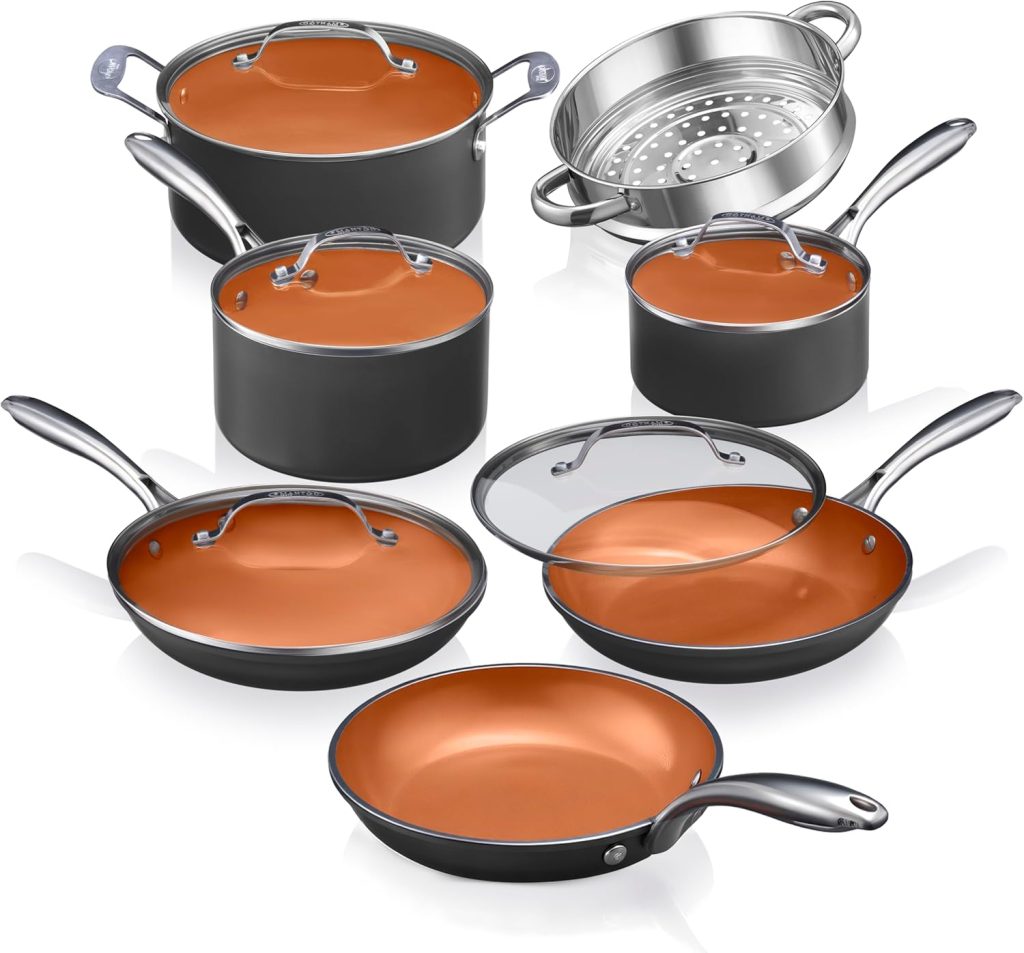
8. Gotham Steel Pots and Pans Set 12 Piece Cookware Set with Ultra Nonstick Ceramic Coating
Overview:
Gotham Steel has made a name for itself with aggressive marketing claims about its ceramic non-stick coating infused with titanium. This 12-piece set promises cooking so non-stick that you can cook without butter or oil, along with metal utensil safety and easy cleanup. The aluminum construction with a stainless steel induction plate makes it compatible with electromagnetic cooktops, while the copper-colored titanium ceramic coating provides a distinctive appearance. This set targets budget-conscious consumers seeking non-stick convenience with induction compatibility.
Key Features:
- Ti-Cerama coating: Ceramic non-stick infused with titanium for durability
- Aluminum body with stainless steel induction base: Lightweight construction with magnetic properties
- 12-piece set composition: Includes 8.5-inch and 10.25-inch frying pans, 1.5-quart and 2.5-quart saucepans with lids, 5-quart stockpot with lid, 2.75-quart sauté pan with lid
- Metal utensil safe: Claims resistance to scratching from metal spatulas and spoons
- PTFE, PFOA, and PFOS free: Ceramic coating avoids controversial chemicals
- Tempered glass lids: Allow cooking monitoring
- Oven safe to 500°F: Supports various cooking methods
- Dishwasher safe: Marketed as easy-care cookware
Performance and User Experience:
The Gotham Steel set delivers mixed results that require honest assessment. Initially, the non-stick performance is impressive—eggs slide across the surface, and cooking with minimal oil is genuinely possible. The ceramic coating releases food easily when new, and the easy cleanup lives up to marketing promises. The lightweight aluminum construction heats quickly on induction cooktops, making it energy-efficient and responsive.
However, long-term performance reveals significant limitations. The ceramic coating degrades faster than traditional PTFE-based non-stick surfaces, with many users reporting diminished non-stick properties within 6-12 months of regular use. Food begins sticking, and the surface becomes increasingly difficult to clean. While marketed as metal utensil safe, using metal tools accelerates coating degradation noticeably.
The induction compatibility works, but the lightweight construction and thin base create uneven heating on electromagnetic cooktops. Hot spots develop more readily than with heavier, better-constructed cookware. Temperature response is quick due to the thin construction, but heat retention is poor—adding cold ingredients causes significant temperature drops.
The handles, while staying reasonably cool, feel less substantial than premium alternatives. The hollow construction occasionally develops looseness over time. The glass lids fit adequately but don’t create the tight seal found on higher-quality cookware.
Pros:
✅ Excellent initial non-stick performance when new
✅ PTFE, PFOA, and PFOS-free ceramic coating addresses chemical concerns
✅ Very lightweight design reduces cooking fatigue
✅ Affordable price point for complete induction-compatible set
✅ Quick heating due to thin construction
✅ Attractive copper-colored appearance
✅ Oven safe to 500°F temperature
✅ Dishwasher safe for convenient cleaning
Cons:
❌ Non-stick coating degrades quickly—typically within one year
❌ Thin construction creates hot spots and uneven heating
❌ Poor heat retention compared to heavier cookware
❌ Metal utensil claims don’t prevent coating damage in practice
❌ Handle construction can loosen with regular use
❌ Not suitable for high-heat cooking techniques
❌ Limited warranty compared to premium brands
❌ Replacement becomes necessary relatively quickly
Ideal For:
This set suits extremely budget-conscious shoppers who need immediate induction compatibility and understand they’re purchasing disposable cookware with a limited lifespan. It’s appropriate for temporary living situations like college dorms, first apartments, or rental properties where investment in permanent cookware isn’t practical. Occasional cooks who use cookware infrequently may find the lifespan acceptable. Anyone philosophically opposed to PTFE-based non-stick coatings might consider this as a short-term alternative.
The Gotham Steel set represents a challenging value proposition. While the initial performance and low price are attractive, the rapid degradation means you’ll likely need replacement within a year or two of regular use. When you calculate the cost-per-year and the environmental impact of frequently disposing of cookware, the value becomes questionable. The aggressive marketing claims about durability and metal utensil safety don’t align with real-world longevity. This set works as an emergency solution or temporary cookware, but serious cooks seeking long-term value should invest in more durable options. If you purchase this set, treat it as consumable cookware with a defined lifespan rather than a permanent kitchen investment.
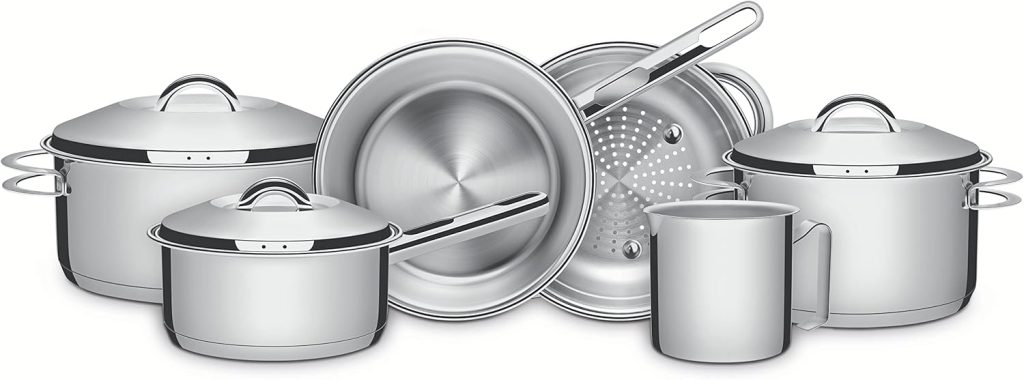
9. Tramontina Gourmet Prima Stainless Steel 18-Piece Cookware Set
Overview:
Tramontina, a Brazilian manufacturer with over a century of metalworking expertise, offers remarkable value with their Gourmet Prima collection. This 18-piece set features tri-ply construction that delivers performance rivaling cookware costing significantly more. The company’s manufacturing experience shows in the precision construction and attention to detail. This set represents the sweet spot for budget-conscious buyers who refuse to compromise on fundamental quality, offering professional-grade construction at accessible pricing through efficient manufacturing and smart business practices.
Key Features:
- Tri-ply base construction: Stainless steel-aluminum-stainless steel layers for optimal heat distribution
- 18/10 stainless steel interior: Professional-grade material provides durability and non-reactive cooking
- Magnetic stainless steel exterior: Ensures induction compatibility and attractive appearance
- Extensive 18-piece set: Includes 1.5-quart, 2.5-quart, and 5-quart covered saucepans, 8-quart covered stockpot, 3-quart covered sauté pan, 8-inch and 10-inch frying pans, 12-inch frying pan, 5-quart covered Dutch oven
- Tri-ply clad base: Extends slightly up the sides for improved heat distribution
- Precision-fitting covers: Tempered glass lids with stainless steel rims
- Riveted cast stainless steel handles: Contoured for comfortable, secure grip
- Oven and broiler safe to 500°F: Accommodates diverse cooking techniques
- Dishwasher safe: Easy maintenance and cleanup
- Lifetime warranty: Demonstrates manufacturer confidence
Performance and User Experience:
The Tramontina Gourmet Prima consistently surprises users with performance that exceeds price-point expectations. The tri-ply base construction delivers heat distribution that rivals fully-clad premium cookware for most cooking applications. While the sides don’t have the multiple layers of fully-clad construction, the base’s quality ensures even heating across the cooking surface—the most critical area for preventing hot spots and burning.
On induction cooktops, the magnetic stainless steel base responds excellently to temperature adjustments. The aluminum core spreads heat evenly, while the substantial thickness prevents warping even with repeated high-heat use. The cooking surface develops an attractive patina with use that actually improves non-stick qualities when proper techniques are employed.
The 18-piece count provides exceptional variety, including multiple frying pan sizes and both sauté and Dutch oven options. This comprehensive selection means most cooks won’t need additional specialty pieces. The tempered glass lids with stainless steel rims add a quality touch, fitting precisely and providing clear monitoring.
Handle design shows thoughtful engineering. The contoured shape provides comfortable grip from multiple angles, and the cast construction creates substantial feel without excessive weight. The handles stay surprisingly cool during stovetop use, though pot holders remain advisable for safety. The riveted attachment ensures handles won’t loosen over extended use.
Pros:
✅ Exceptional value—professional performance at mid-range pricing
✅ Tri-ply base construction provides excellent heat distribution
✅ Comprehensive 18-piece set covers virtually all cooking needs
✅ Lifetime warranty backs quality construction
✅ Oven and broiler safe to 500°F supports versatile cooking
✅ Dishwasher safe for convenient cleanup
✅ 18/10 stainless steel interior ensures durability and non-reactive cooking
✅ Precision glass lids with stainless rims
✅ Substantially built with quality feel
Cons:
❌ Tri-ply base rather than full-clad construction
❌ Handles can warm with extended high-heat cooking
❌ Stainless steel requires proper technique to prevent sticking
❌ Polished exterior shows fingerprints and water spots
❌ Less brand recognition than premium American manufacturers
❌ Individual replacement pieces harder to source
Ideal For:
This set is perfect for value-conscious cooks who want professional-quality results without premium pricing. It suits anyone setting up a complete kitchen with a single purchase who needs comprehensive variety. Home cooks ready to graduate from non-stick to stainless steel will appreciate the forgiving price point while learning proper techniques. Large families benefit from the multiple size options. Anyone who cooks frequently and values durability over brand prestige will find this set delivers outstanding long-term value.
The Tramontina Gourmet Prima stands as one of the best values in induction cookware, delivering performance that legitimately rivals cookware costing two to three times more. While lacking the full-clad construction of premium brands, the tri-ply base handles the vast majority of home cooking tasks beautifully. The comprehensive 18-piece set, lifetime warranty, and solid construction make this an intelligent choice for budget-conscious buyers refusing to sacrifice quality. For cooks seeking professional-grade stainless steel cookware at accessible pricing, Tramontina delivers exceptional value that’s difficult to match.
10. GreenPan Lima Healthy Ceramic Nonstick Cookware Pots and Pans Set, 12-Piece
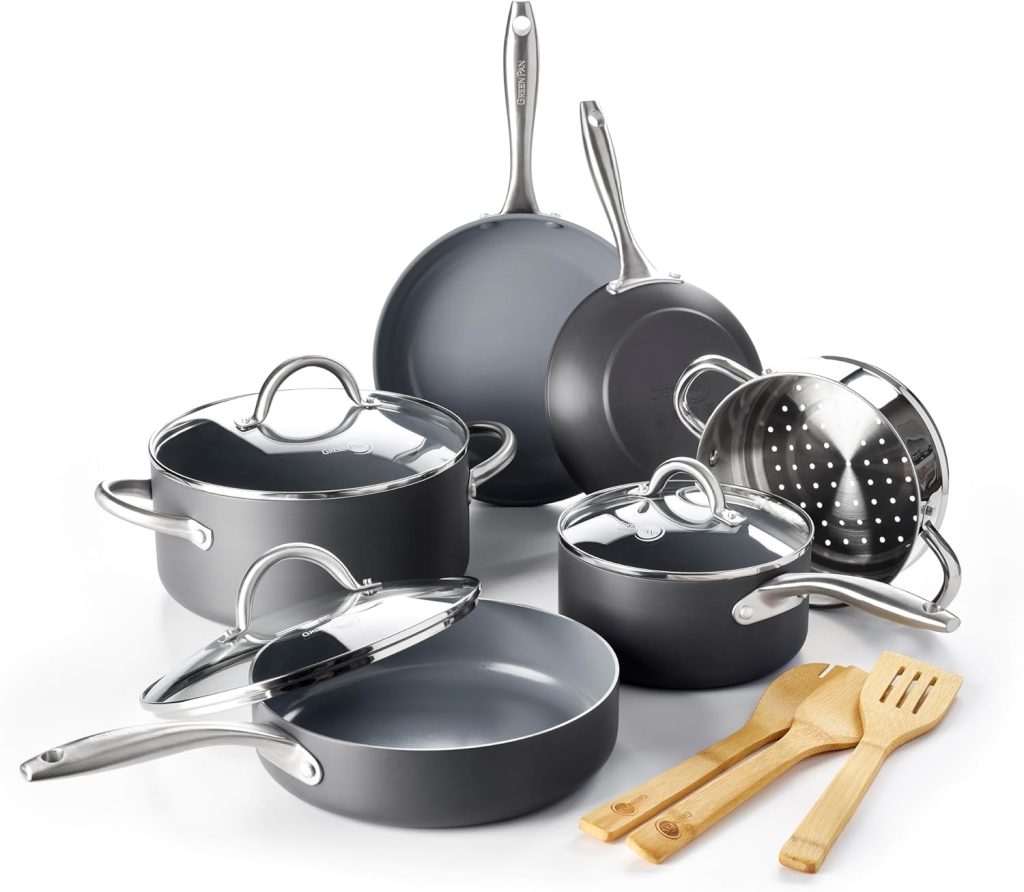
Overview:
GreenPan pioneered healthy ceramic non-stick coatings and continues leading the category with their Lima collection. This 12-piece set addresses growing consumer concerns about traditional non-stick coatings by using Thermolon™ ceramic, which is free from PFAS, PFOA, lead, and cadmium. The hard anodized aluminum construction with a magnetic stainless steel base ensures induction compatibility, while the ceramic coating provides non-stick convenience without controversial chemicals. This set targets health-conscious cooks who want non-stick performance with peace of mind about coating safety.
Key Features:
- Thermolon™ Minerals ceramic coating: Healthy non-stick derived from sand, free from PFAS, PFOA, lead, and cadmium
- Hard anodized aluminum body: Provides durability and excellent heat conduction
- Magnetic stainless steel induction base: Ensures compatibility with all cooktops
- Diamond-reinforced coating: Enhanced durability and scratch resistance
- 12-piece set includes: 7-inch and 9.5-inch frypans, 1-quart and 2-quart saucepans with lids, 5-quart stockpot with lid, 2.5-quart sauté pan with lid
- Riveted Bakelite handles: Stay cool during stovetop cooking
- Tempered glass lids: Oven-safe lids for monitoring and versatility
- Oven and broiler safe to 600°F: Exceptional heat tolerance for ceramic non-stick
- Dishwasher safe: Easy maintenance
- Made without forever chemicals: Coating manufacturing produces 60% less CO2 emissions
Performance and User Experience:
The GreenPan Lima delivers reliable non-stick performance while addressing health and environmental concerns. The Thermolon ceramic coating releases food easily when properly preheated and used with appropriate heat levels. Eggs slide cleanly, pancakes flip effortlessly, and proteins release without tearing. The diamond reinforcement provides noticeably better scratch resistance than standard ceramic coatings, maintaining performance longer.
On induction cooktops, the stainless steel base responds well to temperature changes, though not quite as quickly as premium multi-ply stainless steel. The hard-anodized aluminum distributes heat evenly, reducing hot spots that cause sticking. The coating can withstand higher temperatures than many ceramic alternatives—up to 600°F—making it suitable for finishing dishes in the oven.
The Thermolon coating demonstrates superior durability compared to many ceramic alternatives. While it will eventually show wear like all non-stick surfaces, the degradation occurs more gradually. Proper care—avoiding extreme heat, using wooden or silicone utensils, and hand washing—significantly extends the coating’s effective lifespan.
The Bakelite handles stay genuinely cool during stovetop cooking, providing comfortable grip without the constant need for pot holders. The riveted attachment ensures permanent, secure connection. The handles are oven-safe along with the cookware, tolerating the impressive 600°F temperature limit.
Pros:
✅ Healthy ceramic coating free from PFAS, PFOA, lead, and cadmium
✅ Diamond-reinforced for superior durability compared to standard ceramic
✅ Excellent non-stick performance with proper use and care
✅ Oven and broiler safe to 600°F—exceptional for non-stick cookware
✅ Environmentally conscious manufacturing with lower emissions
✅ Hard-anodized construction provides durability and even heating
✅ Handles stay cool during stovetop cooking
✅ Dishwasher safe for convenient cleanup
✅ No toxic fumes if accidentally overheated
Cons:
❌ Higher price point than traditional non-stick alternatives
❌ Ceramic coating eventually wears despite enhanced durability
❌ Requires moderate heat for best performance—high heat damages coating
❌ Hand washing extends life significantly despite dishwasher-safe claims
❌ Non-stick performance diminishes faster with metal utensil use
❌ Not as slippery as PTFE-based coatings when new
Ideal For:
This set is ideal for health-conscious cooks concerned about chemical exposure from traditional non-stick coatings. It suits environmentally aware consumers who appreciate sustainable manufacturing practices. Parents cooking for young children often prefer ceramic coatings for peace of mind. Anyone with chemical sensitivities or simply philosophically opposed to PTFE-based coatings will appreciate this alternative. The high oven-safe temperature makes it suitable for cooks who frequently finish stovetop dishes in the oven. Those willing to invest moderately more for healthier cookware will find this set worthwhile.
The GreenPan Lima successfully delivers on its promise of healthy non-stick performance with genuine environmental consciousness. While it costs more than traditional non-stick and won’t last forever, the peace of mind about chemical safety and environmental impact justifies the premium for many buyers. The diamond-reinforced Thermolon coating provides noticeably better durability than standard ceramic alternatives. The impressive 600°F oven-safe rating expands cooking versatility significantly. For health-conscious cooks seeking non-stick convenience without chemical concerns, this set represents the best currently available option, balancing performance, safety, and responsible manufacturing.
11. Anolon Advanced Hard-Anodized Nonstick Cookware Pots and Pans Set, 11-Piece

Overview:
Anolon brings decades of hard-anodized cookware expertise to their Advanced collection, creating a thoughtfully designed set that balances performance, durability, and affordability. This 11-piece set features twice-hard-anodized construction that creates an exceptionally durable cooking surface, combined with premium-quality non-stick coating and induction-compatible bases. The collection targets experienced home cooks who appreciate the superior durability of hard-anodized aluminum but want it optimized for induction cooking. Anolon’s reputation for lasting quality shows throughout this well-executed design.
Key Features:
- Twice hard-anodized construction: Creates surface twice as hard as stainless steel for exceptional durability
- Premium-quality DuPont Autograph non-stick: Top-tier PTFE coating provides superior release and longevity
- Induction-compatible stainless steel base: Ensures compatibility with all cooktops including electromagnetic
- 11-piece set includes: 8-inch and 10-inch French skillets, 1.5-quart and 3-quart covered saucepans, 8-quart covered stockpot, 3-quart covered sauté pan
- SureGrip handles: Dual-riveted stainless steel handles with silicone covering for comfort
- Shatter-resistant glass lids: Tempered glass with wide stainless steel rims
- Oven safe to 400°F: Supports stovetop-to-oven cooking techniques
- Lifetime warranty: Covers entire life of original purchaser
Performance and User Experience:
The Anolon Advanced set demonstrates what happens when a company specializing in hard-anodized cookware optimizes their expertise for induction cooking. The twice-hard-anodized exterior creates an incredibly durable surface that resists warping, scratching, and denting better than standard aluminum or even most stainless steel. This construction quality translates to cookware that maintains its performance characteristics for years of regular use.
The DuPont Autograph non-stick coating represents premium-tier PTFE technology, providing superior food release compared to standard non-stick surfaces. The coating maintains its non-stick properties longer than cheaper alternatives, with many users reporting excellent performance even after several years of regular use. Eggs slide effortlessly, delicate fish fillets release cleanly, and cleanup remains easy throughout the coating’s life.
On induction cooktops, the stainless steel base plates provide good magnetic response and heat distribution. The hard-anodized aluminum body spreads heat evenly, virtually eliminating hot spots. The combination creates responsive yet even heating that handles everything from gentle simmering to high-heat searing. The substantial construction provides better heat retention than thinner non-stick cookware, reducing temperature drops when cold ingredients are added.
The SureGrip handles excel in both comfort and functionality. The silicone covering stays cool during stovetop cooking and provides secure grip even with wet hands. The dual-riveted attachment ensures the handles never loosen, addressing a common failure point in lesser cookware. The balance feels natural, reducing wrist strain during cooking and pouring.
Pros:
✅ Twice-hard-anodized construction provides exceptional durability
✅ Premium DuPont Autograph non-stick maintains performance for years
✅ Superior heat distribution eliminates hot spots
✅ SureGrip handles stay cool and provide comfortable, secure grip
✅ Lifetime warranty demonstrates manufacturer confidence
✅ Oven safe to 400°F supports versatile cooking methods
✅ Hard-anodized exterior resists warping and denting
✅ Quality construction at mid-range pricing
✅ French skillet design provides versatile functionality
Cons:
❌ Hand washing required to maximize non-stick coating life
❌ Non-stick coating will eventually need replacement despite premium quality
❌ Lower oven temperature limit than stainless steel alternatives
❌ Exterior can discolor with extreme heat or improper cleaning
❌ Heavier than standard non-stick cookware
❌ Replacement individual pieces can be expensive
Ideal For:
This set is perfect for experienced cooks who appreciate hard-anodized cookware’s durability but need induction compatibility. It suits those willing to invest moderately more for superior non-stick quality that lasts significantly longer than budget alternatives. Home cooks who use their cookware daily and want it to maintain performance for years will appreciate the premium construction. Anyone frustrated by non-stick cookware that degrades quickly should consider this more durable option. The lifetime warranty makes it ideal for buyers seeking long-term confidence in their investment.
The Anolon Advanced Hard-Anodized set represents the upper tier of non-stick induction cookware, delivering durability and performance that justify the moderate premium over budget alternatives. The twice-hard-anodized construction and premium non-stick coating create cookware that outperforms and outlasts cheaper competitors significantly. While the coating will eventually wear—no non-stick lasts forever—the years of excellent performance and lifetime warranty make this a smart investment. For cooks seeking the best non-stick induction cookware available without venturing into ultra-premium pricing, Anolon Advanced delivers outstanding quality and lasting value.
Comprehensive Buying Guide: How to Choose the Best Induction Cookware
Purchasing induction cookware requires understanding both the unique demands of electromagnetic cooking and the fundamental qualities that separate exceptional cookware from mediocre options. This comprehensive guide examines every critical factor, helping you make informed decisions that match your cooking style, budget, and performance expectations.
Understanding Induction Compatibility
The foundation of induction cookware selection begins with magnetic compatibility. Induction cooktops generate electromagnetic fields that induce electric currents in ferromagnetic materials, creating heat directly in the cookware rather than heating a surface that transfers to the pot. This fundamental difference means not all traditional cookware works with induction technology.
Testing for Induction Compatibility: The simplest compatibility test uses a common magnet. If a magnet firmly attaches to the cookware’s bottom, it will work on induction cooktops. The stronger the magnetic attraction, the better the induction performance. Cookware with weak magnetic properties may technically work but will heat inefficiently and may not be recognized by all induction units.
Materials That Work: Cast iron and magnetic stainless steel (including ferritic and martensitic types) provide excellent induction compatibility. Many manufacturers use 18/10 or 18/8 stainless steel for interiors, which isn’t magnetic, but incorporate magnetic stainless steel or iron in the base layer. Hard-anodized aluminum and standard aluminum require magnetic base plates to function on induction cooktops.
Materials That Don’t Work: Pure copper, standard aluminum without magnetic bases, glass, ceramic, and austenitic stainless steel (non-magnetic) won’t function on induction cooktops regardless of quality. Some copper or aluminum cookware now includes magnetic base plates specifically for induction compatibility—always verify compatibility rather than assuming.
Base Diameter Considerations: Induction cooktops have minimum base diameter requirements for element activation, typically 4-5 inches. Smaller pots may not trigger the heating element. The magnetic base should closely match the induction element size for optimal efficiency—a small pot on a large element wastes energy, while a large pot on a small element creates uneven heating with cold spots around the edges.
Construction Methods and Heat Distribution
Construction quality dramatically affects cooking performance, durability, and price. Understanding construction methods helps you evaluate whether cookware merits its price point and will meet your performance standards.
Disk-Bottom Construction: Less expensive induction cookware typically features disk-bottom or encapsulated-base construction, where a magnetic plate is bonded only to the bottom of an aluminum or stainless steel pot. This construction works adequately for boiling water and basic cooking but creates uneven heating patterns. The sides remain cooler than the base, causing ingredients to cook unevenly when they contact the sides. Foods like risotto or polenta that require constant stirring along all surfaces perform poorly with this construction.
Tri-Ply Construction: Middle-tier cookware often uses tri-ply construction, bonding three metal layers throughout the cookware or just in the base. The typical configuration sandwiches aluminum or copper between stainless steel layers. When the tri-ply extends throughout the entire pot (fully-clad), you get even heating from base to rim. Tri-ply base-only construction (where layers exist only on the bottom) performs better than simple disk-bottom but worse than fully-clad.
Five-Ply and Multi-Ply Construction: Premium cookware incorporates five or more layers, typically alternating stainless steel and aluminum throughout the entire piece. Each additional layer improves heat distribution, reduces hot spots, and enhances heat retention. The performance difference between tri-ply and five-ply is noticeable but not revolutionary—diminishing returns set in beyond five layers. Seven-ply and higher layer counts often represent marketing more than functional improvement.
Clad vs. Ply: “Clad” refers to bonding dissimilar metals throughout the cookware, while “ply” indicates the number of layers. Fully-clad tri-ply cookware bonds three layers from base to rim. This construction method creates the most even heating, eliminates cool zones on sidewalls, and provides superior temperature control. Expect to pay premium prices for fully-clad construction, but the performance justifies the investment for serious cooks.
Impact on Cooking: Superior heat distribution prevents hot spots that burn food, enables lower cooking temperatures (saving energy on induction), and provides the even heating essential for delicate sauces, caramelization, and precision cooking. Budget cookware might boil pasta adequately, but it fails at techniques requiring temperature precision. Your cooking ambitions should guide how much you invest in construction quality.
Material Selection: Pros and Cons
Each cookware material brings distinct characteristics that suit different cooking styles and priorities. Understanding these differences helps match materials to your needs.
Stainless Steel: The most versatile cookware material resists corrosion, doesn’t react with acidic or alkaline foods, and maintains appearance with proper care. Quality stainless steel (18/10 or 18/8) contains chromium and nickel for durability and corrosion resistance. The non-reactive surface means tomato sauce won’t pick up metallic flavors, and you can deglaze with wine without concern.
Stainless steel requires proper preheating and cooking technique to prevent sticking. The surface isn’t naturally non-stick, though it develops improved release properties with proper care and use. Many cooks appreciate that sticking isn’t always bad—the fond (browned bits) stuck to stainless steel makes outstanding pan sauces. The durability is exceptional, literally lasting generations with proper care. Stainless steel handles high temperatures safely, making it ideal for developing crusts and browning.
Cast Iron: Traditional cast iron provides unmatched heat retention and develops natural non-stick properties through seasoning. The exceptional thermal mass maintains consistent temperatures even when cold ingredients are added—perfect for searing steaks or frying chicken. Cast iron is naturally induction-compatible and incredibly durable, often lasting 100+ years.
The drawbacks include substantial weight (8+ pounds for a 12-inch skillet), slow heating compared to other materials, and maintenance requirements. Cast iron requires seasoning maintenance, can’t be soaked in water, and reacts with acidic foods until well-seasoned. Despite these limitations, cast iron remains irreplaceable for certain cooking tasks and represents outstanding value considering its longevity.
Hard-Anodized Aluminum: This electrochemically treated aluminum creates a surface harder than stainless steel with excellent heat conduction. Hard-anodized aluminum heats quickly and evenly, distributes heat efficiently, and weighs less than stainless steel or cast iron. The surface resists scratching, staining, and corrosion better than standard aluminum.
For induction use, hard-anodized cookware requires magnetic base plates since aluminum isn’t ferromagnetic. The non-stick coatings often applied to hard-anodized cookware will eventually wear, requiring replacement. The material is non-reactive after anodization, allowing cooking of acidic foods without metallic taste. Hard-anodized aluminum offers excellent performance at moderate prices, making it popular for quality non-stick cookware.
Copper: Prized by professional chefs for unmatched heat conductivity and responsiveness, copper cookware provides instant temperature adjustment and supremely even heating. However, pure copper isn’t magnetic, so induction-compatible copper cookware requires either magnetic base plates or stainless steel linings that reduce some of copper’s performance advantages.
Copper cookware demands significant investment and regular polishing to maintain appearance. The material reacts with acidic foods, which is why most copper cookware has stainless steel or tin linings. For induction cooking, the magnetic base plate requirement diminishes copper’s advantages, making it less compelling than for gas cooking. Unless you’re passionate about copper’s unique properties and willing to maintain it, other materials offer better value for induction use.
Non-Stick Coatings: Modern non-stick surfaces fall into two categories: PTFE-based (Teflon and similar) and ceramic. PTFE coatings provide excellent food release, require minimal oil, and clean effortlessly. Quality PTFE coatings (DuPont Autograph, Whitford Xylan) last significantly longer than cheap alternatives. However, all PTFE coatings eventually degrade, and overheating can release harmful fumes.
Ceramic non-stick coatings address chemical concerns, using silicon-based materials free from PFOA, PFAS, and other controversial chemicals. Ceramic coatings are more environmentally friendly but typically don’t last as long as quality PTFE. Neither coating type lasts indefinitely—plan on 2-5 years depending on quality and care. For induction use, the base material and construction quality matter more than the coating type for heat distribution.
Size and Piece Selection
Choosing the right sizes and pieces for your cooking style maximizes value and ensures you have appropriate tools for your typical meals.
Essential Pieces for Most Cooks: A well-rounded collection includes a 10-inch skillet for general cooking, a 2-quart saucepan for heating liquids and small portions, a 6-8 quart stockpot for pasta and soups, and a 3-quart sauté pan with lid for versatile one-pan meals. This basic four-piece foundation handles 80% of typical home cooking tasks.
Fry Pans and Skillets: The 8-inch size works for single servings, omelets, and small portions. The 10-inch represents the workhorse size, handling most daily tasks from browning meat to sautéing vegetables. The 12-inch accommodates larger quantities or whole chickens. Most cooks find 10-inch most useful, with a second 8-inch or 12-inch complementing based on household size.
Saucepans: The 1-2 quart size heats single servings of soup, melts butter, or prepares small side dishes. The 3-quart handles most sauces, larger sides, and reheating. Larger saucepans (4+ quarts) work for big batches but overlap with stockpot functionality. Two saucepans (small and medium) accommodate most needs.
Stockpots: The 6-quart suits small households and occasional pasta cooking. The 8-quart works for most families and general use. The 12+ quart capacity serves large families, entertaining, or batch cooking. Consider your household size and cooking volume—a stockpot too small means multiple batches, while one too large wastes energy and storage space.
Sauté Pans and Everyday Pans: The 3-4 quart sauté pan with straight sides and lid functions as the most versatile piece, handling everything from sautéing to braising to serving as a compact stockpot. The straight sides contain more volume than equivalent-diameter skillets, and the lid expands functionality dramatically. Many cooks find a quality sauté pan their most-used piece.
Specialized Pieces: Dutch ovens excel at braising, bread-baking, and slow-cooking. Woks need flat bottoms for induction compatibility and special handling considerations. Griddles work well on induction but require large cooking zones. Roasting pans, double boilers, and other specialty pieces serve specific needs—buy these only if you’ll use them regularly.
Sets vs. Individual Pieces: Cookware sets provide cost savings but often include pieces you won’t use. Evaluate whether you’ll genuinely use every piece—unused cookware wastes money and storage space. Building a collection piece-by-piece costs more initially but ensures every item earns its keep. Many experts recommend buying a quality set of essentials, then adding specialty pieces as needs arise.
Handle Design and Safety Features
Handles significantly affect cooking comfort, safety, and longevity. Poor handles make even excellent cookware frustrating to use.
Handle Materials: Stainless steel handles are durable, oven-safe to any temperature, and dishwasher-safe, but they conduct heat and require pot holders. Silicone or rubber-covered handles stay cooler and provide comfortable grip but have oven temperature limits (typically 350-450°F) and can degrade over time. Cast stainless steel or phenolic resin handles offer middle-ground options—reasonably oven-safe while staying cooler than bare metal.
Handle Attachment: Riveted handles provide permanent, secure attachment that won’t loosen. The rivets create interior bumps that slightly complicate cleaning. Welded handles avoid interior bumps but can potentially separate if welds fail. Some premium cookware uses hidden attachment methods that combine cleaning ease with security. Regardless of method, handles should feel solidly attached without movement or looseness.
Handle Length and Shape: Longer handles provide safe distance from heat and better leverage for heavy cookware but require more storage space. Shorter handles fit in smaller ovens and cabinets but stay hotter and provide less leverage. The shape should accommodate various grips comfortably—thick-handled cookware feels substantial but may not suit smaller hands, while thin handles can cause discomfort during extended holding.
Helper Handles: Large pots and pans benefit from secondary helper handles opposite the main handle. These short handles aid in lifting heavy, full cookware safely with both hands. Serious cooks appreciate this feature for stockpots, Dutch ovens, and large sauté pans. The absence of helper handles on large cookware is a legitimate deal-breaker for safety-conscious buyers.
Lid Design: Glass lids allow monitoring without removing the lid, preventing heat and moisture loss. Stainless steel lids are more durable but don’t allow visibility. Quality lids fit precisely, creating effective seals that trap heat and moisture. Lids with steam vents prevent boil-overs and pressure buildup. Oven-safe lids expand cooking versatility—verify temperature ratings match your needs. Some manufacturers sell lids separately, which becomes frustrating and expensive.
Maintenance and Care Requirements
Understanding maintenance requirements before purchasing prevents frustration and premature cookware failure.
Stainless Steel Care: Quality stainless steel withstands dishwashers but develops better patina with hand washing. Bar Keeper’s Friend or similar cleaners remove stubborn stains and restore shine. Preheating and using adequate fat prevents most sticking. If food sticks, deglazing with water or wine releases it for outstanding pan sauces. Avoid chlorine bleach, which can pit stainless steel. The material’s durability means it tolerates abuse better than alternatives, but proper care maintains appearance and performance.
Non-Stick Care: Despite dishwasher-safe claims, hand washing dramatically extends non-stick coating life. Use soft sponges or cloths—abrasive scrubbers damage coatings. Avoid metal utensils even when manufacturers claim metal-utensil safety. Never heat empty non-stick pans above medium-high heat—excessive temperatures degrade coatings and can release harmful fumes. Stack non-stick cookware with protective layers between pieces to prevent scratching. Even with perfect care, non-stick coatings eventually wear and require replacement.
Cast Iron Care: Season cast iron regularly by coating with thin oil layers and heating. Never soak cast iron or put it in dishwashers—dry immediately after washing to prevent rust. Use minimal soap or just hot water and scrubbing for cleaning. Strip and re-season if rust develops or seasoning degrades. Store in dry locations. While maintenance sounds intensive, the routine becomes second nature quickly, and the cookware rewards proper care with improved performance.
Hard-Anodized Aluminum Care: Hand wash despite dishwasher-safe claims—detergents can dull the finish. Avoid metal utensils on non-stick coated versions. The hard surface resists scratching but can show discoloration from high heat or improper cleaning. Avoid chlorine-based cleaners that can damage the anodized surface. With proper care, hard-anodized cookware maintains appearance and performance for years.
Storage Considerations: Stacking cookware can cause scratching—use pan protectors or towels between pieces. Hanging pot racks save cabinet space and prevent scratching but require sturdy ceiling mounting. Drawer storage works for smaller pieces. Lids stored separately prevent scratching but create organization challenges. Consider storage space before purchasing large sets—unused cookware cluttering cabinets wastes the investment.
Price Ranges and Value Considerations
Understanding price tiers helps calibrate expectations and identify genuine value versus overpriced cookware.
Budget Tier ($100-$300 for sets): Entry-level sets provide basic induction compatibility, usually featuring disk-bottom construction or tri-ply bases with standard non-stick or basic stainless steel. Expect adequate performance for basic cooking but limited durability. Non-stick coatings wear within 1-3 years. Handles may loosen. Heat distribution creates some hot spots. Budget tier works for occasional cooks, temporary situations, or very limited budgets. Don’t expect professional results or long-term durability.
Mid-Range Tier ($300-$700 for sets): This sweet spot delivers substantial performance improvements over budget options. Expect tri-ply or fully-clad construction, better quality non-stick coatings, superior heat distribution, and improved durability. Handles stay attached, lids fit better, and overall construction shows attention to quality. This tier offers the best value for most home cooks—significant performance improvements without premium pricing. Brands like Cuisinart, Tramontina, and Calphalon compete aggressively here with genuinely good products.
Premium Tier ($700-$1,500 for sets): Premium cookware features fully-clad multi-ply construction, exceptional heat distribution, superior materials, excellent fit and finish, and generous warranties. Brands like All-Clad, Demeyere, and Made In occupy this space. The performance improvements over mid-range are noticeable but incremental rather than revolutionary. Serious cooks who use cookware daily and appreciate fine tools find premium tier worthwhile. Casual cooks may not notice enough difference to justify the investment.
Luxury Tier ($1,500+ for sets): Ultra-premium cookware from brands like Hestan, Mauviel copper, or custom pieces delivers marginal performance improvements but exceptional aesthetics, prestige, and often heirloom quality. The value proposition here involves appreciation for craftsmanship, aesthetics, and owning the absolute best rather than pure performance per dollar. Unless you’re passionate about cookware as objects beyond their utility, luxury tier pricing rarely makes practical sense.
Individual Piece Economics: Building collections one piece at a time typically costs 30-50% more than buying sets but ensures every piece gets used. The break-even calculation depends on how many set pieces would sit unused. A $600 set with 14 pieces averages $43 per piece, but if you’ll only use 8 pieces, you’re effectively paying $75 per used piece. Compare this to individually purchasing those 8 pieces—often $400-$500 for equivalent quality.
Lifetime Value Calculation: Quality stainless steel or cast iron lasting 20+ years costs far less per year than cheap cookware requiring replacement every 2-3 years. A $600 set lasting 20 years costs $30 annually, while a $150 set requiring replacement every 3 years costs $50 annually. Factor in the frustration of inferior performance and the environmental impact of repeatedly discarding cookware. The genuinely frugal choice is often the initially more expensive option with superior durability.
Common Mistakes to Avoid
Learning from others’ mistakes saves money and frustration.
Buying Sets With Unnecessary Pieces: The 20-piece set sounds like value until you realize it includes multiple lids counted separately, tiny pans you’ll never use, and gimmicky pieces that duplicate functionality. Count useful pieces only—a 10-piece set with 8 useful pieces beats a 16-piece set with 10 useful pieces. Don’t pay for cookware that will clutter cabinets unused.
Prioritizing Price Over Quality: The cheapest option rarely represents the best value. Budget cookware performs poorly, creates frustrating cooking experiences, and requires premature replacement. Spending 50% more often doubles or triples performance and longevity, making it genuinely economical long-term. Save longer for quality rather than settling for inadequacy that will disappoint and need replacing.
Ignoring Construction Details: Marketing emphasizes features like “professional grade” or “restaurant quality” without defining what that means. Examine actual construction—how many layers, where they’re bonded, thickness, handle attachment method. Two tri-ply sets may differ dramatically in quality despite similar marketing language. Reviews mentioning warping, hot spots, or handle problems indicate poor construction.
Mismatching Cookware to Cooking Style: Buying complete stainless steel sets when you primarily want non-stick convenience causes frustration. Similarly, purchasing non-stick when you want to develop fond and make pan sauces leads to disappointment. Honestly assess your cooking style, skill level, and willingness to learn techniques. Match cookware materials to how you actually cook, not aspirational cooking you imagine but rarely do.
Overlooking Oven Temperature Limits: Many cooks finish stovetop dishes in ovens or use stovetop-to-oven techniques. Non-stick cookware with 350°F limits restricts versatility significantly. Silicone handles may have lower limits than cookware bodies. Verify oven ratings match your cooking methods before purchasing. The beautiful pan that can’t go in your 425°F oven becomes frustrating quickly.
Neglecting Induction Cooktop Specifications: Induction cooktops have specific requirements—minimum pan diameters for element activation, recommended maximum sizes for each element, and power limitations. Buying cookware that doesn’t trigger your cooktop’s elements or oversizes them wastes the investment. Check your cooktop’s specifications and match cookware accordingly.
Assuming Induction Works Like Gas: Induction cooking differs fundamentally from gas or electric. The instant heat response requires different temperature management. Starting with high heat like you would on gas can burn food or damage non-stick coatings. Understanding these differences prevents frustration and damaged cookware. Most induction cooking uses medium or medium-high settings rather than constant high heat.
Forgetting About Weight: Pictures don’t convey how heavy fully-clad stainless steel or cast iron feels. Eight-pound skillets require strength to manipulate safely. Test actual weight if possible before purchasing, especially if you have wrist, arm, or shoulder issues. Heavy cookware provides performance benefits but useless if too cumbersome to use comfortably.
Special Considerations for Induction Cooking
Induction cooktops introduce unique factors that influence cookware selection beyond basic compatibility.
Flat Bottom Requirements: Induction cookware requires flat bottoms that sit flush against the cooking surface. Warped cookware performs poorly, losing efficiency and creating uneven heating. Quality cookware maintains flat bottoms through repeated heating cycles, while cheaper options may develop warping that progressively worsens performance. Testing new cookware on countertops reveals whether bottoms sit completely flat without rocking.
Noise Considerations: Induction cooking can produce humming, buzzing, or clicking sounds depending on cookware construction. Multi-ply cookware bonded with certain methods sometimes creates vibration noises at specific power levels. Cast iron typically produces more noise than stainless steel. While not harmful, these sounds annoy some users. Customer reviews mentioning excessive noise suggest potential irritation.
Size Matching: Induction elements work most efficiently when cookware diameter closely matches element size. A 6-inch pan on a 9-inch element wastes energy and creates control challenges. Conversely, a 12-inch pan on an 8-inch element heats unevenly with cold edges. Most induction cooktops have multiple element sizes—choose cookware that matches your most-used sizes.
Power Level Adjustments: Induction’s instant response and concentrated heat means recipes designed for gas or electric often require lower temperature settings. Start conservative with power levels and adjust upward as needed. High settings appropriate for gas cooking can burn or damage induction cookware. Learning this adjustment curve prevents frustration and damaged food or cookware.
Cleaning Advantages: Spills on induction cooktops don’t burn on since the surface stays relatively cool. This means cookware bottoms stay cleaner, and cooktop maintenance is simpler. However, rough cookware bottoms can scratch glass cooktop surfaces. Ensure cookware bottoms are smooth and free from burrs or rough spots. Clean cookware bottoms regularly to prevent residue transfer.
Energy Efficiency Benefits: Quality induction cookware maximizes electromagnetic efficiency, reducing energy consumption significantly compared to gas or traditional electric cooking. The concentrated heating and minimal heat loss to surroundings mean smaller cookware heats faster and maintains temperatures with less energy. Over years of cooking, these efficiency gains offset some of the investment in quality induction-optimized cookware.
Reading and Interpreting Cookware Reviews
Customer reviews provide valuable insights but require careful interpretation to separate valid concerns from unrealistic expectations or user error.
Red Flag Patterns: Multiple reviews mentioning warping indicate genuine construction problems. Complaints about handles loosening after minimal use suggest poor assembly. Reviews reporting non-stick coating failure within months signal inferior coating quality. Widespread reports of uneven heating or hot spots reveal construction deficiencies. These patterns indicate genuine quality issues worth avoiding.
User Error Indicators: Reviews complaining that stainless steel sticks without mentioning preheating or cooking technique suggest user error rather than product failure. Complaints about non-stick coating damage when users admit using high heat or metal utensils don’t reflect cookware quality. Reviews expecting dishwasher durability when manufacturers recommend hand washing indicate unrealistic expectations. Filter these when assessing actual quality.
Helpful Review Characteristics: Detailed reviews explaining cooking methods, techniques used, and specific results provide valuable information. Reviews from users with similar cooking styles to yours offer relevant insights. Updates after extended use (6+ months) reveal long-term performance better than initial impressions. Comparisons to specific other brands provide useful context. Photos showing actual results, condition, or problems add credibility.
Rating Inflation: Amazon reviews skew positive because satisfied customers rate products while others just use them. Cookware rated 4.5+ stars with thousands of reviews generally indicates genuine quality. Lower ratings despite many reviews suggest real problems. New products with limited reviews require skepticism—wait for more feedback before trusting enthusiastic early reviews that may not reflect long-term performance.
Professional vs. User Reviews: Professional reviews from established publications like America’s Test Kitchen, Cook’s Illustrated, or Serious Eats provide expert perspectives based on structured testing. These carry more weight than individual Amazon reviews but may not reflect real-world home cooking conditions. Balance professional assessments with user experiences for complete perspective.
Warranty and Return Policies
Warranties indicate manufacturer confidence and provide protection against defects.
Lifetime Warranties: Brands offering lifetime warranties (All-Clad, Cuisinart, Tramontina) demonstrate confidence in construction and materials. Read warranty terms carefully—some cover only manufacturing defects, excluding wear, abuse, or commercial use. Lifetime warranties typically apply only to original purchasers and may require proof of purchase. Despite limitations, lifetime coverage provides valuable peace of mind and demonstrates quality commitment.
Limited-Term Warranties: Ten-year or shorter warranties are standard for mid-range cookware. Coverage typically excludes non-stick coating wear, which manufacturers consider normal. Handle problems, warping, and construction defects should be covered. Manufacturers denying obviously legitimate claims indicate poor customer service worth avoiding. Research company reputation for honoring warranties before purchasing.
What Warranties Don’t Cover: Normal wear and tear, damage from abuse or misuse, non-stick coating degradation, discoloration from heat or cleaning products, and damage from dishwashers (when manufacturer recommends hand washing) typically aren’t covered. Warranties protect against manufacturing defects and premature failures, not infinite product life. Understand these limitations to avoid disappointment.
Return Policies: Amazon’s return policy typically allows 30 days, providing opportunity to test cookware with your induction cooktop and cooking style. Take advantage of this by testing heat distribution, handle comfort, and overall performance. If cookware doesn’t meet expectations or has defects, return it promptly. Save packaging for easier returns. Extended holiday return periods provide longer testing opportunities.
Manufacturer vs. Retailer Coverage: Some manufacturers offer direct warranty service, replacing defective items directly. Others require returns through purchase retailers. Direct manufacturer service is often more convenient and reliable. Research warranty fulfillment experiences before purchasing—brands with responsive, easy warranty processes add value beyond the product itself.
Building Your Collection Strategically
Thoughtful collection building maximizes value and ensures you acquire cookware that genuinely improves your cooking.
Start With Essential Pieces: Begin with a quality 10-inch skillet, 3-quart saucepan, and 6-8 quart stockpot. This minimalist foundation handles the vast majority of cooking tasks. Use these pieces for several months, identifying what additional pieces would genuinely improve your cooking experience. This prevents purchasing unnecessary items based on theoretical rather than actual needs.
Identify Gaps Through Use: After cooking with your foundation pieces, you’ll recognize genuine gaps. Need for a second skillet for cooking multiple items simultaneously becomes obvious. Frequent small-quantity cooking reveals 1-quart saucepan utility. Entertaining exposes stockpot size limitations. These real-world experiences guide smart purchases better than imagining theoretical cooking scenarios.
Mix Materials Strategically: You don’t need all cookware from one material. Stainless steel excels for many tasks but non-stick simplifies eggs and fish. Cast iron provides unmatched heat retention for searing. Building a mixed collection gives you optimal tools for different cooking tasks. One quality non-stick skillet, several stainless steel pieces, and a cast iron skillet create versatile, efficient collections.
Prioritize Quality Over Quantity: Three excellent pieces outperform ten mediocre ones. Quality cookware improves cooking results, lasts longer, and provides more satisfaction. The single truly great skillet you reach for daily delivers more value than four cheap pans gathering dust. Invest in fewer, better pieces rather than accumulating quantity for its own sake.
Watch for Legitimate Sales: Quality cookware occasionally sees genuine sales during Black Friday, Amazon Prime Day, or other promotional periods. However, verify the sale is actual discount rather than inflated “original” prices. Check price history using tools like CamelCamelCamel. Factory seconds and outlet stores offer legitimate discounts on high-quality cookware with minor cosmetic flaws that don’t affect performance.
Consider Open Stock Programs: Brands offering open stock (individual piece sales) allow collection building and replacing damaged or worn pieces without buying complete sets. This flexibility adds long-term value. Brands discontinuing lines or lacking open stock create replacement challenges when individual pieces wear or get damaged.
Frequently Asked Questions (FAQs)
1. What makes cookware induction-compatible, and how can I test if my current pots and pans will work?
Induction cooktops work through electromagnetic induction, generating magnetic fields that induce electrical currents in ferromagnetic cookware, creating heat directly in the metal. For cookware to work with induction, it must contain magnetic materials—specifically iron or magnetic stainless steel. The magnetic properties are essential because non-magnetic materials like pure aluminum, copper, or standard austenitic stainless steel won’t respond to the electromagnetic field.
The simplest test for induction compatibility uses a common refrigerator magnet. Take the magnet to your cookware and place it against the bottom surface. If the magnet sticks firmly, the cookware will work on induction cooktops. The stronger the magnetic attraction, the better the induction performance will be. If the magnet slides off or barely attaches, the cookware either won’t work or will perform poorly with inefficient heating and possible failure to activate the cooktop’s detection system.
Most modern cookware clearly labels induction compatibility on packaging or on the cookware bottom. Look for induction symbols (usually showing a coiled spring pattern) or explicit “induction ready” labeling. If you’re purchasing online, product descriptions should specify induction compatibility—if not mentioned, assume it’s not compatible and contact the manufacturer for confirmation.
Cast iron and carbon steel are naturally induction-compatible since they’re primarily iron. Magnetic stainless steel (ferritic and martensitic types) works excellently. Many manufacturers use 18/10 stainless steel for interiors (which isn’t magnetic) but incorporate magnetic stainless steel or iron bases specifically for induction compatibility. Hard-anodized aluminum and standard aluminum cookware requires magnetic base plates bonded to the bottom to function on induction cooktops.
The quality of induction compatibility varies even among compatible cookware. Thin magnetic bases may work but heat inefficiently and potentially develop hot spots. Quality induction cookware features substantial magnetic bases that cover the entire bottom surface, ensuring even magnetic field distribution and optimal heat generation. When building an induction cookware collection, prioritize pieces specifically designed for induction rather than merely compatible—the performance difference is significant.
2. Is expensive cookware really worth it, or are budget options just as good?
This question deserves a nuanced answer because it depends on your cooking frequency, skill level, culinary ambitions, and financial situation. Expensive cookware isn’t universally “worth it,” but dismissing it as overpriced is equally wrong. Understanding what you’re actually paying for helps make informed value judgments.
Premium cookware typically features superior construction—fully-clad multi-ply layers bonded throughout the entire piece rather than just disk bottoms. This construction creates dramatically better heat distribution, virtually eliminating hot spots that burn food and create uneven cooking. The difference is subtle when boiling water but dramatic when sautéing, making sauces, or performing techniques requiring precise temperature control. If you regularly cook dishes demanding finesse, premium construction delivers genuinely better results.
Material quality differs substantially across price ranges. Premium stainless steel uses proper gauges that resist warping and maintain flat bottoms through years of thermal cycling. Budget cookware often develops warping that causes rocking on flat induction surfaces and creates uneven heating. Premium non-stick uses top-tier coatings like DuPont Autograph that maintain release properties for years, while budget non-stick degrades within months. The durability difference alone can justify higher initial costs through eliminated replacement expenses.
Handle construction separates quality from cheap cookware significantly. Premium cookware uses solid riveting that never loosens, ergonomic shaping that reduces fatigue, and materials that stay cool while maintaining oven-safety. Budget handles commonly loosen, cause discomfort during extended use, and have lower oven temperature ratings that limit versatility. Lids on premium cookware fit precisely, creating effective seals that trap heat and moisture efficiently. Budget lids often fit poorly, allowing heat loss that extends cooking times and wastes energy.
However, premium pricing doesn’t always reflect proportional performance improvements. A $1,500 set may be 50% better than a $500 set but not three times better. Law of diminishing returns applies strongly in cookware—the performance jump from $200 to $500 is dramatic, but $500 to $1,500 shows incremental improvements that passionate cooks appreciate but casual users may not notice. The most expensive option isn’t always the best value, even for serious cooks.
For occasional cooks preparing simple meals, mid-range cookware ($300-$700 for sets) delivers 90% of premium performance at 40-60% of the cost. Brands like Cuisinart, Tramontina, and Calphalon compete fiercely in this space with genuinely good products. Budget cookware ($100-$300) serves temporarily but frustrates with poor heat distribution, questionable durability, and cheap-feeling construction. Ultra-premium cookware ($1,500+) makes sense for passionate home cooks who appreciate fine tools and cook frequently enough to notice and value the performance differences.
The calculation changes when considering longevity. A $600 premium set lasting 20+ years costs $30 annually. A $150 budget set requiring replacement every 3 years due to coating failure or warping costs $50 annually plus the frustration of inferior performance and repeated purchasing decisions. From this perspective, premium cookware often represents the genuinely frugal choice despite higher upfront costs. The key is matching quality level to your actual cooking frequency and skill—overspending on capabilities you won’t use wastes money as much as buying inadequate cookware does.
3. How do I prevent food from sticking to stainless steel cookware?
Food sticking to stainless steel frustrates many cooks transitioning from non-stick cookware, but understanding why sticking occurs and mastering proper technique transforms stainless steel into a versatile, reliable cooking surface. The “sticking” actually results from inadequate preheating, insufficient fat, or moving food before it releases naturally.
Proper Preheating: This critical first step eliminates most sticking issues. Heat your pan over medium heat for 2-3 minutes before adding oil. Test readiness with the water droplet test—drop a small water bead into the dry pan. If it sits and simmers, the pan needs more heating. If it breaks into multiple droplets and quickly evaporates, it’s too hot. Perfect preheating produces a water droplet that forms a cohesive ball and rolls around the pan like mercury for several seconds before evaporating. This indicates the steel has reached the temperature where its surface tension properties resist sticking.
Use Adequate Fat: After proper preheating, add your cooking oil or butter. The fat should shimmer and move fluidly across the pan surface but not smoke. Smoking indicates temperature too high. You need enough fat to create a barrier between food and steel—typically 1-2 tablespoons for a 10-inch skillet, more for larger surfaces or particularly sticky foods. The fat fills microscopic imperfections in the steel surface that would otherwise grab food proteins.
Don’t Move Food Prematurely: This causes most persistent sticking complaints. When protein (meat, fish, eggs) hits the hot, oiled pan, it initially sticks as proteins bond with the metal surface. This is normal and temporary. As the food cooks, a crust develops and the proteins naturally release from the surface. Attempting to move or flip food before this natural release tears the crust and leaves stuck pieces behind. The food will tell you when it’s ready—it releases easily when properly crusted. If you must pull hard, it’s not ready. Wait another 30-60 seconds and try again.
Temperature Management: Stainless steel works best at medium to medium-high temperatures for most cooking. High heat causes food to stick and burn. Too-low heat prevents proper crust development and causes steaming rather than browning. Each food has optimal temperatures—delicate fish needs gentler heat than beef steaks. Learning these temperature nuances requires practice but dramatically improves results.
Deglaze Stuck Food: If food does stick despite proper technique, don’t panic—this creates opportunity for outstanding pan sauces. After removing the cooked food, add liquid (wine, stock, water) to the hot pan. The liquid loosens stuck bits (called fond), which are flavor-packed caramelized proteins and sugars. Scrape with a wooden spoon to release all stuck bits, then reduce this liquid for simple, delicious pan sauces that make sticking worthwhile.
Develop Pan Patina: With repeated use, stainless steel develops microscopic layers of polymerized oils that improve non-stick properties. This isn’t seasoning like cast iron, but the surface does become more non-stick over time with proper use. Regular cooking with proper technique gradually improves performance. Conversely, harsh scrubbing that exposes raw steel resets this process—clean thoroughly when needed but avoid unnecessarily aggressive scrubbing.
Food-Specific Tips: Eggs require careful preheating and abundant butter or oil—they’re among the stickiest foods. Fish benefits from patting dry to remove surface moisture that causes sticking. Sugary marinades burn and stick easily—wipe excess marinade before cooking. Cold food straight from refrigeration creates temperature drops that promote sticking—let protein rest at room temperature 20-30 minutes before cooking.
Mastering stainless steel technique takes practice, but once learned, it becomes intuitive. The superior heat control, browning capabilities, and durability make stainless steel the choice of professional kitchens. The stuck fond that initially seems like a problem actually creates flavor unavailable from non-stick surfaces. Embrace the learning curve and you’ll understand why serious cooks prefer stainless steel despite its demands.
4. What’s the difference between non-stick coatings (PTFE vs. ceramic), and which is better?
The non-stick cookware market offers two primary coating types—traditional PTFE-based (commonly known by the brand name Teflon) and newer ceramic alternatives. Each has distinct characteristics, advantages, and limitations that suit different priorities and cooking styles.
PTFE (Polytetrafluoroethylene) Coatings: Traditional non-stick coatings use PTFE, a synthetic fluoropolymer that creates an exceptionally slippery surface. Quality PTFE coatings (DuPont Autograph, Whitford Xylan, Swiss Diamond) provide superior food release—nothing sticks like it does to PTFE. The performance remains excellent through thousands of cooking cycles when properly maintained. PTFE handles repeated heating and cooling well, and quality versions resist scratching better than ceramic alternatives.
Modern PTFE coatings are PFOA-free, addressing historical health concerns. PFOA (perfluorooctanoic acid) was used in manufacturing older PTFE but has been eliminated from current production. Current PTFE is stable and safe at normal cooking temperatures. However, overheating PTFE above 500°F can cause coating breakdown and release fumes harmful to birds and potentially irritating to humans. This limits PTFE cookware to medium-high heat maximum.
PTFE longevity depends heavily on quality tier. Premium coatings can last 5-7 years with proper care, while budget versions often fail within 1-2 years. All PTFE eventually wears—the coating thickness gradually diminishes with use until food begins sticking. There’s no way to restore worn PTFE; replacement becomes necessary. Quality manufacturers apply multiple PTFE layers for extended life.
Ceramic Coatings: Ceramic non-stick uses silicon-based materials (often called sol-gel) that contain no PTFE, PFOA, PFAS, or related chemicals. These coatings appeal to health-conscious consumers concerned about synthetic fluoropolymers. Ceramic withstands higher temperatures than PTFE—up to 600°F typically—without degrading or releasing fumes. Manufacturing produces fewer environmental pollutants than PTFE production. Ceramic performs well initially, with excellent food release rivaling PTFE when new.
However, ceramic coatings generally don’t last as long as quality PTFE. The typical lifespan is 1-3 years before release properties noticeably degrade. Ceramic is more brittle than PTFE, making it more susceptible to chipping and cracking from impacts or thermal shock. The coating degrades faster with metal utensil use and dishwasher exposure. Once ceramic begins losing its non-stick properties, the degradation accelerates—performance drops more dramatically than PTFE’s gradual decline.
Some ceramic coatings develop staining or discoloration that doesn’t affect performance but looks unappealing. Ceramic typically requires more oil than equivalent PTFE for optimal performance. The surface doesn’t achieve quite the same slipperiness as top-tier PTFE when both are new, though the difference is minimal for most cooking.
Which Is Better?: The answer depends entirely on your priorities. Choose PTFE if you want maximum non-stick performance and longevity, don’t mind synthetic materials, and will avoid overheating. Quality PTFE provides better value through extended lifespan despite higher initial costs. Choose ceramic if you’re philosophically opposed to fluoropolymers, prefer natural materials, or want higher heat tolerance. Accept that ceramic will need replacement sooner and may require more cooking oil.
For induction cooking, both work adequately—the coating type matters less than base construction for induction performance. Focus on cookware with quality magnetic bases and good heat distribution regardless of coating type. Some cooks keep both types: PTFE for eggs and delicate foods where performance matters most, ceramic for other tasks where chemical concerns outweigh performance priorities.
Neither coating lasts forever, so consider non-stick cookware consumable with defined replacement cycles regardless of type. The environmental calculation involves balancing manufacturing impacts against disposal frequency—ceramic’s cleaner production versus PTFE’s longer life. There’s no universally “better” option, only better matches to individual priorities and cooking styles.
5. Can I use metal utensils on my induction cookware, or do I need to use only wood or silicone?
Utensil choices depend on your cookware’s cooking surface material rather than its induction compatibility. Induction-ready cookware includes stainless steel, cast iron, non-stick coated aluminum, and other materials—each with different scratch resistance and appropriate utensil types.
Stainless Steel Cookware: Metal utensils are generally safe with quality stainless steel. The hardened steel surface resists scratching from metal spatulas, spoons, and whisks used with normal pressure. Professional kitchens universally use metal utensils with stainless steel without concern. However, aggressive scraping or using sharp knife edges directly in pans can create scratches over time. These scratches are primarily cosmetic—they don’t affect performance or create health concerns.
Some cooks notice that metal utensils can leave gray marks on polished stainless steel cooking surfaces. These marks aren’t scratches but metal transfer from softer utensil materials (aluminum, copper) rubbing against the harder stainless steel. Bar Keeper’s Friend or similar cleaners easily remove these marks. If the marks bother you, wooden or silicone utensils prevent them entirely.
The functional exception involves deliberately scratching stainless steel with knife edges or sharp implements. Cutting directly on stainless steel surfaces dulls knives and can create deep scratches. Always use cutting boards rather than treating cookware as cutting surfaces. Beyond this common sense limitation, metal utensils work fine with stainless steel.
Cast Iron Cookware: Metal utensils work excellently with cast iron, causing no damage to the durable surface. The iron is significantly harder than aluminum or steel utensils. Aggressive scraping actually helps maintain seasoning by smoothing out rough spots and evening the polymerized oil layers. Metal spatulas excel at releasing stuck food and cleaning cast iron surfaces. Professional and home cast iron users predominantly use metal utensils without concern.
Non-Stick Coated Cookware: This is where utensil choice becomes critical. Despite marketing claims about “metal utensil safe” coatings, metal implements accelerate non-stick coating degradation significantly. Metal edges create microscopic scratches that accumulate into visible damage over time. Each scratch exposes underlying material where food can stick, progressively degrading the non-stick properties.
Quality non-stick coatings (premium PTFE, titanium-reinforced ceramic, diamond-infused) withstand metal utensils better than cheap coatings, but “withstand” doesn’t mean “unaffected.” The coating still wears faster with metal use than with wooden or silicone utensils. If you want maximum non-stick longevity, use non-metal utensils exclusively. If you occasionally use metal utensils carefully, quality coatings tolerate it, but expect reduced lifespan.
Hard-anodized aluminum under non-stick coatings is extremely durable, but once you scratch through the coating to the aluminum, food sticks at those points and the damage expands. The hard-anodized surface itself resists scratching excellently, but most hard-anodized cookware includes non-stick coatings that require careful utensil choices.
Practical Recommendations: Keep separate utensil sets for different cookware types if you own both stainless steel and non-stick. Use metal utensils freely with stainless steel and cast iron for their superior performance—metal fish spatulas, for example, outperform silicone versions dramatically. Reserve wooden, silicone, or nylon utensils exclusively for non-stick cookware to maximize coating life.
Quality silicone utensils withstand high temperatures (typically 400-600°F) and work with all cookware types if you prefer owning just one utensil set. They protect non-stick coatings while working adequately with stainless steel and cast iron, though not quite as effectively as metal. Wooden utensils offer similar versatility but require more maintenance and can harbor bacteria in cracks or rough spots.
Avoid excessively rigid silicone or nylon utensils that don’t flex—they can still damage non-stick coatings through concentrated pressure. Quality flexible silicone distributes pressure and conforms to pan surfaces, minimizing coating stress. Inspect utensils regularly and discard any with damaged edges that could scratch coatings.
The investment in appropriate utensils is minimal compared to cookware costs, and using correct utensils dramatically extends cookware life. Consider utensils part of your cookware investment rather than an afterthought—proper tools protect your investment and improve cooking results.
6. How long should quality induction cookware last, and what causes premature failure?
Cookware lifespan varies dramatically based on material type, construction quality, use frequency, and maintenance practices. Understanding realistic expectations and failure causes helps you evaluate whether cookware performs adequately or fails prematurely.
Stainless Steel Cookware: Quality fully-clad stainless steel cookware should last 20+ years, potentially a lifetime with proper care. The material doesn’t degrade, coatings don’t wear off (because there are none), and proper construction doesn’t warp or separate. Many families pass down stainless steel cookware through generations. Brands offering lifetime warranties (All-Clad, Cuisinart, Tramontina) demonstrate confidence in this longevity.
Premature stainless steel failure typically involves warping from thermal shock (plunging hot pans into cold water), handle attachment failure from poor riveting or welding, or layer separation in poorly-manufactured multi-ply construction. Quality brands essentially eliminate these issues through superior engineering and manufacturing. If stainless steel cookware fails within 10 years, it indicates either defective construction or severe misuse. Normal wear includes developing patina, minor scratching, and possibly some discoloration—none affect performance and all are cosmetic.
Cast Iron Cookware: Properly maintained cast iron literally lasts centuries. Antique cast iron from the 1800s still performs excellently today. The material is virtually indestructible—it can crack if dropped on hard surfaces or subjected to extreme thermal shock, but normal use poses no durability concerns. The only “failure” involves seasoning degradation, which is easily restored through re-seasoning. Rust from improper storage or cleaning washes off and doesn’t constitute permanent damage.
Premature cast iron failure is exceptionally rare and almost always user-caused. Leaving cast iron soaking in water for extended periods causes rust. Extreme thermal shock (heating to very high temperatures then plunging into ice water) can crack the metal. Dropping from significant height onto hard surfaces can crack or chip edges. Normal cooking, even daily for decades, causes no degradation. Cast iron represents the ultimate buy-it-for-life cookware option.
Non-Stick Cookware (PTFE): Realistic expectations for quality PTFE non-stick range from 3-7 years depending on coating tier and care. Premium coatings (DuPont Autograph, Whitford Xylan) with proper care reach the upper end of this range. Mid-range coatings typically last 3-5 years. Budget non-stick often fails within 1-2 years. “Failure” means the coating degrades to where food begins sticking regularly, requiring excessive oil and scrubbing.
Premature non-stick failure results from overheating (using high heat settings or heating empty pans), metal utensil damage, dishwasher exposure despite hand-wash recommendations, and abrasive cleaning. Each factor accelerates coating breakdown. Using high heat is the most common cause—PTFE degrades above 500°F, and high settings on induction cooktops easily exceed this. The coating gradually thins through normal use, but abuse accelerates the process dramatically.
Some users report non-stick failure within months, which indicates either extremely poor quality or severe misuse. Quality brands shouldn’t fail this quickly with reasonable care. If your non-stick degrades within a year despite following care instructions, either the product is defective (warranty should cover this) or you’re unknowingly overheating or otherwise damaging it. Monitor heat levels carefully—most non-stick cooking should use medium or medium-high settings maximum.
Non-Stick Cookware (Ceramic): Ceramic non-stick typically lasts 1-3 years before performance noticeably degrades. Even premium ceramic coatings rarely exceed 3-4 years of excellent performance. The brittle nature of ceramic makes it more susceptible to damage than PTFE. Small impacts, thermal shock, or flexing can create microcracks invisible to the eye but affecting performance.
Ceramic degrades faster with dishwasher use, metal utensils, and extremely high heat despite better heat tolerance than PTFE. The coating becomes progressively less non-stick, eventually resembling uncoated surfaces where everything sticks. Once degradation begins, it accelerates—ceramic doesn’t gradually fade like PTFE but rather reaches a point where performance drops rapidly.
Premature ceramic failure (under 1 year) suggests either poor quality coating or incompatible use patterns. Very high heat, while not damaging ceramic like it damages PTFE, still degrades the coating over time. Ceramic non-stick is inherently shorter-lived than PTFE—accept this when choosing ceramic for its chemical advantages.
Hard-Anodized Aluminum: The hard-anodized surface itself should last 10-15+ years, resisting scratching and wear excellently. However, most hard-anodized cookware includes non-stick coatings, so effective lifespan mirrors the coating rather than the aluminum base. The hard-anodized construction outlasts the coating significantly. Once the non-stick fails, the exposed hard-anodized surface works adequately but requires more oil and technique like stainless steel.
Premature hard-anodized failure involves warping from poor base construction (rare with quality brands), handle attachment failure, or rapid non-stick coating degradation. The anodized surface sometimes discolors with very high heat or harsh cleaners—this affects appearance but not performance.
Common Failure Causes Across Materials:
- Warping: Results from poor construction quality, extreme thermal shock, or overheating. Warped cookware rocks on flat induction surfaces, creating uneven heating and potentially failing to trigger cooktop sensors. Quality construction and avoiding temperature extremes prevent warping.
- Handle Problems: Loose handles result from poor attachment methods or heat damage to adhesive bonding. Quality cookware uses rivets or welds that never loosen. Handles breaking or loosening within warranty periods indicate defective construction.
- Coating Degradation: Affects only non-stick cookware. Overheating, metal utensil damage, dishwasher exposure, and abrasive cleaning accelerate failure. Even with perfect care, all non-stick coatings eventually wear—it’s a question of when, not if.
- Layer Separation: Poor-quality multi-ply cookware sometimes experiences layer delamination where bonded metals separate. This creates hollow-sounding cookware with terrible heat distribution. Quality brands with proper bonding methods eliminate this issue.
Maximizing Lifespan: Follow manufacturer care instructions explicitly, especially regarding heat levels, cleaning methods, and utensil types. Avoid thermal shock by letting cookware cool gradually rather than running cold water over hot pans. Hand wash even when dishwasher-safe claims exist—hand washing extends life substantially. Use appropriate utensils for each cookware type. Store carefully to prevent scratching and denting.
Quality cookware with proper care provides decades of service for durable materials or reasonable multi-year performance for inherently limited-lifespan non-stick coatings. Understanding realistic expectations for your specific cookware type prevents disappointment and helps you recognize genuine premature failure worthy of warranty claims.
7. What’s the best way to clean and maintain different types of induction cookware?
Proper cleaning and maintenance dramatically extend cookware life and maintain optimal performance. Different materials require different approaches, and following manufacturer recommendations prevents damage while ensuring thorough cleaning.
Stainless Steel Cleaning: For daily cleaning, wash with warm soapy water and soft sponges or cloths immediately after cooking. This handles most residue easily. For stuck-on food, fill the pan with warm soapy water and let it soak 15-30 minutes to loosen debris. Use non-abrasive scrubbers for stubborn spots—nylon scrub pads work well without scratching.
For tough stains, burned food, or discoloration, Bar Keeper’s Friend is the gold standard cleaner. This oxalic acid-based powder removes stains, restores shine, and eliminates rainbow heat discoloration. Make a paste with water, apply to affected areas, let sit briefly, then scrub and rinse. It’s remarkably effective without damaging stainless steel. Avoid chlorine bleach, which can pit stainless steel and cause permanent damage.
Water spots and fingerprints are inevitable with stainless steel but purely cosmetic. If appearance matters, wipe dry immediately after washing, buffing with soft towels. Some cooks use stainless steel polish for show-worthy appearance, though this isn’t necessary for performance. The polished exterior will develop wear patterns over time—embrace this as character rather than fighting inevitable patina.
Dishwashers technically clean stainless steel safely, but hand washing maintains better appearance and allows you to address stuck food more effectively. Dishwasher detergents can dull the finish over time. If using dishwashers, avoid harsh detergents and remove cookware promptly to prevent water spot etching.
Cast Iron Cleaning: The best cleaning method uses hot water and scrubbing, avoiding or minimizing soap. Contrary to old advice, small amounts of modern dish soap won’t harm seasoning, but extensive soap use strips oils. After cooking, rinse the warm pan with hot water while scrubbing with a brush or non-metal scrubber. The chain mail scrubbers designed for cast iron work excellently for stuck food.
For seriously stuck food, add coarse salt to the warm pan with a small amount of oil, then scrub vigorously. The salt acts as gentle abrasive that removes debris without damaging seasoning. Rinse thoroughly. Never soak cast iron or leave it sitting with water—dry immediately and thoroughly after washing. Place on warm burners or in warm ovens for complete drying, then apply a very thin oil coat to maintain seasoning.
If rust develops or seasoning degrades severely, strip and re-season completely. Scrub off rust with steel wool, wash thoroughly, dry completely, then apply thin oil layers and heat in a 450-500°F oven for an hour. Repeat this seasoning process 2-3 times for durable seasoning. This restoration process is straightforward and returns even badly neglected cast iron to excellent condition.
Store cast iron in dry locations. If stacking cast iron pieces, place paper towels between them to absorb any moisture and prevent rust. Cast iron requires minimal maintenance—brief cleaning after each use and occasional re-seasoning maintains performance indefinitely.
Non-Stick Cookware Cleaning: Non-stick cookware requires the gentlest cleaning approaches. Despite dishwasher-safe marketing, hand washing dramatically extends coating life. Use warm soapy water and soft sponges or cloths exclusively—never use abrasive scrubbers, steel wool, or harsh cleansers. These damage coatings even when the damage isn’t immediately visible.
For stuck food, soak with warm soapy water rather than scrubbing aggressively. The non-stick properties mean food releases easily once loosened. If food does stick stubbornly (indicating coating degradation), make a paste of baking soda and water, apply to stuck areas, let sit briefly, then wipe clean. Avoid using this abrasive method regularly—occasional use is fine, but frequent need indicates coating failure.
Never use cooking sprays on non-stick cookware. The lecithin in spray oils builds up on non-stick surfaces, creating sticky residue that’s difficult to remove and degrades non-stick properties. Use butter or oil from bottles instead. If spray residue builds up, clean with a paste of baking soda and water, though this requires abrasive scrubbing that gradually damages coating.
Discoloration and staining on non-stick surfaces are common, especially with ceramic coatings. These don’t affect performance initially but can indicate coating degradation. Some staining removes with baking soda paste or specialized non-stick cleaners. Persistent staining suggests the coating is nearing end of life.
Store non-stick cookware carefully to prevent scratching. Hang pieces if possible, or stack with soft pan protectors, cloth towels, or even paper towels between pieces. Scratches from stacking accelerate coating failure significantly.
Hard-Anodized Aluminum Cleaning: Clean hard-anodized cookware with warm soapy water and soft sponges. The durable surface resists scratching better than standard aluminum, but abrasive cleaners can dull the finish. Avoid chlorine-based cleansers and strong alkalis that can damage the anodized layer.
For stuck food, use baking soda paste or non-abrasive commercial cleansers designed for hard-anodized cookware. The surface tolerates more aggressive cleaning than non-stick but less than stainless steel. Most hard-anodized cookware has non-stick coatings, so follow non-stick cleaning guidelines for coated areas.
Discoloration on hard-anodized exteriors results from high heat or harsh cleaners. This affects appearance but not performance. Some discoloration is inevitable and shouldn’t concern you unless it indicates overheating damage. Hand wash rather than using dishwashers to maintain appearance and protect any non-stick coatings.
General Maintenance Tips Across All Types:
- Clean cookware promptly after cooking while it’s still warm. Dried, stuck-on food requires more aggressive cleaning that risks damage.
- Never use abrasive cleansers or scrubbers on non-stick coatings, and minimize their use even on durable materials.
- Dry cookware thoroughly to prevent water spots (stainless steel) or rust (cast iron).
- Store carefully to prevent scratches and dents. Hanging storage is ideal when possible.
- Inspect handles periodically for looseness and tighten if possible or contact manufacturers about repairs.
- Remove cookware from heat immediately when cooking completes to prevent residual heat damage.
- Follow manufacturer-specific cleaning recommendations—they know their products best.
Proper cleaning and maintenance take minimal extra time but extend cookware life dramatically. The few extra minutes spent caring for cookware properly translate to years of additional service and maintained performance. Consider cleaning part of the cooking process rather than an afterthought, and incorporate proper techniques into your routine.
8. Can I use induction cookware in the oven, and what temperature limits should I know?
Most induction cookware is oven-safe, but temperature limits vary dramatically based on materials, handle construction, and lid types. Understanding these limitations prevents damage and safety hazards.
Stainless Steel Cookware: Fully stainless steel cookware (including handles and lids) withstands oven temperatures up to 500-600°F safely, depending on manufacturer specifications. All-Clad D5, for example, rates to 600°F, while many mid-range brands rate to 500°F. These high tolerances accommodate virtually any home cooking technique including broiling. Verify your specific cookware’s rating, but premium stainless steel generally handles any residential oven temperature.
The limitation often involves lids rather than cookware bodies. Stainless steel lids with stainless steel handles match the cookware’s oven tolerance. Glass lids typically rate lower—usually 350-450°F—because of the glass itself and often because lid handles use materials with lower heat tolerance. If your stainless steel cookware has glass lids, the lid determines the practical oven limit.
Stainless steel cookware with silicone or rubber handle covers has reduced oven tolerance, typically 350-450°F. Remove silicone handle covers before oven use if temperatures exceed their rating, though this eliminates their heat protection. Some manufacturers design removable silicone handles specifically for this purpose.
Cast Iron Cookware: Cast iron tolerates any residential oven temperature without limitation. It handles 550°F+ easily, including broiler use. The material is exceptionally heat-stable and often used in commercial pizza ovens reaching 700°F+. Handles are integral cast iron, so they pose no limitation. The only consideration is that cast iron handles become extremely hot in ovens—use proper oven mitts when handling.
Cast iron’s oven versatility makes it ideal for stovetop-to-oven techniques like searing steaks on the stove then finishing in high-heat ovens, cornbread started on stovetop then baked, or Dutch oven braising that begins with stovetop browning before oven roasting.
Non-Stick Cookware: Oven temperature limits for non-stick cookware vary significantly based on coating type and handle materials. PTFE-based non-stick typically rates to 350-450°F, with premium coatings reaching the higher end. The PTFE coating degrades above 500°F, releasing fumes and losing non-stick properties, so manufacturers set conservative limits well below degradation temperatures.
Ceramic non-stick coatings tolerate higher temperatures, often 500-600°F, because ceramic withstands heat better than PTFE. However, the cookware body and handle materials still impose limits. Hard-anodized aluminum bodies typically handle 500°F, but handles with silicone or rubber components may limit practical oven use to 350-450°F.
Always verify manufacturer specifications for your specific non-stick cookware. Using non-stick above rated temperatures damages coatings permanently, requiring replacement. The conservative approach uses stovetop cooking primarily and limits oven use to warming or finishing at moderate temperatures.
Handle Material Limitations: This factor most often determines practical oven temperature limits. Solid stainless steel handles welded or riveted to cookware tolerate 500-600°F. Cast stainless steel handles typically rate to 450-500°F. Phenolic resin (Bakelite-type) handles usually rate to 350-400°F. Silicone or rubber handle covers rate to 350-450°F depending on quality.
If cookware has handles of mixed materials (stainless steel body handles with silicone covers, or phenolic helper handles), the lowest-rated component determines safe oven temperature. Some cookware allows removing handle covers or features detachable handles specifically for oven use. Check your cookware design and remove any components rated below your cooking temperature.
Lid Limitations: As mentioned, lids often impose stricter limits than cookware bodies. Tempered glass lids typically rate to 350-450°F. Stainless steel lids match cookware body ratings. Glass lid handles may use lower-temperature materials that reduce practical limits. Some lids specify “lid oven-safe to X°F” separately from cookware ratings—follow the more conservative number.
Practical Oven Use Guidelines:
- Verify manufacturer specifications for your specific cookware before oven use.
- Preheat ovens before inserting cookware when possible to avoid thermal shock from sudden temperature changes.
- Use proper oven mitts—handles become extremely hot even if they’re technically oven-safe.
- Place cookware carefully in ovens, ensuring stability on racks.
- Monitor cooking closely initially to ensure cookware performs as expected at oven temperatures.
- Allow cookware to cool gradually after oven use rather than running cold water over hot cookware.
- If unsure about temperature ratings, contact manufacturers directly—they can provide specifications for specific product lines.
Common Oven Cooking Techniques:
Stovetop-to-oven cooking offers tremendous versatility: sear proteins on the stovetop for crust development, then finish in ovens for even interior cooking; start risotto on stovetop, finish in ovens for hands-free cooking; brown Dutch oven contents on stovetop, then braise in ovens; par-cook frittatas on stovetop, finish under broilers; bake cornbread started on stovetops for crispy bottoms.
Understanding your cookware’s oven capabilities unlocks these techniques and expands your cooking repertoire significantly. The investment in oven-safe cookware pays dividends through increased versatility and improved cooking results.
9. How do I know when it’s time to replace my cookware?
Knowing when cookware reaches end-of-life prevents frustrating cooking experiences and potential safety issues. Replacement indicators vary by material type.
Stainless Steel Replacement Indicators: Quality stainless steel rarely needs replacement. Indicators of necessary replacement include:
- Warping: If the bottom no longer sits flat and rocks significantly on surfaces, heat distribution suffers dramatically. Minor unevenness is normal, but pronounced warping that creates visible gaps under the pan center indicates replacement time.
- Layer Separation: Multi-ply cookware with separated layers sounds hollow when tapped and shows air gaps between layers. This causes terrible heat distribution and indicates irreparable failure.
- Handle Failure: Loose handles that can’t be tightened or broken handle attachments create safety hazards. Some manufacturers repair or replace handles, but severely damaged attachments often warrant full replacement.
- Severe Corrosion: Pitting, rust penetration, or severe corrosion (rare with quality stainless steel) that affects cooking surface integrity indicates replacement time.
Cosmetic issues like scratching, discoloration, and patina don’t require replacement. These affect appearance but not performance. If cookware still heats evenly, handles remain secure, and no structural damage exists, continue using it regardless of appearance.
Cast Iron Replacement Indicators: Cast iron virtually never needs replacement. The only failure modes are:
- Cracks: Cracked cast iron cannot be repaired and creates uneven heating and potential breaking. Cracks usually result from severe thermal shock or dropping on hard surfaces.
- Severe Warping: Cast iron can warp from extreme heat or cooling, creating rocking cookware with uneven heating. This is extremely rare.
- Excessive Rust/Damage: Even severely rusted cast iron can usually be restored through stripping and re-seasoning. Only rust-through holes or extensive pitting that creates unusable cooking surfaces warrant replacement.
Lost seasoning, minor rust, and scratches don’t require replacement—restoration through cleaning and re-seasoning returns performance.
Non-Stick Replacement Indicators: Non-stick cookware has definite lifespan limits. Replace when:
- Food Sticks Regularly: When eggs, pancakes, and other typical non-stick foods begin sticking despite proper preheating and oil use, the coating has degraded beyond effectiveness. This is the primary indicator that replacement is needed.
- Coating Scratches or Peeling: Visible scratches, peeling, or flaking coating creates stick-prone areas and potentially allows coating material in food. Once coating integrity fails, performance declines rapidly.
- Discoloration Accompanied by Sticking: Some discoloration is cosmetic, but if combined with increased sticking, it indicates coating degradation.
- Warped Base: Non-stick cookware with warped bases that rock on flat surfaces needs replacement. Warping creates uneven heating and may indicate overheating damage.
Don’t wait until non-stick coating completely fails and food sticks terribly. Replace when performance noticeably declines and cooking becomes frustrating. Continuing to use degraded non-stick creates poor cooking results and requires excessive oil, eliminating the non-stick benefits.
Hard-Anodized Aluminum Indicators: Replace hard-anodized cookware when:
- Non-Stick Coating Fails: Most hard-anodized cookware includes non-stick coatings. When coating degrades (following non-stick indicators above), replace the cookware. The hard-anodized base remains functional but requires different cooking approach.
- Warping: Warped hard-anodized cookware rocks on surfaces and heats unevenly, requiring replacement.
- Handle Failure: Loose or broken handles create safety issues warranting replacement.
- Severe Discoloration with Performance Issues: Some discoloration is cosmetic, but if accompanied by sticking or uneven heating, it may indicate damage requiring replacement.
Safety Considerations: Beyond performance degradation, safety issues absolutely require replacement:
- Loose handles that can’t be secured create burn and spill risks.
- Cracked or severely warped cookware may break during use.
- Peeling non-stick coating potentially introduces coating material into food.
- Severely corroded cookware may have compromised structural integrity.
Don’t continue using cookware with safety issues regardless of sentimental or economic considerations. The risk of injury or ruined meals outweighs replacement costs.
Economic Replacement Considerations: Balance replacement costs against:
- Frustration from poor cooking results
- Increased oil/butter requirements compensating for lost non-stick properties
- Time wasted dealing with stuck food and difficult cleanup
- Potential for ruined meals from uneven heating or stuck food
Once cookware becomes frustrating rather than helpful, replacement makes economic sense even before complete failure. Life is too short to battle inadequate cookware daily.
Preventive Replacement: Some cooks replace non-stick cookware proactively every 3-5 years rather than waiting for obvious failure. This ensures consistently good performance and avoids the gradual decline that becomes normal through adaptation. If you can afford this approach, it prevents frustration and ensures optimal cooking experiences.
Consider cookware replacement an investment in cooking enjoyment rather than a reluctant expense. Quality cookware improves cooking results and makes meal preparation more enjoyable. Replace worn cookware before it turns cooking from pleasure into frustration.
10. What’s the difference between buying individual pieces versus complete sets?
This decision significantly impacts both immediate costs and long-term satisfaction. Each approach has distinct advantages and disadvantages.
Complete Set Advantages:
Cost Savings: Sets provide substantial per-piece discounts compared to individual purchases. A 10-piece set costing $400 averages $40 per piece, while those pieces individually might cost $60-80 each. For equipping kitchens from scratch, sets offer compelling economics.
Coordinated Appearance: Matching cookware creates cohesive kitchen aesthetics. Handles match, finishes coordinate, and lids are interchangeable within the set. Some cooks value this uniformity.
Simplified Decision-Making: Choosing one set eliminates decisions about individual pieces, brands, and price points. This convenience appeals to those overwhelmed by options or lacking cookware knowledge.
Immediate Complete Kitchen: Sets provide all essential pieces in one purchase, immediately equipping kitchens for diverse cooking tasks. This suits new homeowners, recently married couples, or anyone replacing complete cookware collections.
Complete Set Disadvantages:
Unnecessary Pieces: Most sets include pieces many cooks rarely use. The 1-quart saucepan, second small frying pan, or specialty pieces might see annual use or sit unused forever. You’re paying for cookware that clutters cabinets.
Compromised Quality Distribution: Some manufacturers use sets to move lower-quality pieces by bundling them with desirable items. The set might include excellent skillets but mediocre saucepans, forcing you to accept inconsistent quality.
Inflexible Configuration: Sets come in predetermined configurations. You might want two large skillets but sets include one large and one small. The predetermined mix may not match your cooking patterns.
Size Limitations: Set pieces come in standard sizes that may not suit your household. A family of six needs larger pots than sets typically include, while singles need smaller pieces than sets provide.
Individual Piece Advantages:
Perfect Customization: Select exactly the pieces you’ll use in precisely the sizes you need. Build collections matching your specific cooking style without unnecessary items.
Quality Optimization: Invest more in pieces you use daily while economizing on occasional-use items. Your perfect collection might include a premium stainless steel skillet, budget non-stick egg pan, and mid-range saucepans—mixing quality tiers strategically.
Gradual Investment: Spread costs over time by purchasing one quality piece monthly rather than spending large amounts immediately. This makes premium cookware accessible through incremental investment.
Brand Mixing: Combine brands to leverage each manufacturer’s strengths. Use All-Clad for skillets, Lodge for cast iron, and T-fal for non-stick—selecting best-in-class for each category.
Replacement Flexibility: When individual pieces wear out, replace only that item rather than feeling pressure to replace entire sets for matching appearance.
Individual Piece Disadvantages:
Higher Total Cost: Purchasing pieces individually typically costs 30-50% more than equivalent set pricing. Building a 10-piece collection individually might cost $600-800 versus $400-500 for a set.
Analysis Paralysis: Choosing individual pieces requires research, comparisons, and decisions that overwhelm some buyers. The abundance of options complicates rather than simplifies purchasing.
Gradual Assembly: Building collections piece-by-piece means temporarily lacking certain items. You might need to borrow or improvise until completing your collection.
Mismatched Aesthetics: Mixed brands and styles create visually inconsistent collections. This doesn’t affect performance but bothers appearance-conscious cooks.
Compromise Approach: Many experts recommend a hybrid strategy:
- Purchase a Quality Core Set: Buy a 5-8 piece core set from a quality manufacturer covering essentials: 10-inch skillet, 2-quart saucepan, 6-8 quart stockpot, 3-quart sauté pan. This provides the foundation at set pricing.
- Add Individual Specialty Pieces: Supplement with individual purchases matching specific needs: cast iron skillet for searing, non-stick pan for eggs, additional sizes missing from the core set.
- Replace Individually as Needed: When pieces wear out, replace them individually with best-available options rather than feeling locked into the original brand.
This approach captures set economics for core items while maintaining flexibility for personalization and optimization.
Decision Framework:
Choose complete sets if you:
- Need to equip kitchens immediately and completely
- Prefer simplified decision-making
- Value coordinated appearance
- Have limited cookware knowledge
- Find compelling set deals with useful configurations
Choose individual pieces if you:
- Have specific size or style requirements
- Want to optimize quality across different price tiers
- Can spread purchases over time
- Have clear understanding of your cooking needs
- Already own some cookware and need specific additions
Neither approach is universally superior—the right choice depends on your specific situation, budget, cooking style, and preferences. Honestly assess your priorities and constraints rather than assuming one approach automatically suits everyone.
Final Verdict: Top Picks and Expert Recommendations
After examining eleven exceptional induction cookware options and exploring the comprehensive factors that influence purchasing decisions, certain clear recommendations emerge for different cooking styles, budgets, and priorities.
Best Overall Value: The Cuisinart MCP-12N Multiclad Pro stands out as the most compelling choice for the majority of home cooks. It delivers professional-grade performance through tri-ply construction, comes as a comprehensive 12-piece set covering all essential cooking needs, and accomplishes all this at mid-range pricing that dramatically undercuts premium competitors. The lifetime warranty demonstrates manufacturer confidence and provides long-term security. For cooks seeking the best balance of performance, durability, completeness, and value, this set is exceptionally difficult to beat.
Best Premium Investment: The All-Clad D5 Brushed Stainless Steel represents the pinnacle of cookware engineering for those able to invest in the absolute best. The five-ply construction, starburst finish, exceptional heat distribution, and legendary durability justify the premium pricing for serious home cooks and culinary enthusiasts. This is genuinely buy-it-for-life cookware that may outlast your kitchen. If your budget accommodates premium pricing and you cook frequently enough to appreciate the performance differences, All-Clad remains the gold standard.
Best Budget Option: The Tramontina Gourmet Prima delivers remarkable performance at accessible pricing, making quality induction cookware available to budget-conscious buyers. The tri-ply base construction, 18/10 stainless steel, and comprehensive 18-piece set provide professional-grade performance at a fraction of premium pricing. The lifetime warranty and solid construction make this an intelligent choice for value-seeking cooks refusing to sacrifice fundamental quality.
Best Non-Stick: The Anolon Advanced Hard-Anodized takes top honors in the non-stick category through its twice-hard-anodized construction and premium DuPont Autograph coating. This combination delivers superior durability and extended non-stick performance that outlasts cheaper alternatives by years. The lifetime warranty and thoughtful design details make it the smart choice for cooks who want non-stick convenience with maximum longevity.
Best for Health-Conscious Cooks: The GreenPan Lima successfully addresses chemical concerns while delivering reliable non-stick performance. The Thermolon ceramic coating free from PFAS, PFOA, and other controversial chemicals provides peace of mind without sacrificing too much performance. The diamond reinforcement and 600°F oven rating enhance versatility significantly. For cooks prioritizing chemical-free cooking surfaces, this represents the best currently available option.
Best Single Piece: The Lodge Pre-Seasoned Cast Iron 12-inch Skillet deserves a place in every induction kitchen. The unmatched heat retention, natural non-stick properties, legendary durability, and exceptional value make it indispensable. At its modest price point, every induction cook should own quality cast iron, and Lodge delivers exceptional quality at accessible pricing.
Best for Beginners: The T-fal Ultimate Hard Anodized with its Thermo-Spot heat indicator removes much of the guesswork from cooking, making it perfect for those learning to cook or transitioning to induction cooktops. The comprehensive 17-piece set with included utensils provides everything needed to start cooking immediately. The non-stick convenience forgives beginner mistakes while the included tools eliminate additional purchasing decisions.
Best Specialty Choice: The Duxtop Whole-Clad Tri-Ply deserves recognition from induction cooking enthusiasts who want cookware specifically optimized for electromagnetic cooking. Duxtop’s induction expertise shows in the magnetic response, heat distribution, and overall performance. For dedicated induction users, this set’s optimization for their cooking method provides compelling value.
Final Thoughts
Choosing induction cookware ultimately depends on matching products to your specific cooking style, budget constraints, and performance expectations. The market offers exceptional options across all price ranges, from budget-friendly sets that deliver reliable performance to premium collections that represent lifetime investments in cooking excellence.
The key to satisfaction lies in honest self-assessment. Consider how frequently you cook, what techniques you use most often, your willingness to learn proper cookware care, and your budget realities. Don’t overspend on capabilities you won’t use, but don’t compromise so severely that inferior performance creates frustration.
Remember that cookware is an investment in your daily quality of life. Good cookware makes cooking more enjoyable, improves results, and lasts long enough that the per-use cost becomes negligible. Whether you invest $300 or $1,500, choosing quality cookware appropriate to your needs enhances your cooking experience for years or decades.
The induction cooking revolution has transformed kitchens, offering unprecedented temperature control, energy efficiency, and cooking precision. Pairing your induction cooktop with quality cookware optimized for electromagnetic cooking unlocks this technology’s full potential. Any of the cookware options reviewed here will serve you well when matched appropriately to your cooking style and maintained properly.
Make your choice confidently, cook enthusiastically, and enjoy the superior results that the right induction cookware delivers. Your kitchen deserves quality tools, and you deserve the cooking satisfaction that excellent equipment provides.

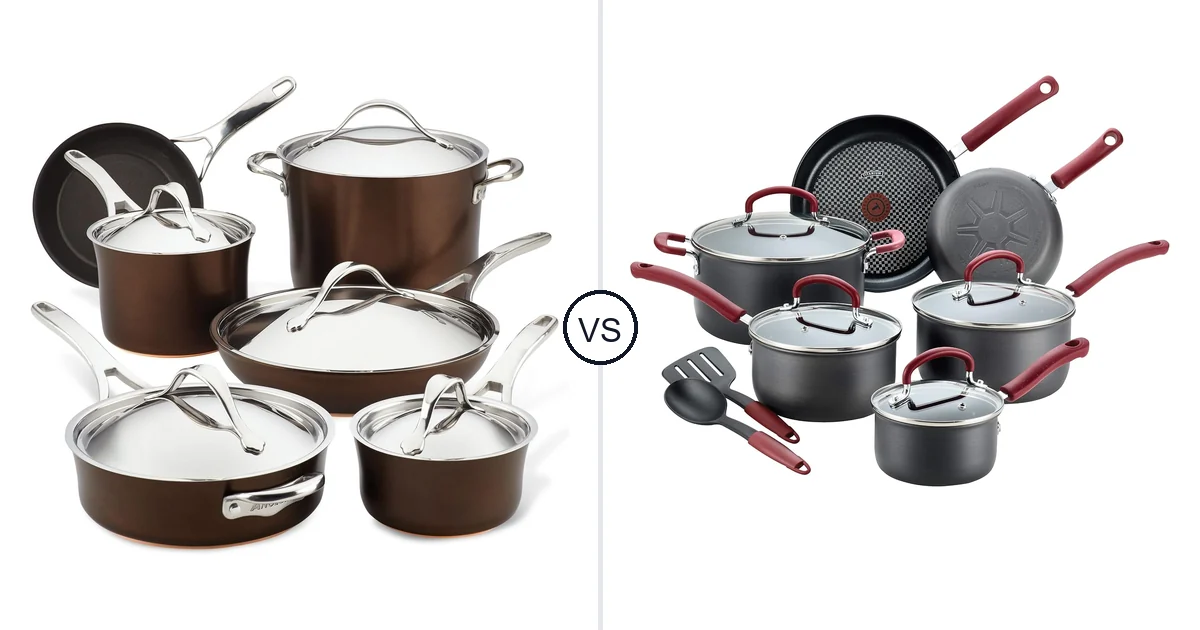
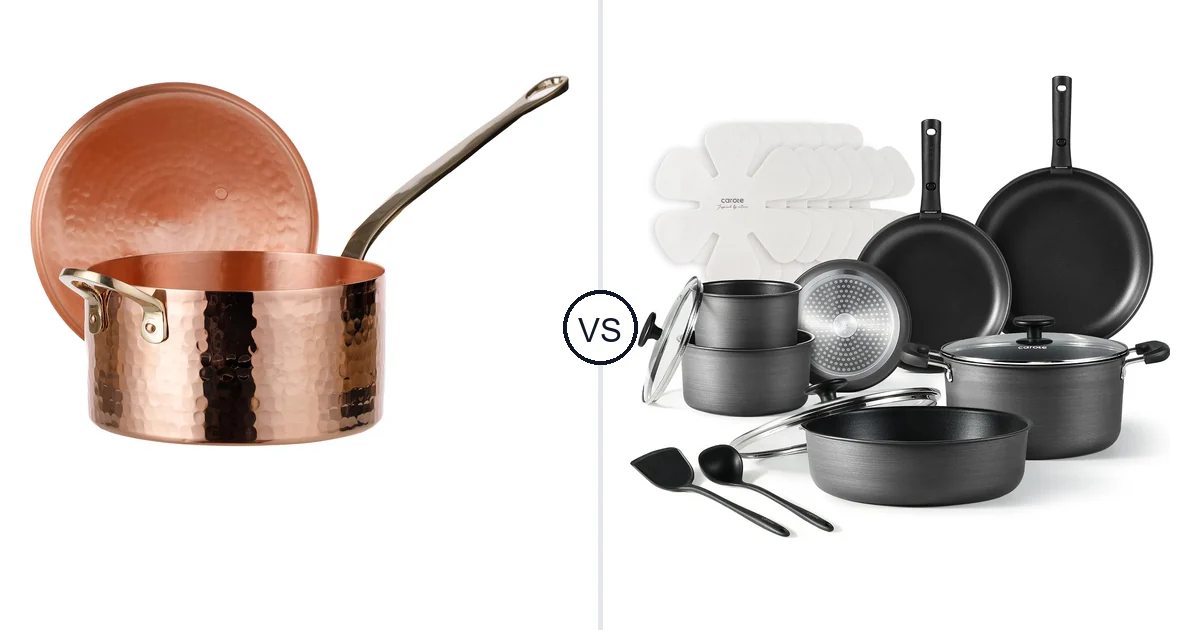
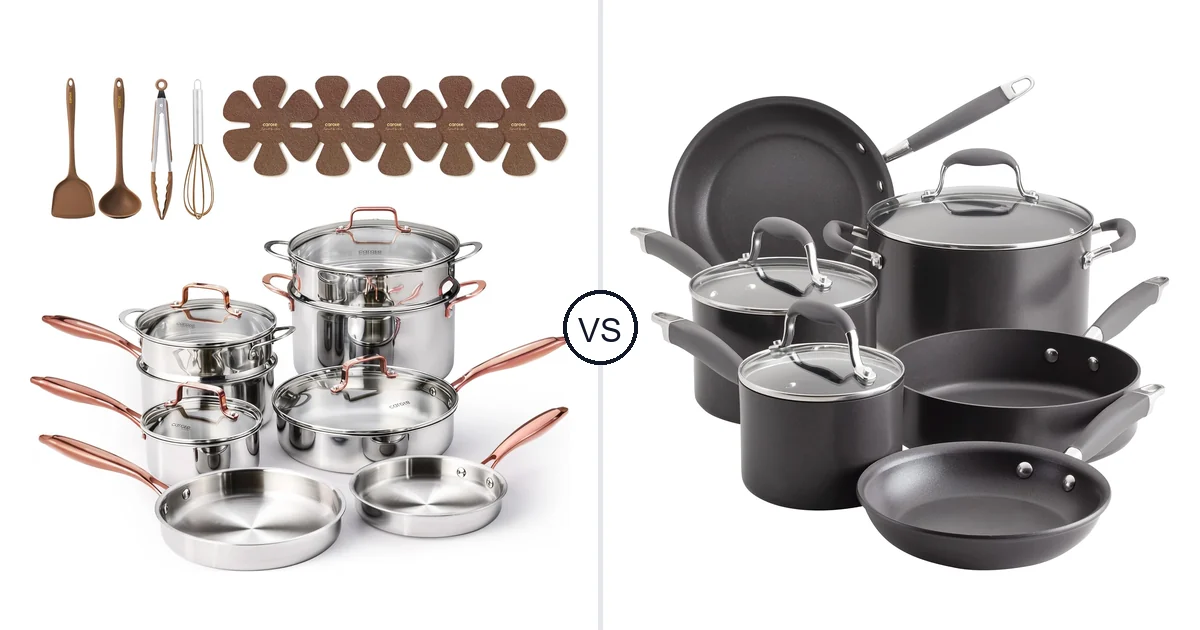
Leave a Reply